With Every Rising of the Sun
With every rising of the sun
Think of your ilfe as just begun.
The past had shriived and buried deep
All yesterdays - there let them sleep.....
Concern yourself with but today,
Woo it and teach it to obey,
Your wish and will. Since time began
Today has been the friend of man....
You and today! a soul sublime
And the great pregnant hour of time.
With God between to bind the twain -
Go forth I say - attain - attain.
Ella Wheeler Wilcox
Two Kinds Of People
There are two kinds of people on earth today,
Just two kinds of people, no more, I say,
Not the good and the bad, for 'tis well understood
The good are half bad and the bad are half good.
Not the happy and sad, for the swift flying years
Bring each man his laughter and each man his tears.
Not the rich and the poor, for to count a man's wealth
You must first know the state of his conscience and health.
Not the humble and proud, for in life's busy span
Who puts on vain airs is not counted a man.
No! The two kinds of people on earth I mean
Are the people who lift, and the people who lean.
Wherever you go you will find the world's masses
Are ever divided in just these two classes.
And, strangely enough, you will find, too, I wean,
There is only one lifter to twenty who lean.
This one question I ask. Are you easing the load
Of overtaxed lifters who toil down the road?
Or are you a leaner who lets others bear
Your portion of worry and labor and care?
Ella Wheeler Wilcox

Home Living: For Ladies at Home, and Those Who Want to Be, and Living Our Best Lives at Home. I hope your visit here will inspire love in your home.
Friday, February 11, 2011


Painting With A Story

I acquired a reproduction print of this painting at a thrift store, and was able to look more closely at the details. It looks like a relaxing scene, but there is a lot going on.
If you will click on the picture and let it take you to the source at Allposters, then you can use the magnifier and look at every corner. The first thing you might see is that the rug on the floor has a fringe that is turned over on the lower right side, as if the hem of the lady's dress had swooped it over as she walked over it before she sat down.
The wind, as well, might be blowing, causing all the roses to fall on the floor of the patio where the lady and gentleman are sitting. A little table to the right holds two cups, one with a spoon, and both seem to be placed on some kind of cloth. The man is dressed formally and the lady, holding a fan, is wrapped in a fine shawl. Her dress seems to reflect the pale pink roses that are growing along the trellis and fence. The couple may have been to a formal event and now are visiting outside as the day grows darker.
I really like the black, wrought-iron fence around the patio, and the landscaping beyond, with the little road or path in a curve. I cannot imagine what they would be talking about but it seems to be serious.
When I hung the picture, I added a little shelf next to it, on which I placed a fan of a similar style, and a tea cup with a pale pink rose, and then draped an old scarf on the frame, all to reflect the theme of the picture.
William Hennessy was born in County Kilkenny but immigrated to Canada when his parents left Ireland. He was an honorary member of the American Society of Watercolor Painters.
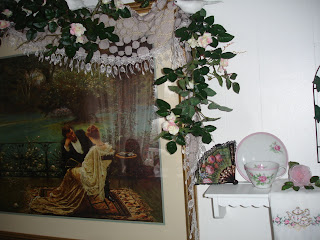

William Hennessy was born in County Kilkenny but immigrated to Canada when his parents left Ireland. He was an honorary member of the American Society of Watercolor Painters.
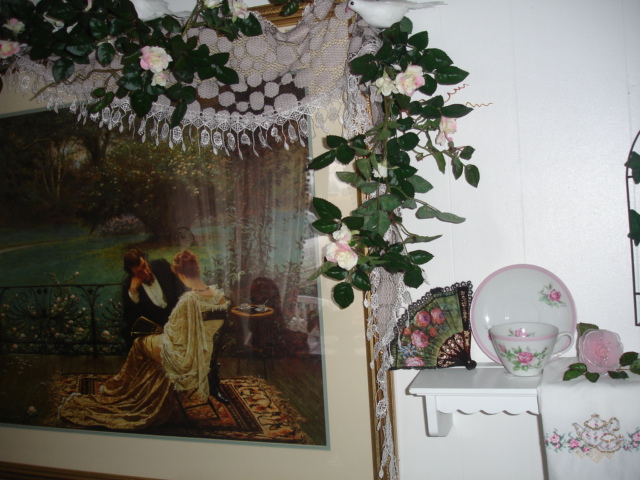

A fan, cup, spoon and floral ornament echoes details of the painting.
Tuesday, February 08, 2011
Women Plowing


Invented religious history claims that women were always workers earning money, either at home, or, after the industrial revolution, in the workplace of factories and offices: That this belief came to light only in the last decade (to me, at least) made me suspect it was another fabrication of the left, marketed to religious people, capitalizing on the women mentioned in the Bible and making them all career women—from Deborah the judge, the Proverbs 31 woman, to the New Testament mention of Priscilla, and Lydia, the seller of purple. They have missed the spiritual point of the scriptures regarding these women, and I leave it to my viewers to comment on this.

Changing history to dictate the present culture:An historical account that I read some time ago told how Communists tried to get people to change the old way of life and embrace their new culture. They tried to erase all knowledge of the past, the way people lived, the roles of women and men, and so forth, and re-write history so that the young people would not go back to the old ways. This revisionist view of women having always been considered a statistical part of the work force is no different. It is an attempt to change people's beliefs and dictate their way of life.

Fairy tales invented to prove points:
While I get letters every day saying that my view of history is a fairy-tale or a fantasy, is not the revisionist view of history even more fantastic? That all women, excepting royalty or the very rich of the 1800's and earlier labored in the fields all day and then gave birth in the fields, getting up afterwards to continue plowing the fields; that all women were beaten by men; that all women earned money; that all women were part of the work-force; that all women of previous centuries who were not royalty lived in putrid poverty with no water, no medicine, no education, no clothes, no shelter, no rights, and no life!
Is not this the same as taking the cases where women gave birth in a car on the way to the hospital and making a claim that all women in the 20th or 21st century had to give birth in cars? Claiming that women as a population always plowed or always earned money is to ignore a great part of the population in much the same way that pollsters choose only a certain amount of people to interview. This kind of thinking leaves out a great number of people; people who lived differently than the perceived norm.

Popular myth today claims that women of the 1800's and earlier were working women because they "plowed all day." Religious people even claim that women of the past "labored in the fields all day, every day," and therefore, were career women. De Toqueville's quotes indicate that American women at least, were busy IN THE HOME and they were held in high esteem because of it. These pretentious historians believe that all women of the past plowed, but how would they go about proving it? Furthermore, they claim that women plowed all day, gave birth in the field and then got up and continued plowing. These ridiculous claims leave out the part of the population of women that saw the house and home as their domain. Before the tractor was invented, plowing was not done by women unless in emergencies, in the absence of able-bodied men, during war, illness, or when men were away. I lived in rural America, as did many people in the 50's, and never saw women plowing in the way that modernists describe. It is possible that some women did, but not full time and not as a career. How would anyone prove that ALL women were occupied in "plowing."
You can't have it both ways:
Some books will say that before women's liberation, or feminism, women were not allowed to work outside the home. Later, authors attempted to show that the feminist movement was not necessary, because past centuries of women worked in the fields all day (after having a baby, of course). This is one way in which so called authorities talk out of both sides of their mouths. Can anyone trust such inconsistent reporters? The Bible tells the truth consistently, and we can trust its author for guidance in our lives.
Modernists sometimes teach that Ruth, in the Bible, was part of the work force, in the fields: but she was simply going to get something that was provided free for poor people. She was not paid for picking up free grain to provide flour for making her own bread, nor was she paying for the grain. She was not employed in the fields. She was getting something that the Jews provided free for the poor in the corners of their fields. She was not laboring in the fields as a career for money. Gleaning made Ruth no more of a career than going to a food bank gives a poor man a career when times are tough and he has to get free food. Whatever the matter, it is doubtful that Ruth worked in the fields after marrying Boaz and starting her family.

Sometimes modernists teach that most women died in childbirth, and at the same time say that women plowed the fields.
Some people insist that women were weak and uneducated, confined, with too many children, sickly and dying in pre-modern times, and yet they worked in the fields all day or plowed. There were some who did work in the fields but anyone with a knowledge of farming knows that it is seasonal work. There will be planting, watering and harvest when farmers are busiest. Family farms always included the women and children, but it does not mean women rebelled against being keepers at home.To listen to revisionists, one would think women were working in the fields in the middle of winter, 8 hours a day, every day, or even when there was no planting to be done.
To claim that most women plowed or worked in the fields is to be unaware of women in cities and towns where there were no fields. How would women do that if they lived in the city? How could they have plowed if they were denied their right to work, in past centuries, as many people claim? Which is it: women of the past were forced to labor in the fields plowing with a hand plow, or they were not allowed to work? Many people are sure that most women of the Victorian era died in childbirth. If this were so, how could they be plowing?
Why did crops fail when the men were gone?
A history book I own which was written shortly after the gold rush states that during the gold rush (1848-1855) in the Oregon Territory when men left their farms to find gold, the crops rotted. Where were all these women who "worked in the field"?
There are people who have kept photograph albums of their relatives in the Victorian era, with diaries and letters showing what all the women did at that time, and these records are more consistent with the observations of Alexis de Tocqueville, who visited America in the 1830's:
.*In America, far more than elsewhere, the lines of action of the two sexes have been clearly divided. You do not find American women directing the external affairs of the family, or entering into business or into politics; but neither do you find them obliged to undertake the rough labours of the field, or any other work requiring physical strength. There are no families so poor as to form an exception to this rule. - Alexis de Toqueville
How would anyone go about proving that all women in the past worked for money or that all women in the past plowed? It is an argument that is not worth the time it would take, because to the Biblical woman; to the Christian, all traditions worth following must be rooted in Biblical example, Biblical command, Biblical logic, and Biblical conclusion.
Mind your own business:
Women would be better off to go about the business of the home than to spend too much time trying to refute those who have a new program for them. Don't you see what these arguers against women at home are doing? They are distracting you from being excellent in your work and making you nervous and unsettled. Look at the most religious women you know whose place is in the home. Are they distressed about the things other people are saying about women at home? Does it seem to bother them at all that part of the world thinks they should not be home? Observe them as they shop for food or fabric, and as they go about the business of managing the home. They are business-like, seriously and intensely concentrating on the next task at hand. They seem never to be bored and never to long for the world and its sorrows. They seem industrious in the management of their homes.
The Bible, our ultimate standard of living:
What does it matter if an entire century of women went to work in the fields? Would not those who had been taught the word of God want to change their lives to follow the scriptures, rather than follow the customs and commandments of men? If an entire generation of women rushed off to work outside the home for some national emergency, as they did during World War 1 and 2, would that be a guide for us to follow? Maybe you had an aunt or a grandmother who worked during the war to help in the war effort. Does that mean that you should use it as your standard?
We may learn from history, but the Bible is our ultimate authority and standard. History can show us the outcome when people do not follow God's law, and the rewards when they do. Measured against the Bible, it can be useful for our lives, but when it comes to a choice between what people did and what God says to do in his Word, we must follow Him.
Inductive reasoning, verses deductive reasoning:
I have written in comments previously about the matter of deducting a truth based on your own experience or based on God's word. Inductive reasoning says, "The Bible says women should be keepers at home, but I had an aunt who did not believe it. My aunt was a nice person and she did just fine in her life, even though she didnt follow the scriptures."
Deductive reasoning says, "Even though my aunt did okay with her life, and she is a nice person, I could not live as she did. The Bible is my guide, not other people." Revised historical accounts seem to imply that because women of the past worked in the fields, women of today must work in the factories or the offices, and that they do not need to be keepers of the home. This reasoning leaves out Bible as the standard to follow.
The French writer, Alexis de Toqueville observed in his visit to America in the mid-1800's, that women, rich or poor were at home:
"For my part, I say this without hesitation: although the American woman rarely leaves her domestic sphere and in certain respects is very dependent within it, nowhere does she enjoy a higher status. And now, as I come near to the end of this book in which I have recorded so many considerable achievements of the Americans, if I am asked how we should account for the unusual prosperity and growing strength of this nation, I would reply that they must be attributed to the superiority of their women." Alexis de Toqueville, Democracy in America, 1830.
A woman's domestic sphere includes anything she needs in order to fulfill her obligation to guide the home and manage it. In spite of these observations by past historians, many modernists will claim that all women of the past were laborers or out plowing in the fields as a career.
Followers of God are different:
Followers of God's word in any era live completely different than the world around them and do not go down the broad path with the prevailing culture. It is easy to spread the belief that everyone did the same thing at a certain time in history, but it would be impossible to prove it. One thing that is certain: the Bible as the word of God is our pattern to follow. History can always be written to suit those in power, but the Word of God is truth.
John 17:17Sanctify them through thy truth: thy word is truth.

Some people think truth is what they see around them, instead of looking to the Bible for their authority:
There are those who see things as they are now, and assume that life was always this way. Some people grew up never having seen a woman in the home full time, and believe it could never have been any different. It may be that a generation never saw a woman at home full time, but that cannot be the authority for living. The Bible is the final authority. It cannot be viewed as just another history book, but a book of life. Man must conform his life to the scriptures, instead of trying to conform the scriptures to his life.
In the past that I lived in, people generally understood the Proverbs 31 woman, and were not likely to create an issue over it. Lately though, there has been an attempt to turn her into a real estate agent and a garment designer and ultimately part of the work force. In their attempt to turn her into a factory worker and a wage earner, many people have failed to find the real Proverbs 31 woman, who carefully watched the activities of her home life. Unable to get people to reject the teachings of the Bible, many modernists attempt to teach a different meaning of the Bible. They will say that the women were career women, just like the women today.

In the unlikely event that it be proven that women all went to work in the 1800's, should Christian women do it, or will they follow the teachings of the Bible?
In the past, men were proud of being providers and protectors and were ashamed if their wives worked. It was a shame (and still is) for a man to put his wife in the workforce if he is able bodied and if he claims to be a follower of the Bible. Even more shameful are the ministers, preachers and religious leaders who have their wives working. The world is expected to go the the way of the crowd, but Christians should be guided by the word of God and have a different standard in their homes. That will mean putting up with some pressure, but when you follow God's word, you have a host on your side.
Psalm 18:30 As for God, his way is perfect: the word of the LORD is tried: he is a buckler to all those that trust in him.

Many women at home did earn money: Though they sold their extra eggs or milk, or sewed for someone, it does not mean that they indulged in full time careers and neglected their homes. Extra produce that you grow yourself does not always make it into the freezer or the canning jars. There is nothing wrong with selling the fruit of your labors and your talents to your friends and neighbors or others, nor is there anything wrong with earning money. However, a woman's ability and willingness to earn money can be easily exploited or capitalized upon by others, who will distract her from her real job of keeping the home. It must be given moderation. Taylor Caldwell's excellent essay in the "American Opinion" magazine explained the problem of women earning money being an attraction to weak men who did not want to be providers.
Guard your home life:
Women need to guard their homes from many things: overcrowding her time, over-burdening her with extra work, and other things that rob the home. If over-taxed with extra activities, women, who are to be regarded as the weaker vessel, will crack under the strain and suffer many problems in their home lives. Guard against others expecting you to bring in money, lest they begin to depend on it and demand it from you. I am sure we have all observed women whose husbands wanted them to work temporarily, ending up working permanently because their expenses grew to envelope the extra money; money that was not so "extra" after awhile.
The scriptures are instructions to a special group of people:
The scriptures are written to those who have been converted, that they may be God's own peculiar people (1st Peter 2:9) . Titus 2 was written to instruct Christian men and women on their conduct, so that the word of God be not blasphemed. It would make them different from the rest of the world. Women were to guide the home, teach their children, love their husbands and, as they grow older they are to teach the younger women about these same things. That is the role of women in the church and those who follow it will be pleasing the Lord. Living Titus 2 and other scriptures pertaining to women and the home, sets women apart from the world.
Church members are not supposed to follow the wisdom of the world:
In saying "church" I am referring to the body of people who have obeyed the gospel and worship according to the example and practice of the New Testament. They are not to follow the prevailing culture, but the word of God. Though the women in the world around them may proclaim superior freedom than the ultimate freedom taught by Christ, the women of God will always be different from the world: "For the wisdom of the world is foolishness with God." (Ist Corinthians 3:19). People on the outside will think that following the Biblical role of woman is silly and unnecessary, but God thinks their wisdom is foolish. What will it be? Will we chose the wisdom of the world, or the way of God, which never changes?
My main objection to the popular culture regarding this issue, is the attempt to turn women into workhorses whose only worth is the amount of money they earn. Another concern is the lack of appreciation of women who are content to be home looking after their husbands and houses and not meddling with the world. Women should be valued for the dignity they bring to the home, and for the virtue they teach their children. This is like the women of old, who were gracious believers in their faith and who lived quietly at home, distinctively different than the prevailing culture in any era. Following the Titus 2 role gives Christian women a chance to be different than the world and to bring attention to the teachings of our Lord.
Wednesday, February 02, 2011
Recycling Calendar Art

Catherine Klein, "Red Rose"
A previous post featured a printable calendar with Victorian roses. It is a new month now, and I wanted to share what I did with last month's rose picture. I suggested that the calendar be printed on cardstock, leaving the other side blank, so that it could be recycled into cards and clip art.

Cut out the picture from last month. It will fit the long business-size envelope just fine.

Place the card on folded cardstock, centering and cutting to fit the envelope. There will be a strip left over that could be rubber stamped or decorated in some way to use as a bookmark, which you might enclose in the card.

Pretty Hand Made Soap

I have been looking at all the creative soaps in various shops and also on the web, and decided to make some of them. This is from a craft book written by a Scandinavian author. My soaps did not look exactly like the pictures in the book, but I decided to use them for gifts and hope that the recipients would know it was soap.


The slices will be wrapped and given away to the ladies in the Ladies Bible Class which meets in my home each week. These little cakes and slices look so nice in the bathroom and are lightly scented with a vanilla-pear soap scent.

I hope you have been watching all the lovely ideas appearing on my blog roll. It is so inspiring to see the creative things people do in their homes that make home living joyful and appealing.

Monday, January 31, 2011
Fabric Hearts

Catherine Kline Postcard

With right sides of fabric together, put the cardboard template in place and draw a pencil line around it. Then, cut a fourth to a half inch larger, as you see here, marking two places on the straight side of the heart, where you will leave an opening.

Back stitch to secure the stitching, and then go all the way around the heart, pivoting at the points, until you get to the other mark. Back stitch and forward stitch again to secure it. Clip little wedges on the curved areas to make it smoother when you turn it inside out. This can easily be hand stitched.

Turn the heart so that the right sides with the pretty print is out, and press out the points and curves and seams with the tips of your scissors. gently. If you prefer, you can press the heart with the iron before the next step.This is a new spring cotton from Walmart. Click on for a larger view. I have already cut a dress from it, and hope it won't take me another year to get it sewn!


This one is made from fleece fabric. Some sources say that when doors had keyholes, little pillows like this were hung on the inside the door to cover the keyhole, for privacy and warmth. I have seen some very nice heart pillows with keys attached to them, on various blogs this season.

I found this lovely pin cushion at JoAnn Fabrics. If you do not intend to use your 40 or 50% coupon for any large item, you can always buy something like this.

This is some new cotton fabric I found at JoAnns. I got a yard of it and I really like the feel of it. It is very soft but closely woven. I would sure like to get more of it. I am not sure what I will use it for, but like all fabriholics, it is just nice to have it in a little stack with other samples, to look at.

Easy Valentines

These paper hearts consisting of only cardstock, paper and clip-art from old cards take very little time. They are only one layer and the greeting is written on the other side. They look as though the roses are printed straight on the card, but they are cut out and glued on with ordinary glue. Click on for a more detailed view.

This has to be my favorite, made with a piece clipped from an old card. Cardstock, on which it is glued, can be cut with any kinds of scissors, including children's scissors.


The large rose has been cut out of a scrapbook paper, and the handle for hanging comes from a scrap left after cutting the shaped edging. Just two pieces, plus a dot of liquid paper-glitter, makes this very easy.

The pattern for these hearts are in the previous post. You can also use fabric to decorate with, by tracing around your card template, cutting it out with fabric scissors, and applying the cloth shape to the cardstock heart with a glue-stick. The liquid glue does not work as well with fabric-on-cardstock as well as the office glue stick. I've used a punch to make holes to insert ribbon for hanging.

I have changed my mind about my favorite, for I believe the above is really my favorite, and it is very simple. Just cut the edges with deckle scissors (sometimes available at dollar stores and discount stores), then cut out a piece of clip art with scissors that will cut details, glue on, add liquid glitter, and there you have it. Please be sure to click on for a larger view. This one is cut of cardstock, like the others.

You can either clip out the rose in detail, or leave it as is and apply to the card as you see above.

Some of the clip art is available on Victorian clip art sites.
Friday, January 28, 2011
Easy Heart Cards

Here is a very easy way to make Valentines using paper and clip art from magazines or ads that come in the mail. The heart has a special country style shape, so if it does not suit you, just make your own shape by folding paper in half and cutting a half-heart shape, and using it for a pattern. This one is designed to fit in the long business envelopes, as you see below:

I bought these envelopes at WalMart when they had a special pink office supply promotion.

This heart is made of white cardstock and a simple rose is glued on. Without much fuss, and no embellishments, it is still really pretty.

In the photograph above I have sketched a simple little scene of a path leading to a house surrounded by trees, with hills in the background and a clear sky, which you can print and use to make the card like those old post cards. This one is just done with crayons and a rose sticker is added at the lower end of the heart.
All you need is construction paper or thin scrapbook paper, or cardstock if you prefer. The clip art can be anything you have, such as stickers or pictures. The only equipment you need are scissors and white glue. Deckle edge scissors and glitter glue is optional. For children, this is very easy, since they only have about three things to put on the card. I've added stick-on diamonds and ribbon to some of these.

A long stemmed rose is included in the pattern. Just cut the entire rose on green paper, and then cut out the rose bud in another color and glue over the stem, clipping where necessary. A white card with the rose on it would look just fine. I have used glittered puff-paint by Polymer and Scribbles to outline the above card. The template provides a small rose shape to glue inside the larger heart. This one is made with a small heart from glitter paper.

This is done with a clip-art tag and a hand made feather, which can be made just by drawing a feather shape and clipping the edges. Shade the tip and make it look like a quill pen.

Print the template, above, on cardstock or glue to cardboard. Cut out the pieces and trace around them on various types of paper, for your heart cards. These are just one layer. The personal greeting is written on the other side.

If you sell things from your home, this would be a very easy and quick project. Line up all your supplies and get everything in order before you begin, and it will go fairly easily. The white cardstock hearts on the left are made only with cardstock paper and stickers. Just two ingredients are simple for children and still make a lovely impression.

Take a second look at the things that come in the mail and you'll find some good clip-art. The bookmark from Country Living magazine promotion is made of good quality cardstock, has a beautiful scene of roses on it, and is just the right size for the business envelopes I am making these cards for.

Here is what the junk mail clip-art looks like on cards. The bookmark at the top of the picture made a lovely card, tied with coordinating ribbon.


The smaller heart shape makes perfect little tags, which can be attached to gifts or gift bags. The construction paper comes from the dollar store.

If you do not have enough envelopes, just open a business size envelope from any mail you have, or use a new one, and glue it on to cardstock. Cut it out and use it as a pattern on thin scrapbook paper, putting the white side on the outside and the print on the inside.

To make a book or letter-card, just punch holes on the straight edge of the card and thread ribbon through it. Cut out extra pages but make them slightly smaller all around.

This one has a length of silver beads to tie it and is outlined in silver glitter-glue. I've made a guest book out of this one, just for one day. You can get quite a few pages in it for one postage stamp, for writing letters.
You can also trace this shape on fabrics, cut them out and glue them on the cards with a glue-stick. The liquid white glue does not work as well with fabric.

While I think of it, I discovered something to share: Sidewalk chalk (that odd looking piece on the edge of the chalkboard) works really well on old chalkboards. Normal chalk seems to slide and not stick on the board when it gets older and worn out, but children's sidewalk chalk is great, and you can get it at the dollar store. It erases a lot more easily too, and it comes in large sticks in many different colors, or in shapes like bunnies and ducks, etc. If you are not able to refurbish the black boards with chalkboard paint, cannot get any, or do not want to spend the money, this sidewalk chalk makes them look fresh and new.
Have a look around at things you normally would throw away and you will find quite a few things you never noticed before. For example, in the picture of all the hearts, the last card on the right of the top row has a rose on it made with a green stem cut from part of a brown paper grocery bag. Part of the bag was green. You might find a little rose on your tea box or floral stickers from your junk mail, that you could use to brighten up a card.
Although there are high quality products widely available today for crafters, it is always good to understand how to be creative and resourceful and to use what you have on hand, to make something beautiful for someone else.
Subscribe to:
Posts (Atom)