Wednesday, November 04, 2009

A Passion For Potatoes


Peeling Potatoes, by Ernest Walbourn
British, 1872-1927


Potato Digging in the Kitchen Garden
by William Small,  British: 1843-1929


Potato Harvest
by Ernest Masson (France 19th century)


Planting Potatoes
by Frederick Leighton
Britain, 1830-1896


Digging Potatoes November 4th
These are all Copyrighted photos: all rights reserved! Do not duplicate or put anywhere on the web.


How do you know when a potato is ready?  When the blossoms and the vine dies and looks lifeless.


Looks like there is something here...


I am quite sentimental about potatoes.


Potato digging is very hard labor and  dirty work...


Yet, it is somewhat more glorified if my dress matches the potatoes. This cotton fabric did not stain or tear, and looked just like those pink skinned potatoes. Please notice the back grounds of the potato diggers in the paintings of the 1800's and take in the pretty clothing of the homemakers of the 1800's, depicted there.  As I love potatoes I was just thrilled to find several artists that capture the women planting, harvesting and preparing potatoes. This is true beauty!


They scrub up quite nicely. I can bake them or use them in different recipes...


...such as baking them in a large, shallow pan in the oven, with olive oil and rosemary...


...or making a garden potato salad with tomatoes and chives..

or
Potato Scones, which are always a great hit at a tea party.

Take 6 cups of mashed potatoes and mix in one cup of unbleached flour. Lay the mixture on a flour covered piece of wax paper and pat to about an inch thick. Cut into circles or squares and fry both sides in hot olive oil until brown and slightly crisp on each side. . Let drain on a paper towel and serve with butter or jam or honey.


Our parents wisely put us to work when we were very young, planting and harvesting potatoes. If you have read my book, "Just Breathing the Air, " you would have seen the photograph of me with my first potato crop, which I sold to a local grocery store. I have not stopped loving the discovery of dozens of beautiful pink, gold, or purple potatoes beneath one dead stalk, which began with one tiny potato. 

One reason I like potatoes so much, is that I know how comforting they are, as a food, even when you do not feel well. They are loaded with nutrients that improve your mood and can help you feel better when you are not well.  One way to fix them for a sick person is to cook them til they are soft enough to mash, and mix them with other boiled produce such as green beans, brocoli, carrots, etc.  Take all these cooked vegetables and blend them in a blender or mash them or use a mixer and puree them. Leave some of the broth from the saucepan, and blend it up til it is a soup. Then pour it into a bowl and top it with croutons, and it seems to revive a person suffering from illness.

One reason for this, is that potatoes are easily digestable. Potatoes are packed with Vitamin C and B-complex, and minerals like potassium, magnesium, phosphorous, and zinc, which are all good for your skin!!  You can make a face pack out of crushed  raw potatoes and honey, and you can use a slice of potato on a burn or cut to heal it.  Eating cooked potatoes can help prevent viral infections like colds.

Eating potatoes regularly can reduce high blood pressure and prevent sugar cravings, thus lowering the chances of related diseases. It keeps the brain active and alert, prevents heart disease, kidney stones, and diarrhea. No wonder potato soup is a favorite among potato-lovers.

For me, it is the entire outdoor experience that makes me a potato-lover.  You do not have to be in the country to have potatoes. Just turn a section of your yard into a miniature farm and you'll experience the joy of having your own food, unadulterated by chemicals of any kind. You must dig a shallow, long ditch, and plant the potatoes, sprout side up (or a whole sprouted potato) in the dirt that makes the hill section.  If you will make a distinct mound for each plant, they will be easier to find when it is time to dig.  Dig a wide area around the hill and not too close to the vine, so that you wont cut the potatoes with your shovel. 

Working outside seems to clear the mind of troubles, and renew your optimism. When you return to the house, you feel you can do anything!


Pretty potatoes from my garden: Yukon Gold, White, and Purple. The purple potatoes are purple inside, as well, which adds color to any meal.

Your local farmers market, and some grocery stores that have good produce, is a great way to get the potatoes you need if you do not grow them.  You can use potatoes for the entire meal and put a variety of toppings on them. If you have limited space, try growing them in a large container. You will not even have to dig them. Just pull up the potato vine or dump the pot of soil, and see those wonderful potatoes.

Read more about potatoes here http://www.organicfacts.net/health-benefits/vegetable/health-benefits-of-potato.html

and see a list or essential nutrients, including a whopping amount of Vitamin C, here http://home.howstuffworks.com/potatoes3.htm

If you are interested in "potato politics" you might study this site http://mises.org/story/2978  


Saturday, October 31, 2009

Dressing for the Home


from Country Living Magazine


From Country French Magazine


From Country French Magazine


Susan Rios has a new painting on ebay. You can view Susan Rios art at the following places: http://www.susanriosinc.com/ , http://www.piersidegallery.com/artists/rios/ ,and http://roses-and-teacups.com/susan-rios-art.php

There is a November home tour here http://theoldpaintedcottage.com/pages/cotm.htm
It is always a joy to see lovely pictures like this.

Tuesday, October 27, 2009

19th Century Clothing From Paintings and Photography


Miss Elspeth Mallock
by Edward Arthur Walton, Scotland
1860-1922


Two Girls at the Frame
by Alexander Max Koester, Germany(1864-1932)


The Pitcher Girl
by Victor Thirion , France (1832-1878)


Portrait of a Young Woman
Carl Timolean Von Neff, Estonia (1805-1877)


Mountaineers
by Charles Edward Boutibonne
France (1816-1897)


In the Garden
by Frederick Fursman
United States, 1874-1943


I have been absorbed  in the study of textiles and  clothing in the 19th century, and also  enjoying the book, "Calico Chronicles: Texas Women and Their Clothing," which is available in various online bookstores.  I only wish it had been in color.  However,  a friend told me about a magazine article she had read, which told about  late 19th century color photography called "autochrome," which was made with potato starch to produce color.  It was discovered and developed by the French, and  was used before color photography as we now know it.   In many ways, I think it looks better,  and the people in the pictures more life-like. 


Window Ledge Portrate (autochrome photograph)
by Marice Rampert 1907

 I have been looking at the autochromes from the online public libraries, and would like to include them here.As I  looked through these photographs, I was happy to see that they were not at all inconsistent with the artists of the time, which I have been showing regularly on this blog.


Alpine Group (autochrome photograph)
by Maurice Rampet (1866-1941)


Among the Irises (autochrome Photograph) 1924


Woman Reading in a Garden (autochrome color photograph from the early 1900's)

The above photo is very similar to paintings that I have shown here before.  The one of the woman in the peasant blouse has very detailed painted lace. All of the dresses you see worn in the paintings and the photographs, can be sewn today, using current patterns. Just find a peasant blouse and a long skirt pattern and a vest.  Some of the other photos and paintings can be immitated with what is called the "Garden Party Dress."  Patterns for Garden Party dresses can be found at Jennie Chancey's pattern site and Costume sections of your pattern books at fabric stores, which I will post later.


Autochrome Photograph, early 19th century. Notice the pretty striped fabric and the lace collar and and cuffs . This appears to be a hand made matching mother and daughter (or sister) outfit.  The autochrome has a very life-like appearance. Learn more about autochromes here http://www.photographymuseum.com/exhibitstart.html

There is a way of looking at paintings and photography that helps you understand more about it. You can ask the following questions about them:

Where is the lightest part of the painting?
Where is the light coming from?
Is the painting portraying something warm and sunny, or cold and foggy?
What other colors do you see?
What are the people in the painting doing?
Name some other things you see in the room of the painting.
Point to other things in the painting that show how the people lived or what their activities were.
What is in the background of the painting?
Tell something about the hairstyles of the women in the paintings, as well as the clothing styles.
What do you think the focus or subject of the painting is?
Tell something about the fabrics you see on clothing or draperies.
What do you think the artist was trying to show?
Is there a mood in the painting, of happiness or contentment, excitment or adventure?

Part of the fun of viewing these paintings is the opportunity to pose them yourself, using similar props and scenes and clothing, and take photographs.
This is especially enjoyable with scenery or still life and with children.
Both the paintings and the photographs show that women and girls dressed femininely, and without wearing men's clothing, were quite active and engaged in hard work.

Speaking of potatoes, I have been busy getting mine out of the ground, washed, and stored.

There are several colors of potatoe: purple, red, gold and white. My favorite for flavor are the gold or yellow potatoes. They look yellow when cooked, as though they have butter in them, and have a lot more flavor than the other kinds. These are red potatoes.  Potato growing is about the dirtiest work in the world, but at least my boots match my dress ;-)


These are some colors around here that are easily imitated in fabrics.  I am sewing an autumn dress the color of the dark red leaves here.  A burgundy colored dress, with a light green shawl is bright spot on autumn days when the light is dimmer, and it is also a pretty color on houses.


Butterfly-ladybug fabric from http://www.joann.com/

Wednesday, October 14, 2009

Mood Dressing


Basket of Cherries
by Robert Spears Dunning (1829-1905)


In the Orchard
by Walter Boodle  (1859-1914)


Cherry Fabric
(You can click on for a larger view if you go here


Mood dressing is something women have done for years. It is a way of selecting a dress that would make you feel your brightest and your best. Having something beautiful to wear that matches the day or the season or the events in your life, can give you a new attitude and a burst of energy.


Cherry Earrings
by Frederick Morgan 1856-1927


(this is the painter that enlisted the help of fellow-artist Arthur John Elsley to paint the animals in his scenes.)

Sunday, October 11, 2009

Texas Women and Their Fashions: 1830-1910


Reading (1865)
by Jerry Barret


The Sewing Class
by Carl Frederick Aagaar1835-1895

Calico Chronicle: Texas Women and Their Fashions,  by Betty J. Mills, is a wonderful history book about the clothing of the Texas homesteading women. Calico was a fine cloth, made from cotton in  Texas. Isolated from most of the world and the fashion designers of the time,  these women made beautiful fashions from their own cloth made in Texas.  People who visited Texas in that era, expected to find women dressed in humble, poor looking clothing, and were impressed to see how elegantly dressed they were, using this colorful cloth.

Those who have read this book have said that it makes you want to sew, and that it inspired them to do more with what they had. 


This calico is called "lily pond."  This is a newer print, but many calicos are reproductions of the prints used by Texas woman in the 1800's. Calico was a common dress fabric. Women used their scraps to make quilts. When their dresses began to wear out, they would alter them by replacing cuffs and collars and piecing various areas. Later, used clothing was used to make rugs and things for the home.


Bathing fashions of the 1800's
 (from Karen's Whimsey Victorian Graphics)


Friday, October 09, 2009

Once A Year Planning


Sitting In the Garden,
by Susan Rios

Susan Rios would like to expand her mailing list informing people of her painting events. To receive her newsletters, sign up here.


Picking Daisies, by H. Seeger (German, 1857-1945)

Before I complete this part of the sewing series, I want to show some planning techniques for selecting clothing, even if you buy ready-made. You might sketch a garment or include the picture of the pattern you are going to use, on your scrapbook planning page.  I have attached snips of fabrics and made notes about what the dress might be suitable for (travel, homemaking, church, etc).


click on for details

Take some time once a year to make a planning page like this(the spring is an ideal time to begin), and  use a dark pencil or pen and your crayons, to illustrate your planning page. I have a deluxe box of crayons containing just about every color that you can get in crayons, and use them a lot.


You can also make a scrapbook page with a collection of clothes from catalogs and magazines, to give you ideas for sewing or selecting to wear. I hope you do not have a problem printing it out.


A collection of clippings for ideas in design and color.


On the planning sheet there is a clip of yellow and sage fabric similar to the dress and shawl worn by Molly on the way to her father's wedding. She also wore it while staying with the Miss Brownings. If you want to get a look at how calicos and cotton prints are used in every day dressing, look through Wives and Daughters films and notice Molly's clothing.  There is a good screenshot of the bodice of this yellow dress with the shawl  here http://enchantedserenityperiodfilms.blogspot.com/2008/02/wives-and-daughters-screencaps.html

Thursday, October 08, 2009

Fabrics From Nature


"Window in the Alcove"
by Susan Rios
(Paintings by This Artist For sale at Ebay, Susan Rios Editions, and Chatsworth Florists)


Basque Gypsy
by William Adolphe (1825-1905)
Notice the wonderful color choices--a combination of seafoam green or aqua and deep burgundy rose, that is rarely seen in the clothes today. 


This is a print of the Victorian Crazy Quilt, made into a skirt several years ago. "The Gypsy" clothing is somewhat similar to the colors in this fabric, as well as many beautiful floral paintings like the one above.  The blue blouse on the right matched the blue background.  The fabric store sold bolts in every single one of the fabrics represented in this print.


This is an example of how to piece your material if you come up short and do not want to go back to the store. You cannot tell in this picture, that the skirt has been pieced. The top of the skirt underneath the waistband has been pieced together, using scraps of fabric, to match the print exactly. With some small prints, you do not have to be precise if you piece it, as it will not show. However, with a larger print, you simply find a scrap that matches the piece you need to add something to, and sew it, right sides facing.


This is a closer view of the seam where the skirt was pieced.  This skirt had two main pieces and was very easy to make.  After adding pieces to lengthen your fabric, lay the pattern on top and cut as you would a whole piece of fabric.  Some of the previous dresses I showed on this blog, were pieced on sleeves and hem areas when I wanted them longer, but you cannot tell it is there.

You can buy the matching fabrics and make a variety of dresses and little jackets or skirts and blouses that all co-ordinate. All cotton, this fabric is a joy to sew, because it is soft and the colors are so sweet and so reminiscent of the beauty of nature all around...


...like this profusion of color growing here, with the aqua sky in the background.


The fashion show has been moved ahead a few more months, but I will try to include photos of the garments then. Inbetween time, I will show some children's clothing.  Someone asked me to do a sewing tutorial. That is being thought out also, as well as some pictures for the blog of how to sew a hair scrunchy or hair bow with a clip.

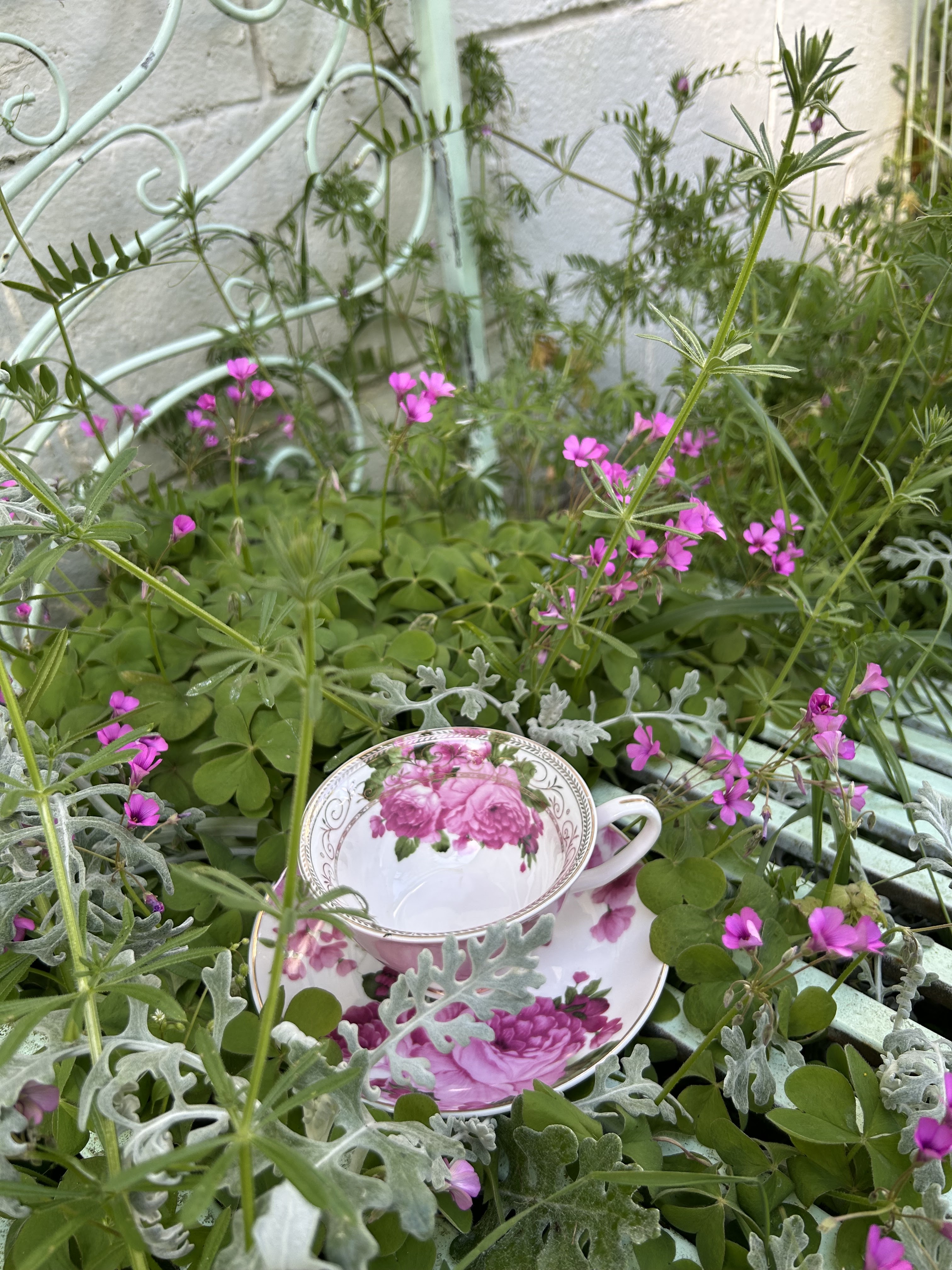
Even if women do not sew, there is a lot to be learned by looking around you and feeling the mood of the season or the time of day and choosing clothing that looks like nature or the beautiful things around us: a pretty house, a lovely object, or even a teacup, can be an idea for choosing clothing or sewing.


For an example of what I mean by getting ideas from beauty all around you, this Royal Albert tea set, called "Blossom Time"....


...looks like this fabric from Joanns.com. It is called Allover Floral by Leslie Beck for Springs Creative Products.

The "Corelle"(Corningwear)  brand of glass, unbreakable dishes, has this pattern, called "Meadow", which also matches this fabric print, perfectly.


The dish set has been on sale for $19.00 for a set of four dinner plates, for dessert plates, four bowls and four large cups.

If you use your 40 percent coupon at Joanns, you can get an expensive fabric like this for three to four dollars a yard. I bought a fourth of a yard of it just to use as a napkin for that tea cup.  So look around and see what you have in your home, or look outside at the sky and see the trees in bloom, and you will have a lot of ideas about finding clothes.


Here is another delightful piece from Joanns.com, which I have also seen in the store (and touched ;-)  It is thicker than the previous piece, but it looks like a flowering tree in the spring, or a meadow that has just come alive with the color of wildflowers.

Psalm 90:17 And let the beauty of the LORD our God be upon us: and establish thou the work of our hands upon us; yea, the work of our hands establish thou it.


Monday, October 05, 2009

The Fruit of the Land


Baskets of Stawberries and Raspberries
by Eloise Harriet Stannard (1829-1915) from http://www.lovelywhatevers.blogspot.com/


Basket of Fruit,
by Elois Harriot Stannard (1829-1915)
(more paintings by this artist are available at Lovely Whatevers)


Today's supply of grapes, plums, and pears, ready to be made into juices, purees, and sauces.


A Summer Beauty
by Emile Vernon  (1872-1919)

This dress could be easily immitated by using a Hawaiian pattern (see link in Hawaiian Dress post on this series) and pale peach or palest pink cotton fabric. The background scenery is so nostalgic of soft summer days spent innocently admiring the beauty of the earth.


Autumn dress made of cotton quilters fabric, which is soft and non-iron.  When the weather gets hot again, I will shorten the sleeves. I can add a deep burgundy edging on the neckline and the sleeves. These photographs are not very clear, and the dress looks much nicer "in real life."

A close up view of the print: dark roses on light pink background.


When choosing trims and scarves, I look closely at the colors within the print. This scarf matches the deeper burgundy-red color within the small roses. To make a matching scarf, just buy a fourth to a half yard of fleece. If you want a "wrap", buy a whole yard. 

One half yard of fleece only costs about $2.22 and does not have to be hemmed or trimmed. It can be wrapped seveeral different ways.


a half a yard of 50 inch fleece makes a quick shawl, with no sewing.  To make a really adequate wrap, I like to use 3 yard lengths, when it is affordable.


This ready-made dress can be ordered from an online catalog called "Seventh Avenue."  It has all those beautiful colors of the season.


Here is another example of matching the fleece, which can be woolen or acrylic, to the print. This is a higher quality cotton aqua-dot combination, for winter.  The hostess that invited me to have a fashion show of modest, colorful clothes, has decorated her home in these colors, so I thought I would wear a suit or dress with the brown wrap, to compliment her and her home, if I had time to make it.

Wednesday, September 30, 2009

Preserving the Home


Welcome Home
by Susan Rios
(Available at Susan Rios Editions)*


Preserves: cucumber relish, blackberry syrup, peach preserves.


Remember how the women of the past were able to come home from church and serve a big meal to company?  I used to wonder how in the world they managed it, and why it seemed so difficult for the modern homemaker, who has so little time.  This question was answered during gardening:  they had convenience foods, which they preserved from their gardens. While it was quite an intense operation to do this during certain times of the summer, they only had to do it that one time, and there would be convenience foods for the rest of the year. Potatoes could be put up in jars, and later just opened, poured into a pan, and heated.  Other foods, like plums and grapes, could be dried, and later put into pies.

  When the freezer was developed, people learned to pre-bake pie crusts and breads, for the winter. They could also freeze the green beans and brocoli that they blanched and put into freezer containers. This was their fast-food. It was hard work, but the whole family, even the men and boys, participated in some ways. Grandmothers were engaged to take care of little ones and keep them from being underfoot in the kitchen, and sisters and aunts could help with cleaning and laundry and meal times.

Fishing was a big deal in the old days, too. Our parents preserved fish by creating a method of letting smoke preserve it, or canning it in a special canning set.  This was an intense job but yet the time seemed leisurely. These people liked doing it and I suppose the happiness they felt at knowing that they were providing their own foods, made up for the time-consuming effort.

Preserving the home is very hard work and requires that a woman go over her territory regularly, checking attiudes and reminding the family members of their duties and their beliefs. It means that they watch out for influences that would cause disharmo  ny, disorderliness and disloyalty. It means they watch the moods of their children and correct errant thinking.  Contrary to popular belief, we are supposed to control the home. We are to guard it, and direct it.  Like preserving food, it takes some intense moments, but if we are alert and send out reminders, both by what we say and what we do, we can come closer to preserving the family and home life.

There are other things, that though material in nature, contribute to preserving the home. One is cleanliness and another is doing things at the time they need to be doing. Letting something "go" can only make it worse, so when something has to be looked after, is the time to do it. When preserving food, it has to be processed just before it gets too ripe, and should be canned or frozen or dried the day it is picked. Each day that goes by, and the riper it gets, the more likely it will lose its goodness and attract bacteria.  In preserving the home, we have to take responsibility to see that the home is guarded and guided.  It does not mean that the woman has to do every single thing herself, but that she sees that it gets done.

I did not sew a special dress or apron for food preparations of harvest (canning, freezing, drying, collecting), but I did learn what was needed: clothes that were cool, and aprons that looked like the berries or tomatoes, that would hide stains for a while. 

Preserving the home means also that we cling to certain beliefs about marriage, parents, children and others, even though the prevailing culture wants to interfere. It means we do not listen to everything around us that tries to crack our system. It means that we do not fear to guard our marriages and our children, even when others try to break down our beliefs with the temptations of money or things or temporary happiness.

The produce from the garden has to be treated carefully, kept clean and pure, and preserved to be eaten when it is needed.  Putting time into the preservation of your home life will pay dividends later. It might not be easy to establish your freedom to be a home guard and home guide, but the effort will pay off, if  you do not give up.

There is surely a lot more to preserving the home, and I am sure others can contribute some things I have not even thought of, to this discussion.

If you like original art, Susan Rios sometimes puts small pieces on auction on ebay, for as low as $45.00

Friday, September 25, 2009

Salad Dressing


Raspberries in Cabbage Leaf
by Eloise Harriet Stannard 1880

Check out other paintings by this 19th century artist, at allposters and other art sites online.

This red rose cotton print has the lovely light green or "sage" background that reflects the colors of the vegetable garden. The color bar on the edge of the fabric is great to use on a card in your purse, whether you are using it for home decor or clothing. Take it with you whe you want to match up your colors to other things. (  This is a "garden dress" which will be photographed later.) The print comes in other combinations, including a peach colored back ground with co-ordinating roses, a pink back ground and a beige back ground. Check it out at Joannes. It might be in the  "Quilters Showcase" collection. The colors in this garment look a lot like the salad ingredients from the garden, so I call it "Salad Dressing."


A bountiful basket with a late crop of salad vegetables.

Even the red and green peppers (capsicum) are works of art.


From the lower end: parsley, green pepper, cucumber and tomato.


In regard to my previous article on overcoming discouragement, someone requested that I post a reminder about good nutrition and proper rest.  I am glad to be reminded of this, because indeed, things usually seem bleaker as evening progresses, and problems loom larger. In the morning, people's burdens are lighter and the weight of the day is not upon them. If they do not get enough sleep throughout the week, life seems more discouraging.  There is a saying that life is better after a good nap! 

Food without additives, particularly sodiums, just make the mind clearer, and good pure water without additives, can  make people think better.  If you grow just one vegetable in a pot, you will notice the taste is different and  it is loaded with the nutrients it is supposed to have.  If you begin growing vegetables one at a time, you will not be overwhelmed with work, and it will help teach your children to grow food and be able to look after themselves.  If you have no children,  and grow something, even a potato or string beans, you can share it with others.

To make your own salad dressing, mash an avocado with a fresh tomato and add a crushed or shredded cucumber, and any seasonings you like, from your herb garden.


Sunday, September 20, 2009

Seaside Colors in Fabrics


This is a new painting by Susan Rios and can be purchased online, called "The Ocean as Lace." There are a lot of other people who think in terms of fabric, when they look at the world around them.  The foam on top of blue water, does look like lace.


"A Familiar Walk" is an older painting by Susan Rios. This blue dress is a perfect compliment to the surroundings, with the lace collar looking just like the ocean's white lacy foam on the blue water.  The paintings can be viewed at Susan Rios Editions.


This is one of my winter dresses, made from a cotton that looks like linen. When a lace scarf or collar is added, it has a similar look to "The ocean as Lace".  This soft cotton dress is one of the most comfortable things I have to wear when the weather is too cool for short sleeves. There are two shades of teal : one has a blue tone, and the other, a green tone. This one is blue.


These are the five dollar flats at WalMart that I will be buying for my modest fashion show. They look a lot like the shoes in the 18th century paintings of women, including one of the paintings included in this "Painting Inspired Clothing" series: Eugene De Blass paintings show similar shoes. If you want these shoes, you need to buy a half or whole size larger than your regular size.


Just buy 1/4 yard of lace fabric, to make a scarf. This really looks like the foam against the ocean, as in the Susan Rios painting I showed, above.  Scarves provide a little more modesty, and I will try to also include a post on scarves as jewelry. I don't wear them at home, but they are a nice touch in the public, when you want a little more barrier between you and other people. Scarves are great if you do not have the time or money to invest in making new clothes, or buying new, modest clothes. Just use scarves over your other clothes, and make them more modest. That is one of the advantages of the Indian saree, which can wrap around the body and provide a little more coverage, without adding to heavy a layer of fabric. Scarves are also very, very feminine.


This picture just shows the added seashell buttons, making it a garment with a seaside theme.


This is the little triangle scarf I made that is sheer cotton, for a removeable collar. Similar ones can be seen on some of the paintings of the 18th and 19th centuries.


Saturday, September 19, 2009

Fabrics from Nature


Do not overlook the nursery prints at your fabric stores. One hundred percent cotton, these are soft and very sewable for adult clothing. The children love to look at skirts of their mothers and grandmothers, as they sit and read to them. This one is a mock-patchwork piece, which is quite expensive, so I got only a strip of it to add as a border to a dress.


The fabric of roses you see on the left, was very affordable, at less than two dollars a yard, so I got enough for dresses for adults and children.  The nursery print on the right, has all kinds of co-ordinating fabrics, such as the stripes and the calico prints.

If you can see it, there is a strip on the edge of the fabric, there in the middle, which contains dots of color. I call this the color bar, and I use it to match fabrics that I want to coordinate with the main piece. Just clip it and put it in your purse, along with a snip of the main print, and take it when you are shopping for other things, like home decor, or shoes or hair clips, or whatever it is you need to match. That color bar contains all the colors that it took to make that particular print.


This was the morning's inspiration for sewing with nature: a multi-colored morning glory bush that is climbing its way to the roof, covering an old, unsightly pipe,


and a cute little fellow hiding behind the bush. I have been told by dedicated vegetable gardeners that these creatures are not "cute" if you are trying to grow food for your family and they are eating it up. We left an outside row of string beans for them and they never bothered the main garden. I guess they were too full.  He just sat there so still ad let me take his picture.


Here is why I believe Wal-Mart should re-stock their fabric departments or keep the fabric departments:

When Sam Walton created the first Wal-Marts, he did it for the country people so they would not have to drive a long way to get a pair of shoes, a toothbrush and a hammer or a package washcloths.  He wanted to be able to get it all from the same store. He began his first small stores in country areas, and they were a big success, and included fabrics and patterns and notions.  From these profits he built even more stores in more country areas. The country people made his stores successful. 

His profits attracted the larger cities and his stores were soon established in those places, too, but it was built on the loyalty and business of the country folks who shopped those smaller Wal-Marts.

Now it only stands to reason that if someone is going to make a curtain, she will then buy a curtain rod on the way out of the  store. If she is going to make a dress, she may stop by the shoe department and get a pair of matching shoes. If she is going to sew a bathroom ensemble,, she will stop by the bathroom accessories and pick up some matching towels. By the way, the color families in WalMart all seem to cooridinate--from the candles to the lampshades to the rugs. So, a seamstress will want other things in the same store. Or, she may just notice there is a can of peanuts or a jar of olive oil on sale, on her way up to the cash register, and buy that, too. So, Wal Mart stands to profit by keeping its fabric.

Just the other day I was talking to one of the men that cuts the fabric in my area at a Wal Mart. He said that I would not believe how many people came all across the nation from the furtherest coast, to buy fabric. He had spent the morning cutting 10 yard pieces for a woman from Dallas, Texas, and 7 yard pieces for a woman in New Orleans.  I think if WalMart execs pay attention, they will find there is a tremendous surge in fabric sales at their left-coast stores, but it is ridiculous that these people are so deprived of their local fabric stores.  I have friends in tiny country towns in Texas and Oklahoma who say it is not as much pleasure to shop at WalMart since they took away their fabric department.  They now have to drive 30 or 40 miles to a fabric store, and cannot buy tea or flour in the same store, or toothpaste.

So, they shot themselves in the foot when they did this. It was these people who built the WalMart success, and now these people for whom Sam Walton built WalMart stores, are again left trying to find a hammer and a hairbrush and fabric by travellling 30 miles.  His descendents that have taken over the stores, need to understand people. I know it is a business, and it is about money, but if you care about people, your business will be assured.

Wal-Mart, please bring back your fabric department.

I recommend this book:  "Sam Walton, Made in America--My Story" by Sam Walton.
He writes: 

"Competition is good for business.
"Why do I drive a pick-up truck?  How am I supposed to haul my dogs in a Rolls-Royce?
"  Family...must believe in the bedrock values of hard work, honesty, neighborliness and thrift."

Tuesday, September 15, 2009

Overcoming Discouragement

Discouragement: that which destroys or abates courage; the act of deterring from an undertaking.

"Evil examples are great discouragements to virtue." Noah Webster, 1928 Dictionary


Discouragement is a natural part of life, but how in the world can it be used? Some people look at life as a story unfolding, and when discouragement comes along, they are rather amused by it. They use it is part of their story. They view it as a challenge, or an obstacle that they have to find a way to remove.


Other people are bewildered by discouragement, feel trapped, and do not know what to do with it.
Table Scene from Country Living Magazine
Creating a beautiful spot in the home helps you recover from discourgement.

Growing food or flowers is an interesting way to learn about overcoming discouragement. Anticipating discouragement, some gardenners put three seeds in every
 hole that is dug: one to grow, one to get eaten by pests, and a third one to die.  We did this with our string beans, tomatoes, green peppers, lettuce  and corn, but this year ALL of them grew into perfect vegetables. Having several interests in your life, from sewing, to reading, or entertaining, can prevent the spoilers from taking away your enthusiasm, and discouraging you.


 The first few times we planted a garden, nothing much happened and we were not at all impressed by it. Then someone told us that the first year, a garden sleeps. The second year, it creeps, and the third year, it leaps.  Each time it is planted, the soil is built up a little more and nutrients are added. 


Then, there is manure. Manure is unpleasant, but it enriches soil when it is worked into the dirt and allowed some time to develop and  provide important nutrients. The farmer has to decide what kind of manure it is. Some manure is just straight from the animal, but other manure is mixed with straw or hay or wood shavings from the pen where it sleeps. That alters the properties of the manure and determines how much should be put in the garden soil.
Pretty Dining Table With Roses, from Country Living Magazine
Taking time to set a pretty table is good way to keep discouragement away.


Sometimes homemakers are attacked by people around them who want to discourage them. The first year at home, it might not look like there is much going on, because, like the garden, it takes a while to develop the routine and establish yourself.  The second year, things may be a little more noticeable, as you have made a little more progress in the things that matter to you at home. The following years, your homemaking has developed a foundation and a routine that your family has gotten accustomed to.  Your steady adherance to your duties is showing results.


Discouragers are blind to the truth around them. They can see no purpose in your responsibilities at home, and cannot even see obvious results, such as a clean home, good smells coming from the kitchen, an atmosphere of peace, and a beautifully arranged home. The discourager is listening to voices outside the home that say homemaking is not worthwhile.  They begin to doubt that your life as a homemaker and caregiver has any value. Discouragers often have a pre-conceived idea of what homemaking is all about, and expect perfection. They are often intolerant to dishes piled in the sink or laundry not finished, and they will not understand the many interruptions in the life of the homemaker.


 Sometimes jealousy is at the root of remarks aimed to discourage you. Sometimes the love of money is the root of the discouraging comments. Other times, peer-pleasing is the motivation.  You have stopped following the trends of the prevailing culture, and it makes other people uncomfortable. Or, someone  may be genuinely afraid that you will lose every material belonging and end up wandering alone with no food, no friends, and no fruits of your labors at home.


Discouragement can also come in the form of failed tasks or having your work ruined by others.  This is one of the reasons I often refer to the description in Proverbs of the little creatures called the ant, the spider and the cony.  They do not need an overseer or a ruler over them because they have been given direction by their king, the Lord God, who made heaven and earth.  When discouragement comes,in the form of a rain storm or a strong wind, they start over, and rebuild.


Whatever the reason for discouragement, it might be a good idea to treat it the same way as manure, and put it to good use.


 The way to use discouragement is to use it as a signal to do something productive, or reward yourself. If you have just been with someone who has discouraged you, use it as a signal to improve your house in some way.  Put a new vase of roses on your table.  Light a scented candle. Treat yourself to something you like.  Take the children on an outing to look at beautiful houses. Take a basket of gifts to a widow or a lonely person.  Make a package for someone. Watch a favorite movie.  Clean one room in the house. Clean out your china cabinet and organize your tea cups according to color.  Bake a cake. Arrange your children's clothes according to season or color.  Dress up.


 The list does not seem to end, when you are trying to list  good things you can do to respond to the discouragement all around you.  While the other people are wagging their heads and mouthing off, you can create a beautiful guest room and take some pictures for family album.  All these ideas are things that show the fruits of your labors.  "Give her the fruits of her hands," says the Proverbs, referring to the worthy woman.


Even when discouragement is thrown at you, keep doing good. If you are defeated, you are of no use to yourself or anyone. You cannot use your talents or abilities.  This is what you were made for: to glorify God and serve Him. If you allow discouragement in your life, it will defeat you in doing what is right.


Those who fasted were taught by Jesus not to go around with long faces, making everyone around them miserable because they were enduring the hardship of fasting. Instead, they were told to wash and dress in good clothes and be cheerful.


 Discouragment is a lot like fasting, because it can keep you from enjoying your normal life.  Dressing up and starting anew can make a big difference in the way discouragement affects you.  You can use discouragement to create something good, if you will use it as a reminder to do something good. It does not have to be "productive," but it helps if it is pleasant. Just do something pleasant, to counter-act any discouragement.


The things others tell you can be just ridiculous, so look at it like the manure that it is, and get on with your life. You can briefly explain your convictions to a discourager, and if you can see that they want to take you into a long argument, refer back to your original statement and go about your business.


It will take discouragers awhile to understand that being a home maker is partly duty and partly belief. Belief, the Bible says, must be accommpanied by example.  Example brings results, talking does not.  Use discourgement as a building block to something greater.


If someone is constantly worrying you because you are a homemaker, use your computer to write a printable paper about your beliefs. You can hand it to them instead of wearing out your voice and raising your blood pressure.  You could also invite the doubter on a tour of your work at home and say something like, "This is the kitchen, and today, I will have to wash all those dishes and fix x number of meals. " Open the refrigerator and point out that you have to shop for food, and will also be cleaning the refrigerator first. Take them to the laundry room and show them what has to be done there.  Show them the pile of papers that need to be sorted.  Take them to the bathroom and describe what cleaning needs to be done. Show them the appointments on your calender.Take them outside and show them the work that needs to be done there.


Perhaps you could make a special list of things you would like to do or make, and when discouragement seems the most unbearable, do one of those things. Write the list in a beautiful blank book and use a special pen.  Open the beautiful book when your friends have forsaken you or have discouraged you.


David revealed the discouragers in his life, when he wrote the 35th Psalm. He called them "hypocritical mockers," and said they would be brought to shame.


 Each time someone was discouraged, God gave them something to do. Look at Joshua, Moses, Elijah, Nehemiah, and other great people of the Bible who were discouraged. God reminded them of the job they had to do.


 Think of any person you know of, past or present, who overcame discouragemet and accomplished something, and immitate their example in courage. There are many reasons for discouragement. I have mentioned one here. When discouragement is dished up to you, consider it manure, which is useful for growth, if put to work. Use every discouraging comment or action as a signal to produce something of value or do something that has meaning in your life.  The discouragers will see you blossom like a flower  right before their eyes, as they keep shovelling more manure around you.

Monday, September 14, 2009

Clothing Inspiration from Produce

Day in the Garden, by Marian Chase,( 1844-1905)
The English Garden, by William Stephen Coleman, 1829-1904
The Harvest, by Robert Zund (1827-1909)
(click on for bigger view)
In the morning the garden is covered in dewdrops, and the colors of the produce are clear and beautiful.  A lot of things in life can be observed in a garden, one being that no matter how discouraged a person gets, things are always better in the morning, when life
is fresh and new.  This is sweet corn, which is delicious with garlic or butter. The colors gave me the idea for fabric to make an autumn dress. Can you imagine a green this color with a pale yellow, almost a white, combined to make a dress and jacket or an over-dress and underdress.. everything around me this time of year is dressed up in God's beautiful clothing. How much more should we compliment that beautiful creation.
When in a garden early in the morning, the flowers and vegetables appear at their best, their crispest, their shiniest. There is rarely any noise, except the first chirping of a robin or the voice of the dove.
I found this fabric at WalMart. It has coordinating stripe and quilted fabrics. The piece on the right is a dollar a yard. Both are all cotton.
 In a while, I will post a sketch of the dress I am going to make, with these two pieces of fabrics, and include a photo of the $5.00 shoes that match the fabric.  Since the patchwork pattern on the right (which is also glitterized), is expensive, I will just be using half a yard or one yard of it for parts of the dress, while the golden yellow that has curliques of burgundy in it, will be used for the major part of the dress.


The lower onion has the beautiful berrry color that is in the vibrant fabric, above. I have been invited to have a fashion show and explain about beauty and modesty in clothing for women. This will take place in early October, so I am busy getting the invitations composed, and the material ready to present. I will post everything on the blog.  Since the little flats at WalMart have gone down to $5.00 a pair, I will buy a pair for each of the 5 participants in my fashion show, to match the garment I make for them, which will just be one of the easy patterns I am using. I am doing this not because I recommend everyone sew like this or use that particular style, but because it is expedient for the time that I have available. I'm just trying to inspire women to dress for the wonderful creation around them and be inspired by nature and other things around them: the pretty blue sky, a field of wheat shimmering in the dusk, or a bowl of shiny "Pink-Lady" apples from the market. 
Have a look of the paintings of the previous centuries, before women wore pants and dressed like men. They showed women in beautiful clothes that were actually quite plain, but were shown complimented by matching flowers or gardens.

Saturday, September 05, 2009

The Rose Garden


Rose Poem of the Past:
This life that we're a'livin' in
Is mighty hard to beat,
You get a thorn in every rose,
But ain't the roses sweet!
The rain drops were still on the roses when I photographed them today. I liked these old fashioned tea roses, and have seen a lot of paintings of the same, which I will post later in this sewing series. I have been trying to share how a seamstress can get ideas from different sources, such as a cute cottage, a beach, a rose garden, or even a pair of shoes. These were on sale at Wal Mart for $10.00. I had not bought shoes in a long time, but these were so pretty, I took them over to the fabric department and matched them up to this fabric...


...and made this dress with it
 The roses were so pretty, I felt I should dress up for them. The most popular pages in this sewing series has been the Hawaiian Dresses, so I made this up to look somewhat like them. The light green shawl is just a piece of cotton fabric, hemmed all around, and it was really needed in the cool of the morning.  After wearing this style for awhile, I think the Hawaiin dresses come close to being one of the most ideal dresses to wear. They are cotton, cool, loose but still shaped, and they are so colorful and comfortable.  I gathered up the hem at each side, with a gathering stitch, shown close up, below:
A clearer photograph of the dress on a dress form will be posted soon.  Please click on the roses for a larger view of the rain drops. 
In a Garden of Roses
by Ford Madox Brown (British: 1821-1893)
Study of Multi-color Roses
(French: 1855-1911)
Click on the artist ame to read more about him.

Clothing in the Garden

Over the Garden Wall, by Helen Allingham
(England, 1848-1926)
Day Dreaming by Dewey Bates
(American, 1851-1899)

The Fair Gardener , by Arthur Hughes
(British, 1832-1915)
Country Girl Gleans After the Oat Harvest
(c. 1850)
If you will notice the photographs and the paintings of the peasants of the previous centuries, the clothing was not colorful.  There has been some discussion on this blog about today's dull colors marketed to women, in the form of browns and grays and mudied greens that look like army uniforms. 

 The garden clothing of the past had all those "dull" colors--black, brown, faded, etc, yet, you can tell it had a different affect. What was the difference? The length, and the folds in the skirts, created a more graceful look for women.

  The painters were certainly inspired by the look of a woman, surrounded by beautiful scenery, to capture the memory. I dont know if the clothing of today can inspire this kind of art. Yet, these fabrics were not bright colors and were not of any kind of beauty. It is the drape, and the length,  that makes even the darker colors (black, brown,)  womanly and feminine. 
So, if you like browns, and want to change from wearing pants, to skirts and dresses, here is an idea for you.  Just use the same dull colors, but make a long dress or skiert and a pretty top. This is fabric I bought at Joanns, a toile with an aqua background for the blouse or jacket, and the solid brown for the skirt. You can work in the garden and not feel you will be ruining it, as the colors are similar to what you will be working with. The brown fabric and the toile are all 100 % cotton, loosely woven, and tends to be more comfortable than a high thread count, in hot weather or hard work outside. (This just means it is not as high quality as the firmer cotton, but it is generally, in my opinion, more comfortable and not as expensive.)
One of the scenes on the cotton toile.
Here it is in brown. I'll use this piece for a long apron that will protect the bodice and skirt.
 Another scene from the brown toile. An over dress or "jumper" would be nice in this fabric, or it could be used to go with the brown skirt, and worn to work in the garden.
This is the new Thomas Kinkade fabric at Wal Mart.
It is expensive so I bought only a yard, to make an apron, and add some color to the brown dress I will be making. 


It is the longer length of any garment that gives it a soft and flowing look. You can take the same colors and prints, and put it in the shorter and tighter styles and it will not have the same effect at all.


The Young Shepherdess
by Johann Baptise Hoffner,
(German, 1832-1913)
If you will click on the link below and then click on the painting for a larger view, it will show the fabric more closely. The blue apron/skirt that she is wearing on the top of her skirt, looks as though it could be our modern day blue denim fabric, but what a difference it makes to the total appearance and demeanor of a woman when the fabric is loose and flowing and folded in a way that is different than a man's garment. The whole point of some of these "Painting-inspired dressing" posts is to emphasize that women should look different than men in their clothing.  Someone comment before, that the pants were worn under the skirts, and never would a woman wear them as outerwear. What was underwear a hundred years ago, is now outerwear.

Wednesday, September 02, 2009

Modest Active Wear

The Hop Picker, by Charles Perugini
Summer's Fun, by George Sheriden Knowles,
1863-1931
Summer's Fun, by George Sheriden Knowles,
1863-1931

Spring Bouquet
by Ilya Efimovich Repin


The Croquet Match
by Sir John Lavery,
Picking Turnips, by Robert Crawford
The Reapers, by Jules Breton
Arriving Home, by Isaac Henzell
Hanging the Washing,
by Helen Allingham
 These paintings from the 1800 artists, show women in various activities outdoors. Apparently, the kitchen garden was maintained by women. If gardenning by hand was anything like it is now, I can truly say it was hard work and required a lot of physical movement. Yet, before the 20th century, women did everything  in dresses: they gardened,  they fished (see Hans Dahl paintings on this blog), they helped in harvest time (see the paintings and links of women pitching hay in these garments), and they took care of the house, wearing aprons to protect their clothing.  I have also included on this blog, paintings of women active in sports.  It is possible to be active and to achieve something without giving up modesty. My sewing series here is showing how to be inspired by these wonderful paintings of the past, and use the ideas of color and cover, for today.  I have tried to show gardenning clothes here, and have fabric picked out to make something similar, which I will show in future posts. Right now, the garden is calling, so I will see you all later.

Tuesday, September 01, 2009

Today's Garden

One of the most pleasant experiences of being at home, is the ability to watch the process of food in the garden. Whether or not you have a "real" garden, it might be possible to grow a few things in pots on a porch or  patio. Pumpkins can be cooked in
the oven and then mashed, to make a pie or used other ways. 
Yellow apples have a mild flavor and store well in a bucket or bag on a cool floor throughout the winter.
Berries for pies and jellies and flavorings are just so beautiful to look at, although you practically have to dress like a bee keeper to be protected from the stickery vines.
The purple plums are almost ready, too.
The grapes are coming along nicely...
The corn was perfect so far, with not a mark on it. There was no fertilizer of any kind or pesticides used in this garden.  I didn't have time to weed much of it and I suppose the bugs just couldnt get to the food very easily through the thorns and thistles.
The cabbage was very sweet, sauteed in olive oil in a frying pan.
One vine gave a full bucket of red potatoes, which made great fries last night. We will be saving some seeds from all this produce, to use in the next garden.
The tomatoes were sweet and there was an abundance to give away.
The onions are getting very large and there are still a lot of cucumbers and heads of lettuce. Green peppers and green beans, as well as hot chilies, are growing, and being used for daily salads, salsas and spaghetti sauce.
It is a lot different than going to the grocery store, when you shop in the garden.  One advantage is  the beautiful view of the sky through the aspens, whose leaves sound like jingling bells in the breeze.
This has been a very busy season for me, but I am still sewing, and just need to get pictures. I have made a dress to wear to a mountain wedding, and next week will be at a rose garden wedding, and following that, a beach wedding. I have made cotton dresses to match each of these locations, which can be worn anywhere, any time, and at home with aprons.  Sewing these kinds of garments is much more practical than buying formal dresses that cannot be used every day.  I hope to post about it soon.  Coming up, there will be an article about discouragement, for those looking for something to help keep their spirits high when there are obstacles to overcome.
Sunflowers seeds were planted along the edges of the garden. It looks like the bees have returned. If you remember, there was some concern in years past at the lower populaton of honey bees and pollinating insects. Planting a garden seems to have helped the increase of the beneficial insects.

Monday, August 24, 2009

Hawaiian Dresses

  I would like to show some Hawaiian dresses from this site http://hawaiianfashionplace.com/SFNT.html       The prices are $75 to $99. If you dont sew and want a cotton dress that can be worn daily and will withstand the wear and tear of the home, it is well worth the price. An apron worn at home can protect it. When you go out, just remove the apron. I love these dresses, and as a sewer, would certainly feel justified in charging these prices, for my time and effort. This cotton appears to be a higher quality than the kinds I am currently using for my home sewing, so if you do have to buy your clothes, this would be a very pretty, modest dress to have. 
Hawaiian Fashion Place has matching shirts and clothes for your husband and children, too.Little girls dresses are here http://hawaiianfashionplace.com/girls-hawaiian-dresses.html
Before I found this site, I had cut out a dress similar to one of these, and bought piping for the neckline. I used that New Look pattern that has no zipper.  
Notice the hem line. This is thread drawn up to make gathers every few inches around the dress. A quilters fabric, 100% cotton, it is very soft, and does not need ironing .
For want of a photographer, I can't post a picture of me in the dress, yet.
 I certainly would have no hesitation in buying one of these gorgeous Hawaiian dresses. The fabrics are available here http://hawaiianfashionplace.com/hawaiian-fabric.html  and are $12.00 a yard. You need an average of 4 yards to make a dress, more or less. If you left off the ruffle it would eliminate a yard or more. 
For Hawaiian style sewing patterns, go here : http://www.myriahsbazaar.com/VICTORIA-JONES-POLYNESIAN-SEWING-PATTERNS-s/80.htm   You could immitate the style with one of the 99c patterns that you can buy at the fabric store when they are on sale.

Sunday, August 23, 2009

Sewing Simple Clothing

  Women Taking Tea
Allbert Lynch, 1851-1912  Peru, South America


Women Taking Tea

Giclee Print


Lynch, Albert


Buy at AllPosters.com


A slideshow of Albert Lynch paintings:
http://www.youtube.com/watch?v=hp-xdCk0nE8


More art from this artist http://www.askart.com/AskART/artists/search/Search_Repeat.aspx?searchtype=IMAGES&artist=11141550

I have just attended a sewing day.  Women brought their unfinished sewing projects, sewing machines and iron boards, and helped each other complete their garments. One young woman had never used a pattern, and needed clothing right away. She took big squares of fabric and draped them around her, and then sewed them together at the shoulders and sides.  She then cut triangles of fabric from a burgundy curtain,  and inserted them in all the skirt. She made a wonderful dress that did not look at all unusual and yet was very long and elegant, and modest.  She is an active young woman who raises sheep and yet she wears these beautiful long dresses that she makes.. 

The dresses in the above painting, from the 1800's, look very simple, yet womanly and modest. Here again is an artists depiction of women's clothing, which shows the shorter length on the young girl, and the longer length on the older women.  Girls at that time wore short dresses and wore their hair down.  I have heard stories from my older relatives about girls begging their mothers to let them put their hair "up" and  let their hems down.  If mothers didn't want their girls to look too grown up too soon, they kept them in the girls clothing.  I think that is interesting, in contrast to the styles imposed on women today.


American women at home need clothing that does not catch on things. Pockets have to be placed so that they do not snag on the drawer handles in the kitchen or the door handles, as they walk past. Sleeves have to be roomy, but not too billowing that they snag on things in the home.  They work in the kitchen a lot, and cannot have ruffled cuffs that would get in the way.  Aprons over the dresses are a must.  American homemakers are hard workers. They do almost every thing themselves, and so their clothing has to be simple. Because embellishments and jewelry, scarves and accessories get in the way and cut down on efficiency, clothing worn for homemaking has to be beautiful in a different way. That is why the cottons in the fabric stores are so appealing. They come in endless colors and patterns. You can use a pattern that is very very plain, but use a wonderful color or print.

An American homemaker might plant a vegetable garden, water it by hand, weed it, and  pick the fruits of her labors to make a salad for lunch or a pie for dessert. These things take a lot of time and work, and the clothing has to be protective, as well as pretty. She does her own cleaning and often sews for the home. The American homemaker is trying to take care of her family and make a comfortable and peaceful home for them. Her clothing has to be something she really likes and enjoys wearing daily. If it is too fancy, she wont wear it every day at home. If it is too shoddy, she will not feel she can wear it outside the home. In this Painting-Inspired series, I have tried to show how a woman can work at home in a cotton dress and then go to the store or post office without changing. It looks good anywhere.

Clothing for the American homemaker has to be dignified and modest, yet a pleasure to wear. Beautiful dresses affect the mood.  If the day is cold and gloomy, the color of the clothes can make a difference.  If some jobs are difficult repetitive, having a variety of dresses to wear, can give her a lift. If there are great responsibilities, and monumental events in the family, the homemakers clothing can make every single day significant.  

That is one reason I am showing some of these beautiful paintings of the past centuries. Historically speaking, this clothing was not just an after- thought. The clothing was sewn by hand, with great care. One woman recently told me that stitches on the seams were done in a special way so that you could not see the seams on the outside of the garment.  That would require a lot of time.

The dresses in the paintings look like something that could be worn today. The garments in the painting would be good autumn dresses. The vivid leaves and the produce--pumpkins and squash in golds and browns and off-whites, and the burgundy colors, plus the darker greens, are good choices for autumn fabrics.
Thursday, August 20, 2009

Sew Pink


A Ray of Sunlight, by Thomas Faed (Scotland) 1826-1900
Thomas Faed painted rural scenes of Scottish folk life in simple moments. It was said of him that "his works were always noble." The artist Robert Herdman was one of his students.


Weekend Games, by Consuelo Gamboa


Something More Than a Diversion, by Harrison Fisher (1875-1934)


During his painting career, Mr. Fisher popularized the look of the American girl, in pretty dresses, engaged in many different activities, with a look of good health and vitality.


The Bride, by John Faed (1859-1904)

John Faed was from Scotland. Some of his works can be viewed at the Glasgow Art Gallery.


The clothing of the 1800's shown in these paintings, was probably hand sewn, with a needle and thread. Shown here is a collection of paintings with women dressed in pink colored fabric. What I find most interesting is the length of a woman's dress. These paintings represent artists of several different countries, yet the women's clothing was long and beautiful.

Painting by Charles Soulacroix , French, 1825-1900
Charles Soulacroix was able to show the fine textures of silks and satins in his paintings. Some of his works are on display at the Lord Mayor's Collection in The Mansion House, London, England.


Pattern from Burda, 2009 costume selection.

Saturday, August 15, 2009

Irish Artists of the Mid-1800's

The Tennis Party, by Sir John Lavery, 1856-1941

The Croquet Match by Sir John Lavery, 1856-1941


The Sonnet, by William Mulready, 1786-1863

Spring, by Sir John Lavery, 1856-1941

The Pride of Dijon, by William John Hennessy, 1839-1917

Posters of these paintings are available at allposters, online. These Irish paintings are so colorful and interesting. The art of the era reveals something about the women's clothing worn at different occasions, from recreation to relaxation. Nearly all these paintings have outdoor themes, and yet the women's clothing is long and soft looking.
"The Sonnet", above, by William Mulready, captures the pose of a young man, looking over his shoulder to see the reaction of the young lady as she reads what he has written for her.

In "The Pride of Dijon,"it looks as though the man is intensely interested in the opinion of the woman.
In the Victorian era, sports clothing was designed for women to be able to move and yet be modest. In general, people of that time believed in covering themselves so that they would not be offensive to anyone. Summer clothing was actually thinner fabrics, and although the styles had a defined waistline, where the garments were held to the body, many of the skirts and blouses were loose, yet very stylish. Not all of it was the same, either, as you can see by the paintings of the time, which I have posted throughout this series. There was a great deal of variety and freedom of design, at the time. I do not see the modern manufactured designs as "freedom" because they all look the same and are limited to what designs are promoted that year. When you sew, you dont have to be peer dependent anymore. The pretty fabrics bring out what is close to a woman's heart. The beauty of the flowers, sky and sea, on the sentimental little prints of fabrics, say something about how you view life.
Fabric is still as interesting today, if not more so. A trip to the fabric store or quilt store reveals a world of beauty that imitates nature. If you have a budding seamstress in your home, it is worth going to these stores just to browse and get an idea what fabric is available. If you find it too expensive, you can always get a small piece to take home and look at.
I am using up my buttons, and these matched the shape of the little white floral print on this fabric. The neckline is trimmed with white piping, a nice contrast on this fabric. Piping has to be sewn on the seam line before the facing or lining is attached.

This is all cotton, part of the Quilters Showcase collection. I added a piece on the hem and covered the seam with white bias tape.

This is another dress made from the pattern with no zipper. It ties in back, and can be loosened for comfort. The sleeves are puffed, and not easy to iron, so I just leave them looking wrinkled, which ends up looking more gathered. This pattern has two main pieces: front and back, and is very easy. It took only a little white to sew and it is so comfortable.
Copyright, Lydia Sherman. All Rights Reserved.

I wore this dress to a back yard wedding ceremony. The bride made her own cake and supplied a tea menu with cucumber sandwiches, strawberries, and savory foods. The couple kept their wedding simple. We were the only guests.
Coyright, Lydia Sherman. All Rights Reserved.
The stairs in the bride's 1940's house. This dress will eventually be worn as an every day dress. These are short sleeves which I made a little larger at the cuff, for the hot weather. Most sleeves are too tight, and sewing your own clothes gives you the option of making things looser.

Tuesday, August 11, 2009

Franz Xavier Winterhalter (available from allposters) German painter, 1805-1873,


"Young Italian Woman at the Well"


This is an interesting garment from the 1800's, and the color is splendid. Many of the paintings of women in the past centuries are placed against exquisite natural backgrounds of flowers, rivers, skies and seas. Winterhalter was the artist hired by Queen Victoria's family, and his portraits are considered historical records. If you live in England, you might be able to find a gallery where his paintings are on display. They were in our country a few years ago, and many people who attended said they were just exquisite to behold up close. The photographs I use here are nothing, compared to the quality in reality.


These flowers from the garden have a similar color as the painting, above, and give me some good ideas for color combination in sewing. You can get inspiration all around you, and I believe that sewing your own clothing is 50 percent inspiration.


Here is a pattern in the costume section of the Butterick patterns, that shows the sleeve covers. These patterns will be going on sale soon, for $1.99 or 99c. I never buy a commercial pattern for more than that. I do buy speciality patterns made by private companies, like Sensibility or Smoke and Fire, or Wendy's at full price, but they are made of better paper and last much longer.


Sewing hint: Sew neat. As you cut out each piece, fold the pattern and put it away. I keep mine in a large zip lock plastic bag. Dispose of small scraps as you cut. Put larger scraps together and keep neatly near your machine. There is no need to clutter the entire home with a sewing project, if you neaten and clean as you sew. Each project should be small enough to put on a little folded table or tv tray near the sewing machine, or a basket, out of the way. Take a break after completing the cutting out portion of the project, to go to the main parts of the house and pick up clutter and straighten. Keeping surroundings orderly makes the sewing more relaxing.


Observe which sewn garments you tend to wear the most, and use that pattern often. This white one with the antique gathered cotton lace that a sweet friend sent me, seems to be the one I wear the most. It has the under dress; the slip with the sleeves, and it has no ties or waistline. I cannot recommend the slip, enough. Because of the slip with sleeves, the dress rarely needs to be laundered. That slip will prolong the life of all the dresses, and I would suggest you make one of them first, as a try-on model for a dress, from white muslin. That way, if it does not work out exactly as you like, you can still use it for a slip or night gown. The slip and pattern suggestion are on this post http://homeliving.blogspot.com/2009/07/alfred-augustus-glendening-1861-1903.htmlThis is the most comfortable dress, and does not stain easily. As long as it is, even with the added ruffle at the hem, it never touches the ground.


Do not duplicate photos anywhere. Copyright Lydia Sherman. All rights reserved


Do not duplicate these privately owned photos or place anywhere else on the web.


I have been reaching for this dress more than any other. It is made from Quilters Keepsake cotton; a flocked print with white hearts. Because the garment is fairly loose, it does not seem to wrinkle, and I have not had to iron it, so far. The under dress, or slip that I made to go with it, helps it to fit well.


I will be making more of these with different kinds of sleeves and necklines. I wore this dress to shop, to tea, and for a walk on the beach. I am enjoying the pattern, and would like to try different colors, sleeves and trims. This Keepsake Quilters flocked white fabric also can be dyed in whatever shade you like. Here I have tried a piece of it with a light rose fabric dye. It makes the print appear more distinctly.

Some viewers have inquired about lotions and creams for the face and hands. I recently sampled a product from a family business and would like to recommend it. I especially liked the spice scented hand lotion...mmmm. It smelled like cinnamon. It contains no mineral oils, no parabens, and no petroleum products. To order, go to http://www.countrylotions.com/ I also have used other products and scents from this line, to great satisfaction.


This is an "anonymous only" blog, so please do not post your identity or your blog name. It protects your privacy and eliminates online identity theft.


Saturday, August 08, 2009


A Quiet Read, by George Goodwin Kilburne


Gathering Primroses by Annie Henniker


A Girl and Roses by August Toulmouche

A Pleasant Afternoon 1880 by Alfred Thomas Bricher


Promenade Park by Alfred Thomas Bricher

Prints of these paintings are available at Allposters.com, of which I am an affiliate.


Portrayed here are a few more artists of the 18th and 19th century and the women's clothing. Since I am sewing up any pink fabric I have, I was interested in the pink garments in these paintings. The artist biographies , dates, names and nationalities will be posted later.


Sewing hints: When you arise in the morning, get dressed as though you are ready for business, fix your hair and put on real shoes. Put a huge container of wonderful stew or soup on the stove and some kind of bread in the oven, as well as a big salad in the fridge. That way, meal times are easier and you can sew, uninterrupted for the day. Clean up the house in the cool of the morning or in the evening before bedtime, and leaves the major part of the day more free for sewing.


Tuesday, August 04, 2009

The Pink Dress


On the Terrace, by Max Nonnenbruch - 1857-1922


The Pink Dress, 1864, by Frederick Bazille (French)available from allposters.com


Woman in a Rose Garden, by Felix Hippolyte-Lucas (1854-1925) French available from allposters.com


The Wedding Dress, by George Goodwin Kilburne


Hollyhocks, by Jonathon Eastman Johnson (1839-1924)


Beautiful Bouquet, by Eisman Semenowsky (Polish) 1857-1911
Pink Lady Victorian 1880 , Redwood Coast, Californiafrom "Divine Wedding Cakes"
I posted the house and cake to show that color ideas for clothing can come from different sources, although most of these sources actually are inspired from the colors of nature.


Each of these packets has a few glittered rose-buttons, which I used on this sparkly dress.


This is 100% cotton fabric, with a glitter glaze and a white star print all over it. The glittered fabric seems to be stronger and last longer, getting softer as it is washed and worn. It does not have much "give," so it needs patterns which require wovens.


If you are always a bride and never a bridesmaid, you have probably been married quite awhile. I thought it might be fun to have a bridesmaids dress, using the Laura Ashley pattern, from the 1980's, McCalls 8909.


This is a vintage pattern and you can still purchase it in various places on the web. It is not for beginners. The garment was, in my opinion, very difficult to sew, --that is why it took so long, but I liked the picture on the envelope.. If you attempt this, use some thin cotton, and follow the directions to the letter. There was not enough fabric for the ruffle, so I used muslin. Do not lift or remove this picture or place it anywhere else on printed material or the web, without permission from me. All rights reserved.

To imitate this look with an easier pattern, try New Look 6586. Lengthen it when you cut it out, and add a sleeve from another pattern. This pattern sews up much more quickly. If you have only a few yards of fabric, use the New Look 6352, add a ruffle around the neckline, add a sleeve and a ruffle at the hem. It is easier to sew, although, in my opinion the NL 6352 has some fitting flaws (but still you can wear it, which is better than what you have in stores) . Try also the Its so easy 2901 Simplicity, as it fits better. The ideas are to inspire a type of look, and you do not have to follow them exactly.

Do not lift or remove this photograph without permission from me. All rights reserved.


Today, I would like to recommend Pandora Radio (its free) on your speakers, from the web, the following: Liebestraum no. 3 Notturnos for Piano, by Franz Liszt by London Philharmonic Orchestra. Let me know how you like it!


For your own protection, and privacy, please do not reveal your blog link. Please post Anonymously or make up a name to distinguish yourself. Cyber stalking is a serious problem. Please protect yourself.

Monday, August 03, 2009

Fret Not


Still Life With Roses, by Abbott Fuller Graves (mid 1800's)

The perfect solution for stress and uncertainty is found in this Psalm. Notice the things it gives you to do, and notice who will take care of the rest! This is quite applicable to any homemaker or any do-it-yourselfer. There is a poem called "Somebody said it couldnt be done," and it told how there is always someone to tell you it can't be done. I think the verses are very positive in their approach.


Psalm 37


A Psalm of David


Fret not thyself because of evildoers, neither be thou envious against the workers of iniquity.


For they shall soon be cut down like the grass, and wither as the green herb.


Trust in the LORD, and do good; so shalt thou dwell in the land, and verily thou shalt be fed.


Delight thyself also in the LORD; and he shall give thee the desires of thine heart.


Commit thy way unto the LORD; trust also in him; and he shall bring it to pass.


And he shall bring forth thy righteousness as the light, and thy judgment as the noonday.


Rest in the LORD, and wait patiently for him: fret not thyself because of him who prospereth in his way, because of the man who bringeth wicked devices to pass.


Cease from anger, and forsake wrath: fret not thyself in any wise to do evil.


For evildoers shall be cut off: but those that wait upon the LORD, they shall inherit the earth.


For yet a little while, and the wicked shall not be: yea, thou shalt diligently consider his place, and it shall not be.


But the meek shall inherit the earth; and shall delight themselves in the abundance of peace.


The wicked plotteth against the just, and gnasheth upon him with his teeth.


The Lord shall laugh at him: for he seeth that his day is coming.


The wicked have drawn out the sword, and have bent their bow, to cast down the poor and needy, and to slay such as be of upright conversation.


Their sword shall enter into their own heart, and their bows shall be broken.


A little that a righteous man hath is better than the riches of many wicked.


For the arms of the wicked shall be broken: but the LORD upholdeth the righteous.


The LORD knoweth the days of the upright: and their inheritance shall be for ever.


They shall not be ashamed in the evil time: and in the days of famine they shall be satisfied.


But the wicked shall perish, and the enemies of the LORD shall be as the fat of lambs: they shall consume; into smoke shall they consume away.


The wicked borroweth, and payeth not again: but the righteous sheweth mercy, and giveth.


For such as be blessed of him shall inherit the earth; and they that be cursed of him shall be cut off.


The steps of a good man are ordered by the LORD: and he delighteth in his way.


Though he fall, he shall not be utterly cast down: for the LORD upholdeth him with his hand.


I have been young, and now am old; yet have I not seen the righteous forsaken, nor his seed begging bread.


He is ever merciful, and lendeth; and his seed is blessed.


Depart from evil, and do good; and dwell for evermore.


For the LORD loveth judgment, and forsaketh not his saints; they are preserved for ever: but the seed of the wicked shall be cut off.


The righteous shall inherit the land, and dwell therein for ever.


The mouth of the righteous speaketh wisdom, and his tongue talketh of judgment.


The law of his God is in his heart; none of his steps shall slide.


The wicked watcheth the righteous, and seeketh to slay him.


The LORD will not leave him in his hand, nor condemn him when he is judged.


Wait on the LORD, and keep his way, and he shall exalt thee to inherit the land: when the wicked are cut off, thou shalt see it.


I have seen the wicked in great power, and spreading himself like a green bay tree.


Yet he passed away, and, lo, he was not: yea, I sought him, but he could not be found.


Mark the perfect man, and behold the upright: for the end of that man is peace.


But the transgressors shall be destroyed together: the end of the wicked shall be cut off.


But the salvation of the righteous is of the LORD: he is their strength in the time of trouble.


And the LORD shall help them, and deliver them: he shall deliver them from the wicked, and save them, because they trust in him.


Anonymous comments only. I will be continuing the special sewing ideas soon, with inspirational posts interspersed while I sew. God bless everyone for your kind comments and helpful ideas.

Sunday, August 02, 2009


Fourth Generation, by Melinda Byers


In Her Loving Arms, by Melinda Byers


Words of Wisdom, by Melinda Byers


Three Generations, by Melinda Byers


Please put on some music, make a cup of tea, and add these beautiful paintings by a contemporary artist to your picture viewer slide show on your computer. I am busy getting a few more sewing projects finished.


Remember the "Anonymous Only" comments, for your protection and privacy.


Sunday Conversation, by Lonnie Ollivierre


Garden Brunch by Consuelo Gamboa


My Secret Arbor 2 by Consuelo Gamboa

Swans Picnic by Consuelo GamboaSummer Manor by Consuelo Gamboa

Thursday, July 30, 2009

Alfred Augustus Glendening 1861-1903

Summer Flowers, 1903


Country Cousins


Spring Morning


Reverie By the River


Alfred Glendenning was an English artist who is considered today as a Victorian Master. He loved to paint English landscapes, and the women in their gardens. One of his pupils was his son, Alfred Glendenning, Jr.


Heart shaped buttons reflect the heart flocked print on this "Keepsake Quilters" print, which comes in many different colors. Don't let the words "quilters" bother you when looking for dress fabric. All quilters fabrics are suitable for dresses, and many of them are reproductions of fabrics used for dresses in the 18th and 19th centuries. You can click on this picture for a detailed view. The buttons come in a cellophane package with other shapes, in white, including doves and roses, on the button rack at the store.


Sleeve trim from old cotton lace sent by a friend. You can also click on this for a larger view to see the antique cotton lace.


This dress is made from the New Look pattern, shown below, which has only two main pieces. I used sleeves from another pattern, and added the lace trim, which a "sweet friend" sent me when I won one of her giveaways online. The old cotton lace was exactly enough for the sleeve trims, with a little left for the neckline. The ruffle was cut off the bias edge, so that it did not have to be hemmed. You can get a ruffler quite inexpensively if you watch the sales at the fabric store and use your half price or 40% off coupon. It will ruffle in several different styles. This is the loose ruffle, barely there.


The under-dress or petticoat/slip was made from the short sleeved view of the New Look pattern, pictured below. You have to cut the neckline wider if you want to make a slip, so that it will fit below the dress. A slip with sleeves keeps the white dress from staining. I eliminated the facing and just stitched 1/2 inch around the necline, turned it under, firmly pressed it with an iron, stitched again, then repeated the process until it was low enough in the front and around the shoulders, for a slip. The sleeves can be serged or zig-zagged instead of turned under. It is non- iron , 45 " muslin. I made the sides of this slip more narrow and closer to the body than the dress.


You can use the wide satin ribbon and make a big bow in the back, to make the dress look more formal. I wanted everything to be cotton, so I didnt use any synthetic laces or bows. Here you see the twistie thing for the hair, that matches.
I would suggest experimenting with muslin first, and cutting the dress larger than your size. Cut it in a smaller size at the shoulders and neckline if you have narrow shoulders. Cut it wider at the bustline if you need to, smaller at the waist, or wider at the hips, depending on your needs. That is what those multi-sized printed patterns are good for.


New Look 6352


This cotton dress makes a great "anniversary dresss" and can be dyed later to another color and worn every day. White cotton feels good in hot weather.Qilters Keepsake was on sale for $2.79 a yard. I bought 4 yards for this dress. The cost totally was $12 when the thread and buttons were taken into account


For your own protection, please remember to post anonymously. It prevents trolls and critics and those with criminal minds from following you to your blogs.


Wednesday, July 29, 2009

Norwegian Artist Hans Gude, 1825-1903

Brudeferden


To see a slide show of Hans Gude paintings,
go here:
http://www.youtube.com/watch?v=36xdJKKjxbo

(please view all sites first, before showing young children)
To view more beautiful paintings of Hans Gude, go here:
http://en.wikipedia.org/wiki/Category:Hans_Gude_paintings

A biography of the life of Hans Gude can be found here http://en.wikipedia.org/wiki/Hans_Gude


Many, if not most, of these wonderful painters were sent scurrying into privacy by the trolls and critics of the time, who were bent on and getting rid of realistic painting.


I am certainly glad this artist resisted the attempt to change his style in compliance with the elitist view of the times.


These paintings from the 18th and 19th century are surfacing in auctions. I find it sad that, in many cases, they were not available to the public for a hundred years, so I want to be sure and show them on this blog.


Hans Gude (not to be confused with Hans Dahl, whose paintings I showed at the beginning of this painting-inspired-clothing series) "painted Norwegian scenery in a distinctive and truthful manner."


In our heat wave across the northern hemisphere, these paintings bring a cool feeling. I was particularly noticing the women in the paintings. Some were doing hard, outdoor work, but you could from a distance, still see that they were female.

Monday, July 27, 2009

The Colorful Garments Painted by Eugene de Blaas (1815-1894)

This artist enjoyed depicting scenes of fisher women in their vibrant clothing.You can see them mending nets, in the above picture. Being a fisherman's daughter, I am quite familiar with putting out nets, picking nets and mending nets, and these paintings seem so full of life. In all his paintings, including once called "The Catch of the Day," Eugene de Blaas created scenes of action.


A Helping Hand

Eugene de Blaas had Austrian parents. His father , Karl, was also a painter and a teacher at the Academy in Rome and the Academy at Venice. Eugene often used his wife, Paola, as a model for women in the scenes.


The New Suitor


I love this picture, showing the shoes and stockings, and the aprons and different swaths of cloth draped about the women's skirts, as well as the scarves around the bodices of the dresses. The clutter in the house gives a glimpse of life in that era.

The Farewell

In this painting, t looks like the vest or cumber band they wore as a bodice outside the peasant blouse, was of tapestry or a colorful print. This collar is like the one I made for the yellow dress in a previous post in this series. The little shoes you see on the woman are similar to ones on sale right now in various shoe stores. (Wal Mart $5.00-$7.00)
This is the same fabric in a different print, as the black and pink dress on the post before last.This is pattern Its So Easy Simplicity 2901, no zip. I used a longer sleeve. I cut this a bigger size to make it very loose, and I use a length of wide black satin ribbon by Offray from WalMart (9 ft, and it has matching bows and roses),for a tie.


This fabric had matching grosgrain ribbon, so I bought a roll of it and just tied it in my hair over an elastic band. Grosgrain ribbon is a thicker ribbon which is woven with ridges in it. It does not wrinkle and it is great for ties on dresses. I plan to get a narrow grosgrain ribbon of this type and make ties for this dress. You can put ties on, even after you have sewn the dress, and I will try to show you how sometime. You can see the black piping trim on the neckline of the dress, which is 100% cotton. No, I do not streak my hair with chemicals. The lighter color is what we fondly call "farmers streaks," similar to a farmer's tan, where you get sun up to the sleeves and necklines of your clothes.I wanted to show the drape of the skirt here and how much fabric is in it, although, standing, the skirt is quite slimming. The casual flats are on sale now for 5 to 7 dollars at WalMart, and these matched the almost salmon-pink shade of the fabric. This will be worn for best for awhile and then, as it wears out, for every day house work.


After doing a few more casual dresses, I may move on to wedding dresses, childrens clothes, costumes, kitchen decor, home accessories, which you can make from cotton.
For your own freedom and protection, please post anonymously.

Saturday, July 25, 2009

Sensibility Regency Pattern

Summer Loveby Eduard Niczky, German, 1850-1919

(order this poster from Lovely Whatevers)


On the Balcony

by Australian artist, Abbey Altson 1866-1949


Picking Flowers for a Posy

by Charles Haigh-Wood 1856-1927

(order this poster from Lovely Whatevers)


This pattern is available to order here


This gown was made from Jenny Chancey's Sensibility pattern a few years ago, of raw silk and is fully lined with white cotton muslin. It is a more formal dress, worn to re-enactments and historical events.

The clothes displayed in this sewing series were not all made in one year. I made about 4 garments per year. If a person just sewed four dresses a year, they could build up a collection. Naturally, the first year's clothes would wear more, but eventually it could built up to a substantial collection of good clothing.


This field of daisies cotton fabric is something I am looking at for a future sewing project. I even found some daisy shaped buttons on sale for 50c. They are not all the same size, but it does not matter, as I will use them anyway. When you are sewing for yourself, you can do what you want. The piece of co-ordinating green fabric might be a sash or a border on the hem, border on the sleeves, or some other detail.

Friday, July 24, 2009

Paintings With Multi-Generations of Women

Peasant Women Chatting
by Wencelas de Broczic

Generations
By Loren Entz
Albertino Palau


Butterick costume pattern


Pink piping matches the pink in the fabric on this dress, made from Its So Easy Its Simplicity number 2901. This dress works well with cotton and has no zipper, and the neckline does not need adjustment.

Jacket made with the above Butterick costume pattern. If you try this, you need to know it runs smaller than normal and so it should be cut in a larger size. I cut it in a 10 but when I do it again I will cut it in a 12 or 14. It is lined in matching pink muslin, but any lightweight cotton will work. I did add sleeves to the dress, from another pattern, so that I could wear the dress without the jacket. The fabric is all cotton and does not need ironing.

Here it is trimmed in matching pink rick-rack.


Hanging dresses with the matching hair bow or belt , makes it much easier to locate these accessories.


I made a very long elastic hair band for this outfit. Satin sash is called "My Moments" by Offray, from the WalMart craft section , with matching satin bows and roses, will wrap around twice like an obi-belt and still have enough to make a big bow in the front. You will have to put loops on the sides of the dress if you want to secure the sash, as satin is slippery. This color matched the pink in the print of the dress. These come in all colors and I hope to get one of each in the colors I like.

Without the satin sash, this garment is nice and loose but still has some shape. I think it would look good on a lot of body types. This is the dress I made to wear to the airport when I went on a trip last year. The sleeves came from an older pattern. Also, the little flats can be purchased at WalMart at the end of the seasons, for as little as $5.00. If your dress only cost you $10-15 to sew, you are more likely to afford the matching shoes.

If you learn to cut costs, such as choosing patterns when they are only 99c, and finding ones that do not require zippers or lots of buttons, you can often squeeze quite a few extra things out of a twenty-dollar bill, such as a hat, or the satin ribbon, and maybe a cute pair of five dollar flats that you just wear to church or a tea party.

Regarding clothing for different age groups, I included the 18th and 19th century paintings to see if there was much difference. I found that although there was a difference in what the little girls wore, the adult women of all ages had similar clothes. The younger women perhaps wore more light colors like white and pink, while it appears that the older women in the paintings had darker clothes. If you look at 19th century photographs of women, you may be able to detect if there was any difference in the clothing between young and old.


For beginner sewing, go here http://www.instructables.com/id/How-to-Sew./


http://www.wikihow.com/Sew-Using-Patterns


I wanted to show you one of the latest Martha Pullen Sewing magazines, which is worth buying if you can afford it (they are 10 percent less at Joanns)


http://www.marthapullen.com/ This issue shows novelty prints for little girls dresses, as well as using fabric yo-yo's and fabric leaves to decorate a dress. I've done this with a quilt but had not thought of doing it to a dress. The little girls dress inside is made with the sparkly cupcake fabric. I'll take a picture of the piece I have and show you. I hope to go on to little girls dresses and pantaloons and then to sewing for the home. I still have a few more dresses I plan to make, and with autumn coming, some very vibrant colors in fabrics. Not all colors look good on everyone, so I would strongly suggest you get ahold of a book called "Color Me Beautiful" by Carole Jackson. It showed a method of taking the bolt of fabric to a mirror in the store and pulling a large piece across your neckline to see if the color brightened or sallowed your skin. You learn this just by practice. What it means is that your skin tone is either blue or yellow, and it does not matter what the skin color is, or your race. Colors of fabrics will brighten your skin or yellow it. Carole had the colors defined into 4 color families: spring, summer, winter and fall. The summers were usually people who looked good in clear colors, on the pastel side, and the winters were clear but brighter and darker. The autumns and springs tended to look better in the colors with more yellows and oranges in them.

I just got this to make a girls dress like the one in the Martha Pullen magazine. This has a glitter on it. It comes with a light purple background, a light green background, and another color.

Thursday, July 23, 2009

Light Yellow Cotton Dress

Feeding Doves
by E.K. Johnson 1825-1896

In a Pensive Mood
by Charles Lidderdale, 1831-1895

The fabrics worn by these subjects were probably natural, as opposed to the man-made fabrics (nylon, lycra, spandex, polyester, etc) today. I love the drape of them and the way the artists painted the folds of the skirts.


This is all cotton, a small butterfly print, in yellow. The fabric comes in pink also.


This is a removeable collar I made, and the wide lace cotton was added to the cuffs to make the sleeve longer. The hair band is from matching material.Notice the little elastic piece in the back. This is pattern New Look 6352 again. Just mark the waist line or above it--wherever you want it, and then sew the elastic on the back piece, inside, before you join the side seams. You learn a lot of these techniques from the older patterns from the 80's and early 90's, which had all kinds of details such as peplums and bows and flounces.


It is a gloomy day here, very windy and cold, with no bright light or sun, so yellow is the perfect thing to wear, in my opinion. Why wear gray on a gray day? Here is the dress with the collar removed.

New Look 6352, with added sleeves

In a little while I will make aprons to go over these dresses.

Wednesday, July 22, 2009

At the Garden Gate
by Charles Lidderdale 1831-1895

Charles Lidderdale was a British artist who painted women in rural settings.
Roses
by Harry Watson 1871-1936 -British

This dress is 100 percent cotton ( of course!) and the colors are available in pink, sky blue, aqua, lime green and lemon. I liked the fabric so much, because it was soft, and I do plan on getting some in every color. I liked this dress so much that I plan to make another one in a different pattern. Shown here is piping on the neckline. Piping was invented to reinforce seams where they would get a lot of wear, but it was also decorative. You can make your own piping using bias strips that enclose string, or you can purchase it.

This is what the sleeves look like


Tied with a satin ribbon


You can get inspiration for choosing cloth and styles, from nature. This was something I liked because the color has the freshness of a blue sky and the pure white of clouds.

When seated, the dress hem is still nice and long. If you are used to wearing jeans and want to try wearing dresses, you will find the longer dresses feel more comfortable. As jeans go down to the ankle, so do the long dresses.
This pattern has a slightly low waist, which is more comfortable. The sleeves come from a different pattern, and it does have a zipper.I cut the neckline into the shape I wanted it.

This is what it looks like full length. It also has the same piping trim on the edge of the hem.
This is the elastic made from the same fabric, to wrap around the hair.

I am not the only one who thinks the fashions perpetrated on other people via the designers, manufacturers and stores, are wacked out and impossible to wear comfortably, not to mention immodest. Check this out http://www.youlookfab.com/2009/07/21/grungy-90s-fashion-trends/


Then, take a look to see what these girls are doing with history lessons and costumes: http://visionarydaughters.com/


I used the first painting as inspiration for the aqua dress that I sewed, here. The pattern no. is New Look 6586. Hints for sewing this: the neckline will be too low so you will have to raise it or alter it to the shape you prefer, as I did in this photo. It does have a zipper. The bodice has to be made looser if you want to wear it for every day, so cut a larger size on the sides and bust line, and you have to add over 10 inches to the hemline. Since you add your own sleeves, you have to move the outer shoulder line in a bit. I chose this pattern because it had a slightly lower waist. You can make any fabric into any pattern and immitate any painting. The key is color and trim. I do prefer the one piece dress shown in previous posts from the New Look Pattern and the Easy pattern mentioned, and the ones coming up are all made from those two patterns.

Saturday, July 18, 2009

Beach Scenes

Skagen

by Michael Peter Ancher

Promenade on the Beach
by Michael Peter Ancher 1849-1927


On the Cliffs
by Arthur Hopkins 1848-1930

Contemplation
by Henry John Yeend King
Beach Scene
by John Gadsby Chapman
The Promenade, Scarborough
by John Syer
The Quay
Painted by Emmanuel Phillips Fox, Australian artist

It is interesting to see the women's clothing on public beaches, before the 20th century. I can understand why an artist would choose them as a theme for a painting.

It is also kind of relieving to the eyes to see women on the beach fully clothed, yet relaxed and enjoying the sun. There were special light weight clothes for this activity, which were less hot than many summer outfits today.


Several people have asked about bathings suits of previous centuries. There are pictures of these on the web and there are patterns you can still get. They looked like a sailor suit with leggings and a skirt. You can also find 19th century photographs of women swimming in these outfits.


If you lack motivation for sewing, here are a few ideas: Spring and Summer are a time to dress in fabrics that reflect the beauty of the season. You can get a lot of ideas for clothing, just by observing what is going on during the season, and creating clothing to go with an activity. For example, you make a special outfit to wear to the sea shore, by using the fabrics available with tiny prints or colors of the beach. A rose garden can give you ideas for fabrics and colors of flowers, and having friends over for tea or a visit, can inspire you to make something for the occasion. Sometimes you can get fabrics with tea cups on them, or, you can create a costume. Someone who had hosted a lunch for some friends, made her table cloth and place mats, and then made an apron for herself of the same fabric. Her dress matched the setting she had created with her dishes and table cloth.

If you have never sewn, start with a table napkin or some small thing that is easy.


Below is a detail of the collar on a dress made of flocked muslin. It is gathered in the center and secured with a cameo button, which you can get in the button section of any fabric store.


The dress is made from a pattern similar to New Look #6352. Narrow-shouldered women will have to mark the neckline closer to the neck. It is easy to add sleeves from another pattern, and ties, to this pattern. You may also have to raise the neckline. If you have large upper arms, use a puff sleeve pattern, as it seems to be a bit more roomy. Make sure you measure around your arm and then measure around the pattern to determine your size. We used to pin the pattern completely together and try on the pattern, before we cut out the dress.

To make the bust large, cut the pattern larger at the bustline. To make shoulders narrow, cut the pattern smaller on armholes and shoulder tops.


(This has not been ironed yet. I was anxious to get it on the dress form for a photo)


I lengthened the hem by adding a piece of battenburg lace curtain that I had saved.


This is shown at the beach, with an easy shawl, that I hope to do a tutorial on, so that you can make one yourself.


On this trial run at wearing the dress outside,I did find out that the collar should be tacked down in front and at the sides.


hint: If you are using a cotton fabric you want to iron with a hot iron, you should try to use cotton trims. Synthetic collars and cuffs and other insets will melt under a hot iron.


If you are not used to sewing, do not plunge in headlong. Just sew something small and simple so that you can have a quick success. Do not choose patterns that are complicated. Just find one with a front and a back and no zipper. Look at the fabric suggestions on the back of the envelope. If you aren't an experienced seamstress, you will do better using cotton. Also, cotton does not dull the scissors or pins or needles as fast as synthetics do.


If your daughters want to sew, encourage them to keep a record or album of their dresses. As they grow up and get rid of things, it is always nice to have a photo if they want to make one like it in the future.


Anonymous comments are always welcome.

Friday, July 17, 2009

Inspirational Sewing

"At the Stile"
by Henry John Yeend King
(1855-1924)

Henry John Yeend King was a British Victorian artist, who painted young farm women doing their chores, or just enjoying the beauty of the country. His daughter, Lilian, also became an artist. To view more of the absolutely wonderful paintings, (even more beautiful than the scene above) go here http://www.rehs.com/henry_john_yeend_king.htm Note throughout all these paintings, the aprons the women wore. Also, women are so worried about appearing "dowdy," but these paintings do not show magnificent clothing, just feminine clothing--skirts and dresses. Some of the clothes are not especially bright or attractive, yet the over all effect of the dress does its work. Today's fashions of jeans and tee shirts dont hold a candle to the women's clothing--even the worst, poorest women's clothing, of the past.


I call this my butterfly dress, which I sewed a few years ago. Click on the picture for a larger view. It is made of 100 percent cotton, and has a glitter sheen on it, which does not wash out. For a bit of whimsy, I added these butterfly buttons on the bodice. There are holes on the sides of the buttons to sew through, so that they lie flat, as opposed to buttons with a shank. A shank is an added piece that is useful in some garments, but uncomfortable in others. The neckline of this dress is one that I made up, myself, by cutting a shape on the fold of the fabric, just above the neckline on the pattern. This is where a knowledge of folding paper and cutting shapes, really comes in handy.


The sleeve has a pleated tuck in it. You make it before you hem the sleeve. All my sleeves and hems are machined sewn, and are done by ironing one-fourth of an inch down, twice. This fabric comes with a pink background, a light blue back ground, a green back ground and a lavender back ground. It is an all-over print that does not go just "one way" so there is no danger of getting the butterflies upside-down.

The skirt is circular, but when wearing, it hangs straight. This kind of style and fabric certainly will not suit everyone, but the idea is just to find out what you like and what looks nice on you and what inspires you and makes you happy when you wear it.

I think womens clothing should be fun. We are not tied down to a certain kind of uniform, and we do not have to follow the styles and spend our lives in jeans and tee shirts. A really creative person could take the left over fabric and iron it on to interfacing, then cut out some of the whole butterflies, and stitch them together, tying them with ribbon for the neck.

Make a scrunchie to tie up the hair, by cutting a long strip of fabric, sewing the sides together and inserting elastic.

To answer the question as to what I would wear on a homestead: anything pretty! The birds and the flowers are all dressed up, and the beautiful reflections of the sky in the water is not something ordinary. Dressing to reflect the creation gives you a lot of good ideas for creating your own style.

Don't forget to comment anonymously.

Wednesday, July 15, 2009

Portrait in Blue, by Gabriel Nicolet, 1856-1921

To see a more detailed view, be sure to click on the picture.

Gabriel Emile-Edouard Nicolet was a Swiss painter, as far as I know. Other than that, I cannot find much about him, but you can probably tell from the painting that he painted the details of female dress, in this picture of a blue skirt.

Advertisement for a lawn mower in the 19th century, an era of invention. From the looks of these paintings, women of the past did a lot of things in the traditional garment called a dress.

Inspiration for a dress can be found anywhere, from the color of paint on a house, with the trims, to the blue sky on a clear day. Just look around you to get ideas for fabric selections. I often call this "mood dressing." This is a house from Sunset Magazine.


This outfit is made from the same skirt and blouse pattern mentioned in previous posts. The fabric was 100% cotton, with a metalic sheen on the stars. The white satin ribbon outlining the neckline gives it a sailor, beachwear look. If you had some fabric like this, and wanted to be more creative with it, you could choose star-shaped, silver or white buttons for it, to match the stars.Although this is blurry, you can see the white ribbon sewn on the cuff of the sleeve. Spools of this ribbon are often as low as 33 cents apiece. I buy a lot of them when I see them on sale.
The cotton fabric with the metallic sparkle in it, tends to be sturdier and wears better. The fabric is thicker and the "give" is not as great, so I sewed the bias skirt. This is a garment I can wear every day for homemaking, and gardening and still go to town, without having to change into something else.

I am still trying to get one of the pale pink (like the inside of a sea shell) dress finished, to show, with a painting. Hopefully, it will happen before next year.

The discussion about creating your own style, has been going on with family and friends for some time. My idea was to choose a pattern and make it in several different colors. Using the same pattern will familiarize you with the steps, so that you do not have to stop and read the instructions. Your sewing speed will then increase. If each woman would choose her own pattern and work out her own preferences in colors and trims, she could rise above the tacky clothing that the stores have in store for women today.

Americans have always been do-it-yourself-ers, especially the country people or those who were from hard working families who made their own way in life. In just the past 3 decades, many Americans decided that they could do a better job of teaching their own children, and decided to take the responsibility to do so. The home school movement is still growing.

Many Americans wanted to bake their own bread, just so they could personally monitor the ingredients that go into the food. Gardening is also on the rise, and food is so plentiful from these gardens that people hide when they see someone coming with free zucchini or lettuce. You know what I mean. Everyone wants to do it themselves. There are people around here who build their own cars and their own houses and just enjoy figuring out how things work and making something by themselves. There are even now a lot of little churches meeting in small buildings, or homes, where people have decided to go back to the way things were done in the 1st century.

American women understand the need to investigate ingredients in store bought food. They like to investigate the latest drug on the block and determine for themselves whether it is really necessary for the body, and they are ever more alert about protecting their families from the unwanted intrusion of media that runs down the family. There are more women learning the art of hair dressing, and taking care of their own family's hair, just because they want to do it themselves.

Women can understand things like the above, but we need to investigate more fully the garment industry, from the creation to the fruition, and see what is happening here. If we can teach our own children, cut our own hair, grow our own cucumbers, bake our own scones, and clean our own houses, then it might be time to make our own clothes and take control of several different things.

When you make your own clothes, or have them made for you, or order them from a catalog, or even buy them, you control the market. If you leave the junk on the shelf, the stores will no longer want to invest in it. If you make your own clothes, just like home schooling, you put the ingredients you really want in a dress or garment. If you decorate your own home, it seems like you could create your own fashion designs.

We understand what it means to take matters into our own hands when we want things done right. We need to go further and take control of the clothing industry, too, especially women's clothing. Does not it strike you that men's clothing is basically the same, consisting of jeans and shirts, but women's clothing just gets wackier and wackier, and women bare more and more of their flesh to the public, even if they are not fit and trim, and let the designers tell them it looks good.

I actually saw a fashion "expert" on a show, tell heavier, older women, that they would look younger and thinner if they wore skimpy outfits. She paraded her models on the stage, and to tell you the truth, they looked better in the "before" pictures. I am sure other people have observed this.

This painting-inspired dress series was designed to show you how exciting it can be to choose fabric or ready-made clothing based on beauty. Even if you do not sew, it is possible to find some things that are pretty.
We do need to stop allowing others to do our work for us, if it is something personal, like raising our children, or worshipping God. We need to also stop being so dependent upon the store-bought clothing and make clothes that are personalized. The home is more that just a place to stay. It is a place where creative ideas abound, if we will open our eyes to it and not be influenced by the designers of clothing.

Please keep commenting anonymously.

"The Pink Rose" by Federico Andreotti (1847-1930)

Federico Andreotti was an Italian painter, who, like Marcus Stone, Edmund Blair Leighton and other painters of the 19th century, chose subject matter of the 16th and 17th centuries.
His picture of roses outlining the neckline of the woman's dress is similar to rose prints that I have seen on cotton chintz.
This was a fabric with different colors of roses that I bought just because I liked it, and it reminded me of a rose garden. I liked the sage green background. The patterns are the same as the skirts and blouse in previous posts, with changes in the neckline. The skirt has a facing, instead of a waistband, and a 7 inch zipper. You can get patterns for skirts with elastic waists, also, and they are a little easier, if you are a beginner.


Here is a close up of the neckline and buttons. To be really creative with a print like this, you could sew on buttons of the different colors of the roses in the print, and maybe even find buttons shaped like roses. When I laid out the patterns, I did not notice that I got all print going the other way,(the rose bouquets are upside down) but I wear it at home, anyway. This is one thing you really have to be careful about when dealing with some kinds of prints. If you make mistakes with your sewing, you can still use them.

Fabric is 100% cotton, and does not need ironing if dryer is used. If line-dried, always needs ironin, however, with prints, wrinkles do not show as badly. This was higher priced at about $4.50 a yard, but it takes an average of 4 yards to make a simple dress or skirt and blouse, using patterns noted in previous posts.
You really do not need a painting to inspire you to make a dress from beautiful fabric. Just check out the roses in your garden, or look at the beautiful meadows. I thought these were a lot like the fabric here. This fabric is also a decorator weight fabric, used for various household things, so it is very sturdy and takes a lot of wear and tear and washings.


You have a lot more choice, and control over the colors and styles of your garment, when you sew, or get someone to sew for you. It is almost a guarantee that you will not see a dress exactly like yours, on anyone else. That makes you an individual, a non-c0nformist, and independent.


If you comment, please click "anonymous" to protect your email and your blog!

Tuesday, July 14, 2009

Women's Dresses in Marcus Stone's Paintings (1840-1921)

"Olivia 1888"
by Marcus Stone


Marcus Stone was a British painter who began his career as a book illustrator for Charles Dickens. His drawings in the story "Our Mutual Friend" show many of the styles of womens clothing that later he produced in color on canvas.

This is a dress you can easily make, using the pattern mentioned in a previous post, or one similar. The fabric was a dollar a yard and 100 percent cotton. When you are using cotton, there is no need to wash it in hot water or treat it roughly. Just use your delicate cycle and cold water and the colors will stay better. They do need ironing, but some fabrics actually look okay wrinkled. I am not able to iron the upper part of the sleeve on this one, so I just leave it wrinkled and it looks like smocking.

Here is a close up of the fabric and the neckline trim. It is a good way to use up left over pieces of laces, and this piece is cotton, too. You are talking to the queen of cotton, here. The neckline is curved, and that can be done by inserting a piece of paper under your pattern and re-drawing your neckline. You can make scallops and sweetheart necklines and all kinds of shapes yourself.

This is what it looks like with a big sash around it...

...and here you see some trim on the cuffs, to give it a bit more length. Sleeves are never long enough for my arms. I chose the piece of lace because it has roses on it, which reflected the roses on the fabric print.
This garment hangs very beautifully from the shoulders and has some shaping at the side, for a nice, defined waistline, yet is very loose. This is how I wore it when I had my picture taken on the swing.

I pulled my hair over to the side to show the scrunchie that was made from the same fabric.


Sewing hint: to prevent your garments from becoming faded too fast, always have one started and ready to sew. It prevents wear and tear on one or two outfits if you have LOTS of them. One piece dresses are not hard to make. They are easier than a skirt and a blouse because you only have to make one hem. If you are in a hurry, a dress is the way to sew. No waistbands or buttons, and no zip, and it becomes easy. Check out your New Look patterns on the revolving rack and see if you can find one that will sew up in a few hours, and add your own sleeves and decorations.

Monday, July 13, 2009

Blue Dress Painting


"In a Rose Garden"


by E.K. Johnson


Edward K. Johnson (1825-1896) was a self-taught English artist, who belonged to the water-color society. He lived on a farm with his wife and children, and his first illustrations were for children's books. His paintings of women depict them in brightly colored clothing, often in natural, outdoor settings. One of his most loved paintings today shows a woman in a beautiful dress, relaxing in a hammock.


One day, I would really enjoy making something to match the dress in the painting, "In a Rose Garden." Below, is a garment inspired by this color and the outdoor scene, modified to use in every day life at home. One beauty of wearing a cotton dress, is that you never have to change clothes when it is time to go somewhere, or if anyone comes to the door.


This is my "blueberry dress" on the dress-form. It is 100% cotton, made with a skirt and blouse pattern. It is one example of a garment that began as something to wear more formally, and as it was washed and worn many times, became a casual, every day dress. You can do that, when you sew with cotton, because it can have many uses. This is great for gardening, because it does not matter if it gets soiled or torn. When it is completely worn out, it can be used for something else. Many of our grandmothers took old clothes and tore them into strips to make rugs.


You can see the print on this close-up of the bodice. If you do not have enough buttons for a particular garment, you can use what you have, cut them off old shirts, or mix different colors. This one does not have matching buttons, but they are all a shade of blue. It is a way to use up left over buttons from a package.


Skirt patterns: if you have enough fabric to place on the bias grain, use McCalls 2 hour bias skirts 4258. There is one with a facing, which I used in this pattern. Facings seem to fit the waistline better than the waistband.

If you want a pattern that is placed on the fold of 45" cotton fabric, use New Look 6433. This brand usually has a rack of its own on a stand at Wal Mart or fabric stores. If the pattern works out well, you can iron it on to interfacing and have it a long time.

Most women have fluctuating weight from week to week, so it is best to make things slightly loose.


For the top: I used an older New Look pattern, which I dont think is available. It has a rounded neck, but you could make one easily. Use New Look 6894 for a similar look, and add a few more inches at the lower hem. It will need to be raised at the neckline, or you can put an insert in it. That might be something for a future post.

When you think about buying a pattern: #1 Wait til the fabric store offers a 99c or $1.99 special. Search ahead of time and get the numbers written down (go to the fabric store in a morning when there aren't a lot of people at the pattern area), and then when the sale is on, just go find the pattern in the cabinet. Also, look on the back where is says: SUGGESTED FABRICS and if it says "cottons" anywhere, you can usually make something with very little problems. Synthetics just do not work well in homemaking, and they trap heat and sweat, etc. So stick with cottons. Don't buy a pattern that says "silk types, chiffon, " because it will be stretch, will move all over the place on the machine, and be very discouraging to sew, plus, it wont really hang right on your figure.

Please remember to post anonymously.