Monday, August 08, 2005

Home Away From Home


Almost every married couple has stayed, temporarily with a set of parents, for various reasons. Whether it be waiting inbetween moves, economics, or care of the elderly, here are some ways, from my own experiences, to make it pleasant and less of an inconvenience on all sides.

On the part of the new bride, it can be pretty depressing not having your own place, with your own things about you. That being said, I'll move on to something more positive. The in-laws or parents may look at your visit as an intrusion into their privacy, and a strain on their resources. They probably do not have the energy they used to have, and this might make them uneasy and critical. It isn't easy to accommodate someone else in your home for an extended time.

In view of that fact, I found the best way to get along is to be of some use, if you can. I was good at reaching up to cabinets and places that my M.I.L. could not get to. She looked forward to my coming, because she knew I would wash and wax her old floor, and clean her cupboards that she never got around to cleaning. I got the idea when I was staying with her, that I wanted her to give a good report about me, and be able to tell her friends that she really missed my help and my companionship, so I set about to making her life at home easier, while I was there. I could hang out her wash, wash dishes, clean windows, and do a lot of things that would spare her time later on.

She loved for me to sew for her, and always proudly wore my hand-made dresses. I found that the more positive things I did for her, the more cheerful and optimistic she became. My main objective was to make sure that her life was made better by my having been there. I'm not saying it was all pleasant. Sometimes an irritation would snap be back into realizing what my mission, while there, really was.

My own son-in-law lived with us for a period of time, also, and although I missed my leisurely ways, and found it very taxing, and crowded, I noticed that his attitude was to bless our family by his presence. While he lived with us, he installed a new faucet that had a long neck so that we could get larger things into the sink. He built shelves above the windows in nearly every room. He bought us an air conditioner and installed it. He made us a skylight in the kitchen, and added a room on to the house almost completely by himself. Now, everywhere I look, I see evidence of his visit, in the repairs and additions that surround me. Even though they have their own place to live, they visit often. He has a policy of honoring us, by "paying" for their visit. He recently bought us a canopy swing, so that we could enjoy the view outside in the summer. He also does things like replace an old hose, patch a ceiling,or buy some groceries. I've seen a lot of sacrifice on their part, but they also have been blessed in many ways, in return.

To make a situation like this work, it would be nice if the husband and wife had their own room, and if this were not cluttered. Keep your posessions out of the way and keep the room very clean. You'll reap less criticism if you'll make your presence pleasant, and keep your things out of the way.

If you are at home with the M.I.L. , a project, such as scrapbooking, is a good idea to keep your mind off the inconvenience of things. Your M.I.L. might also enjoy looking over the pages you've done each day, and it will become something that will keep her from becoming too negative. The colors and the themes of scrapbooking these days, are a real boost to the mood.

In the meantime, the husband should make it a priority to get you into your own dwelling as quickly as possible. It isn't good to impose upon older people. I used to think I would want my children to live in the same house with me, but, I found that they make more noise, and stay up later than I do. I would love to have them live next door, but not in the house all the time. I think they should have their own bathroom, bedroom and kitchen, just so they can be as casual as they like, without being self-conscious.

The main point is to be careful about the memories you create. When you leave, will there be bitter feelings? The best thing is to try to make life better for her while you are there. Do good, and worry about the consequences of it later. Don't say "Well, I used to wash her dishes, but she never thanked me." That doesn't matter. It is what YOU do that counts, and what will give you the clearest conscience.

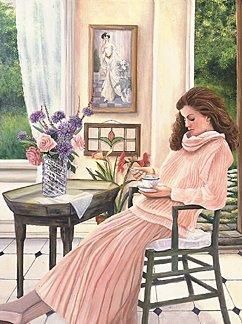
The name of the painting is "A New Place" by Susan Rios, and can be purchased online.

You can comment on this by writing me at ladylydiaspeaks@comcast.net

Tuesday, August 02, 2005

Grandmother's Apron

I was unable to find the author of this piece:

The principle use of Grandma's apron, was to protect the dress underneath, but along with that, it served as a holder for removing hot pans from the oven.

It was wonderful for drying children's tears, and on occasion was even used for cleaning out dirty ears.

From the chicken-coop the apron was used for carrying eggs, fussy chicks, and sometimes half-hatched eggs to be finished in the warming oven.

When company came, those aprons were ideal hiding places for shy children. And, when the weather was cold, grandma wrapped it around her arms. Those big old aprons wiped many a perspiring brow, bent over the hot wood stove.

Chips and kindlling wood were brought into the kitchen with that apron..

From the garden, it carried all sorts of vegetables. After the peas had been shelled, it carried out the hulls. In the fall, the apron was used to bring in apples that had fallen from the trees.

When unexpected company drove up the road, it was surprising how much furniture that old apron could dust in a matter of seconds.

When dinner was ready, Grandma walked out onto the porch, waved her apron, and the men knew it was time to come in from the fields to dinner.

It will be a long time before someone invents something that will replace that "old-time apron," that served so many different purposes.

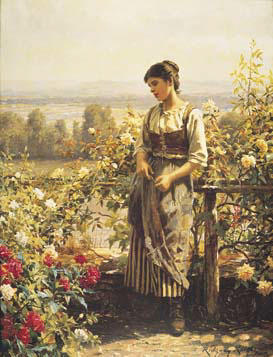
By the way, the painting is called "Ray of Sunshine" by Daniel Ridgeway Knight, (1839-1924), a Pennsylvania artist. To see more of his art go here bertc.com/subtwo/knight.htm or here www.kodnergallery.com/docs/Featured/ridgewayknight.htm . Dutch people settled in that area, and much of the crafts, art, architecture, and so forth, is called "Pennsylvania Dutch."

Saturday, July 30, 2005

Home Alone


I was just looking at the photographs of my family and thinking about the women and their work. My mother and grandmother and great-grandmother all presided over their homes. They guarded them and guided them in many ways. The house and garden was their domain. They were never asked what they "did" -- such a question would have only come from an ignorant, uneducated person, or someone who was being sarcastic.

The grandchildren of my husband's family always looked forward to visiting the grandparents at the old home place in the summer times. Many families did this on their holidays. If the grandmothers had not been home, but had been out working in an office, a factory, or a shop, their homes would not have been cared for or available for the family visits. My mother still looks after my father, in their small place, and wouldn't have left it in pursuit of a career.

The pressures on women whose children are grown, to leave their home unguarded, and seek other work for a paycheck, are tremendous. Even in churches where you expect people to know the scriptures concerning women's roles by heart, people constantly ask these empty-nesters what they are going to "do" now.

The idea that the nest is empty, just because the children are raised, is a total myth, because they come back, and they bring more with them. After you have your big cry when they leave, you better get busy getting a guest room ready for when they come back. Fill the freezer and pantry with food for unexpected company, because, believe me, you will be surprised at how often they come home. Then, get one of your rooms fixed up like a children's room, with all the equipment, including a baby bed, toddlers bed, toy box, diapers, and a few clothes. Put new toothbrushes in the bathroom for them. Make it easy for them to come back. My children keep a set of clothes and grooming items here, just in case they decide to make a sudden trip home. Grown kids may be excited about being out on their own, but their homes will never have the atmosphere of your home, and they'll want to come back often just to feel it.

You may think you'll be sitting home alone with nothing to do, but my experience has been that the work load, once the children are gone, is even greater. Jobs that the children used to help take care of, like yard work, cleaning the car, painting the house, cleaning closets and cupboards, baking and cooking for company, creating gifts and cards, etc. are now only done by the lady left home alone. They take just as much time and sweat as they did when the children were home. The lawn isn't smaller, the floor space to vacuume isn't less, and the bathroom is till the same size as it was before. The only difference is, now, you have no one to delegate the jobs to. You would think there would be less to do, with the family grown and gone. There is less of somethings, but more of other responsibilities.

Are you torn in your heart about what you should do now that your house is "empty?" I say the word "empty" loosely, because I think you will find that you don't have has much time alone as you thought you would when your children go to homes of their own. There are now more demands on your time than ever before. Whereas, when the children were at home, people knew to leave you alone, for the most part, now that they think you are "free" you will find they expect you to do things for others, or be available for them. There are many phone calls that were emergencies of the spiritual type, that I would have missed, had I not been home.

There will be people that need to be entertained, and places to go, that previously, due to the current work at hand with family, you avoided. There are things to do that have been put off for years. Now is the time to do them, for it is truly the middle of your life. You are inbetween raising children and old age. It is a period of time that you can use in a mighty way. Some people in this time of life find renewed energy and enthusiasm for old interests, or new ideas. Most inventions, books and businesses become successful after the age of 50.

There may be rooms you have always wanted to re-decorate, or add on. Or, perhaps you'ave been planning to landscape your area into an old fashioned garden where you can sit or take a walk. Maybe you've always wanted to paint a picture, write a story, teach young women how to keep house or sew, or catch up on some reading and letter-writing. Many women want to leave the home because they think they have nothing to do of value, there. Even if this were so, there is great value in being there to guard your house from theft, from stray animals, from disrepair, untidiness, and many other things. We should fix our houses up and then tend to them and maintain the work we have done. Plants and lawns, and the inside of the house, are full time jobs.

If you have money problems, then may I suggest that you cut back on spending, (find ways to get cheaper rates on things, get rid of subscriptions and other "bills" you can live without), and bring in income through garage sales or a home business. I know two young women who love to clean houses. They pass out their calling card and wait for the calls. They are busy whenever they want to be, and they can turn down any jobs they like. Interior decorating, meal providing, sewing, and many other things are really in demand. People will pay a lot to have some of these things done for them. In doing something that enhances the home life of others, you can earn money and yet stay in the interests of your own role.

Many years ago someone gave me a list similar to this. On it was written, "If you can answer these questions 'yes' , then you have spare time to go to work outside your home."
This list somewhat describes the Proverbs 31 woman. One does not have to do everything on this list. Like Proverbs 31, it is designed to show your true worth as a woman in the home; to show you how much you are needed, and the tasks that are available to you, should you choose to do them.
1. Have you shampooed your carpet in the last 3 months?
2. Have you rearranged your furniture in the last 6 months?
3. How long has it been since the inside of your house has had fresh paint?
4. Are your husbands shirts ironed?
5. Do you make your own clothes?
6. Do you cook from raw ingredients, or "scratch" and avoid processed, prepared foods?
7. Have you invited anyone over for an afternoon tea?
8. Is there a family at church you need to have over for an evening of fellowship?
9. Are you teaching younger women any of the homemaking skills, or teaching your own children at home ("homeschooling")?
10. Are your photos sorted by date and put into albums, or have you created a memory scrapbook for each member of the family?
11. Are all your closets and cupboards, pantry, etc. clean and orderly?
12. Have you had a garage sale this year?
13. Do you make things to sell?
14. Are you able to take your time to fix a meal?
15. Is your pantry and fridge stocked well enough to last a few weeks?
16. Are you prepared for the next family event held at your house?
17. Do you make your own gifts and cards?
18. Do you read a chapter in the Bible each day?
19. Have you caught up with your correspondence?
20. Do you grow a vegetable garden?

You could probably add about 20 more tasks available to the homemaker, if you thought about what you do during a day. Do you have time to go to work? Let me assure you that, just when you think you've been abandoned, and have nothing to do, someone will come to see you. I've never seen an older woman with grown children, have a totally empty house for very long. After they leave, you'll have to clean all that up and then get back to your sewing or painting projects, or catch up on the other special work you have. You'll begin to think there isn't enough time to do anything.

Staying home also provides protection from various troubles in the work place. If there are problems in the home, at least they are yours and you have a reason for caring about them.

Staying at home provides a good example to the younger women. Think in your mind of the women mentioned in the Bible from the beginning of time, through the New Testament. Their main concern was their husbands, families, and homes. Technically, you could probably prove that some of them worked outside the home, but does it mean that you should? Is there a command to do so? The woman was always supposed to guide the home. Just because she doesn't have children, doesn't free her of that duty.

If a woman can do all those things described in this list, or in Proverbs 31, Titus 2, and II Timothy 5:14, and if her working doesn't bring reproach, and if she can still be a helpmeet to her husband, and if she is not too tired, and her work at home is caught up, then can she find time to work outside the home.

Another problem of working elsewhere is the amount of dedication it will take to fulfill the job for the employer. There will be days when you do not feel well. You can not lie down on the job, like you can at home when you need to.

There might be those who demand to know why you are not working, and you can always ask them, if you dare, why they aren't at home. Some women get work in offices or stores because they "just can't stay home." They are restless and do not understand the job at hand. They cannot work unless they are regulated by a job. They may be escaping their work at home. I've noticed, as you may have, that the times I feel most like leaving home, is when it is not orderly, and I'm behind on everything. It would just be easier to go somewhere else.

Many women at home are helping their husbands make wise investments and save money. What they save by this standard of living, equals what they would have earned. Most women who work, do not really get much for it. By the time everything is paid, there is little satisfaction and enjoyment left from that paycheck.

One advantage to being home alone is the peaceful times spent in quiet thought. Working women are frazzled with travel time and schedules. Women at home have time to rejuvenate, and then do a really good job with their energy. Women weren't created to work like machinery and keep the rigorous schedules of work outside the home. They need special emotional and physical care , which can only be found in keeping themselves busy at home. So if you are home alone, pray out loud and sing at the top of your lungs. Its a wonderful opportunity to grow and develop your full potential.

Thursday, July 21, 2005


Bedtime Story by Alan Sakhavarz Posted by Picasa

She Never "Did" Anything

While discussing the estate of a beloved relative, which involved the details of her tea cups and furniture, I was told by someone in her family that there wasn't much left to the family, from her belongings. This was, he said, because "she didn't do anything much."

"She never worked outside the home," he said. "She didn't have any money."

I felt sad that this was his attitude toward the worth of this woman. While I knew her--approximately 25 years, she created beauty and order in her home. She was a good helpmeet for her husband. She crocheted the most beautiful pieces I've ever seen. Her home exuded a warmth of old-fashioned welcome, that I have not been able to match. She sewed her own clothes and was a good cook. I always looked forward to visiting her. She had a cheerful response to everything, no matter what troubles came upon her.

Married in the 1930's, her husband, like many others, was proud to support her full time at home, and did not wish for her to work. One could easily see that it was a full time job just caring for him, the garden, the house, and the many ways in which she served the local church.

The thing I remember most about her is her laughter, and her optimism, until the day she died.
Though she had no children, she was loved by her nieces and nephews, and all her other relatives.

How very tragic that people cannot think of success in any terms but money. I'm sensing a real attack on family values, Biblical standards, and the sanctity of marriage and the home. It doesn't matter what achievement one has in the corporate world. If they cannot keep a marriage together, their accomplishments will not last. If they do not put a concentrated effort into teaching their children, nothing of real value will be handed down to the next generation. If the women cannot become experts, through years of practice and experience, in homemaking, they have no glory. If they are praised by the world for their profession, they can still lose their families. There is no accomplishment that can make up for this.

Such women of the home, ought to be honored. At one funeral I attended, I heard someone remark that "She cared about her home. She was a good housekeeper, and a conscientious mother, and a good wife." There is no greater acclaim.

The beauty of such a life, is that it is unique. Each homemaker has her own talents and way of doing things. Each can make her home special. It would be boring indeed, if, when visiting the homemaker, we would find the homes identically kept. Everyone brings into the homelife their
own likes and talents. One may have her home decorated in blue, while another might enjoy antiques. Others may be keenly interested in baking breads of different types, while some may love the touch of the sewing machine across a pretty piece of fabric. Others might find great fulfillment in providing hospitality, and others may be able to create a home business from their talents and hobbies.

We ought to laud these women, who do not feel they have to compete; who pay no heed to the voices that call them from their nests. We ought to give them prizes, medals, and big baskets of gifts, for their steadiness of purpose at home. There is constant pressure on them to relent. "You won't have a pension," "You won't have any tenure at work," "You'll have nothing to do when you are older." This is nonsense. It is a smoke screen. It is a diversionary tactic. None of it is true.

I heard a religious woman speaking on the radio one day who was claiming to offer counsel to younger women. She claimed that "this is not the 1950's, and no one is ever going to look after you all your life. You have to get some training and get a job." She obviously didn't do the research. There are still a lot of women, more than can be counted, who are staying home. Through their helpful frugality, and the wise management of their money and posessions, they've helped their husbands become successful, and now, in their later years, they are both secure. The ones who thought they should work, however, are still working, still not secure, and sufferring from health problems.

You don't have to justify staying home. The Bible clearly shows that a woman best ministers and blossoms in her home. She is protected from outside stresses, and she can more easily build up a reputation of being "a good woman."

If you've been home for a few years, you've done well. Keep on doing it. Stand up to those who say it can't be done, by showing that it can, and that it is being done. There is no greater accomplishment in life than to have a successful home life. Divorce, troubled children, mother working, a house in disarray, is not successful home life. Much of this can be turned around by the woman's return to the home as a career. Not all women will approach it the same way. It is different for each home. Through a woman's own special personality and dedication, each home though different, can produce the same successful results: children who are able to form good relationships, houses that are well cared for, hospitality shown to others, strong churches, and good marriages.

I overheard two women talking about their finances. One woman said, "We added and subtracted, and looked over our expenses, and decided that "I" should do something." There it is again, the new bywords: "do something." It means "I must leave my home and go to work."
An acquaintance, seeking sympathy from a co-worker about the trouble he has making ends meet (his house payment and taxes are very high), was told, "You wife should 'do something.'"

"Do Something," is a modern phrase for "My wife stays at home. She doesn't earn money or 'help out.'" In colleges, young men and women are taught, in not so many words, that a woman should get a job so she can "help out." "Help out," is the next new phrase on the scene.

I know a couple in financial trouble, who decided to follow the Biblical standards of the roles of men and women. They had a tough first year, as the wife quit her job and stayed home to homeschool their child. Now, only a few years later, they are out of debt, with money to spare. Her husband has no impressive income. He has no job of any prestige. They have decided to follow the Biblical plan and let the wife keep the home and the husband provide a living. There are plenty of stories like this, and it might be surprising to learn that these people do not live miserable, overly frugal lives. On the contrary, they have more leisure time and are under less stress than other families where both people work.

Wednesday, July 20, 2005

Tuesday, July 19, 2005


A Girl and Roses by Auguste Toulmouche (1800's) Posted by Picasa

Wednesday, July 13, 2005

Articles You'd Like to Read

There are so many things to write about that concerns the keeper of the home and family. What seems to be the most timely or urgent subject for you, at this time? Please email me with your requests, and I'll try to do the research on it and post new articles. ladylydiaspeaks@comcast.net

Tuesday, July 12, 2005


Pardon Mama by F. Munier 1888 Posted by Picasa

Extracted Apologies

Apologies, Apologies

Why should I be concerned about the increasing tendency among people to extract apologies from others? Because it wasn't always as widespread. True, some people would demand an apology and it was given and accepted, in blatantly obvious, public offenses, but for the most part, people were so busy at their lives that they had little time to worry about the offenses of others.

Entire afternoons, or, sometimes evenings, are taken up with the procedure of extracting apologies. Meetings are arranged, and files collected, so that everyone can "put their differences out on the table." Yet, never have I seen this be fruitful way of solving problems. In a few months, it must be done again. These meetings often cause more hurt feelings, as things are dredged up and said, requiring further apologies!

These days, it seems that apologies are extracted for another reason: - to take away the uneasiness a person feels about their life. Not everyone lives as they should,and therefore they can get a "feeling" that they aren't accepted or approved of. People natually stiffen at the sight of them, recoil from them, or avoid inviting them to their social events. This results in the offender -- whether he is rejected naturally because of careless dress, immodesty, being unbathed, smoking dope in front of people, wearing embarrassingly immodest clothing, a bad example, or just being sarcastic and sneering at someone's lifestyle---feeling unwelcome.

What is to be done about this, she thinks? These people aren't making me feel good. I feel terrible because they aren't embracing me, and accepting my beliefs. Should I sue, or demand an apology? A person might feel bad about their lifestyle, and can't get that feeling to go away. She builds up bitterness as she thinks of the people that haven't really "approved" of her. It seems the only thing preventing her feeling good about herself, are those who disapprove of her. Bitterness begins to build up, until she demands an apology. Demanding apologies is very rude, and seldom does it win friends and influence people.

It might never occur to the offended, that they might change their attitudes.

Once obtained, the apology just doesn't seem to be "right." This is because the person didn't need the apology. They needed to get rid of root problems that will make them continue to demand apologies in order to feel better. One such problem is "quiet wrath." Looking at what they perceive of as past offenses, (including the failure of the offender to approve wholeheartedly and warmly of their lives), they begin to keep score of wrongs. Soon, the unforgiveness is welling up in their souls. They want the feeling to go away. If someone will apologize to them today, they'll feel better. I've known of a few individuals who extracted at least an apology a day from someone, in order to validate themselves.

Sometimes apologies are carefully monitored to see if the apologizer really means it. This can result in more offenses, as the offended person adds more offenses from the actual apology.

This is the era of the demanded apology. China demands an apology from America for crossing their sea or air space. Muslims demand an apology from Russia for saying that they will root out terrorists, "even in the loo." Brits demand an apology from France's leader for saying that the food in Britian was not worth eating. If you can think of any more national demanded, extracted apologies, please, send them to me.

What do these apologies accomplish? Momentarily they may satisfy the demander. Most of the time, apologies don't hold much weight. Eventually someone become offended again and cannot live without another apology. We used to joke that so-and-so was out to get his weekly apology. It was like fuel to him. If he wasn't at someone's house getting one, he was in his own home stewing about how someone looked at him wrong, and how he would extract an apology from them. His basic problem was not so much that others were offending him, but that he was harboring resentment and bitterness and wrath. His life was not right, and so he was using his accusations against others to distract attention from his own faults.

There are some people, who, just by their clear consciences and clean living, offend people. I've known people who have been in rooms where they have said absolutely nothing, and yet incited the furor of someone who knew they would not participate in their vice, or approve their actions. I'm saying this so that you'll realize that just because someone demands an apology, does not mean they are justified in getting one.

Apologies should be offered freely by those who want to give them. They are not ours, to have, unless someone freely extends them. Once forced out of a person, an apology does not do what it could do, had it been freely given, prompted by the other person's conscience. There are those in society today who would judge a person by how many times they've heard them apologize. I heard a preacher who was bitter toward his wife say, "She never apologizes." Whether or not she should, is not what I'm talking about here. Maybe she should, and maybe not, but no one has a right to judge us by the imagined apology quota of the year. Whether or not you've apologized for something, does not determine who valuable you are as a person.

I'd die of shame before I would ever demand an apology from someone. I'd rather overlook the fault.

As I said, apologies are alright, as long as freely given by the donor. They are not the same, once forced, accompanied by threats of various types (lawsuits, visits from church authorities, disassociation, etc.). Some people will apologize out of fear. Some will apologize just to keep the peace. Others will apologize because they recognize the immaturity of the one they are apologizing to. Some people apologize because they are truly the nobler person. Sometimes grown children, who want to reconcile with estranged parents, will apologize. This should be accepted graciously, as the father accepted the Prodigal son.

Apologies can actually cause more trouble than if a person was left alone. There is an old saying that we should "let sleeping dogs lie." Once you kick him, he will cause more trouble. Sometimes an apology is met with derision, rejected because it wasn't good enough, or argued with. I know, as a girl growing up in a family of 7, that we behaved as well as we could so that apologies would rarely occur. Once an apology was extended, the offended was likely to bring up a long list of past wrongs, accompanied by the accusation "You always," or "You never," pulling the apologizer deeper into an argument they couldn't get out of.

Let us look at demanded apologies in the Bible. If you are thinking of finding an example of a demanded apology, you might not find it. Apologies today are given for the satisfaction of the one who demanded it, not necessarily out of concern for the one who gave it. "Forgiveness for Offenses," the term used in the scriptures, is a lot different than the apology for an offense. Instead of demanding an apology, the offended person approaches the offender and says something like, "I was offended." If the offender wants to, he can say, "Will you forgive me?" which puts the burdon on the one offended. Ones the offended lets go of the grudge and says "Yes, I forgive you," he is free of the burden of the offense. Notice that it is the offended person who goes to the one whom they are upset with. They don't tell their woe to someone else first and get the other person all sympathetic and eventually enraged. They don't wait.

Forgiveness doesn't always mean the other person is right, it just means that you are free. Unforgiveness means that you can accumulate years of bitterness and wrath, which, no matter how many apologies you demand, will never go away. Forgetfulness and forgiveness go hand in hand. If a person offends again, the past should not be remembered, and a long list dredged up with past offenses. Now is now, and then was then. Though tempted, I try not to remind people of past failures in their lives, or past offenses. Forgiveness is the key factor in overcoming the fault of demanding apologies.

Studying this carefully, you can see that it is sometimes wrong to get offended. Overly sensitive people just constantly get offended by everything, and then want someone to ask forgiveness. It is just as wrong to be offended by every little thing, as it is to offend. Getting constantly offended stirs up trouble, and shows self-centeredness.

If you really want to mature properly, you have to learn that throughout life, there will be things that will offend you, and you can't confront everyone for it. It would make you quite busy getting your daily apology. Confronting everyone that offends you usually causes the other person to avoid you. You'll see people walk away when they see you coming, if you have this habit. Some people think they are obligated to get justice for every little thing that they perceive as offensive against them. Some people want to force you to accept their friends, their habits, and their disrespectual attitudes. If you don't like it, they say, then it is you who must change.

It would be better if these apology-bullies would be stood up to, and not allowed to control families and churches. They make everyone miserable instead of happy. They need to learn they don't get apologies just because they demand them. Not everything warrants an apology. Still, the one offering it should do so at his own free will, not from force.

If you'll learn to overlook a fault, you'll find that you don't have to collect offenses, confront people, and demand apologies. You can let the offenses slide over you like water off a duck's back, and get something more creative done in your life. I've noticed that people that want apologies are not absorbed in life. They are not minding their own business, making something, learning something, or helping someone. They are "social creatures," every looking to see how everyone pleases them.They are expecting to be served, expecting to be honored, expecting to be welcomed, and expecting to be praised. The ones who never seem to have problems with other people, are understanding, forgiving, serving and learning. They would be embarrassed to have any attention focused on them.

When we look at the final days of our Lord, we see he did not spend his time extracting apologies from people. He had a purpose, and "like Him, we should be," so we should have a purpose too. Extracting apologies from people shows an unhealthy absorption of the self. If someone offends you, try overlooking it rather than confronting them. You'll find your blood pressure will go down, and you'll be able to sleep at night.

I am not speaking here of necessary intervention, but I am addressing those who find power in demanding apologies. One man said it well: "Some demands for apologies come off as power-trippy." It is best to remember to yield your rights and forgive constantly, and not collect offenses, thus avoiding the tendency to confront and demand of others.

Seeing the results of the meetings where apologies are arranged, I personally think it would be better for you to let the meeting convene, but go shopping, instead. The order, the lights, the colors, and the cheerful atmosphere of the stores might do you much more good than the ugly re-hashing of faults that characterizes these meetings. I know one particular mother who has tired of them. She arranges her home with tea and biscuits (She's from Scotland) in peparation for the relatives, she excuses her self once the meeting has begun, and either goes outide to work in her garden, or gets in the car and drives to the mall. Until the meeting changes to a "praise and appreciation" session, that mother says she will not attend.

What if someone deeply wounds or offends you with words or actions? It is proper to tell them, in the proper humble spirit, that you were hurt, but it is up to them to apologize. Sometimes demanding an apology from them, especially if you are angry, will make the situation worse. I do believe it is okay to say you are hurt, but always be prepared for the other person to retaliate by listing the hurts he feels, in return. In confronting someone, we often open up more trouble. My husband has been located as a preacher in the same congregation for 13 years now. His parents before him were here for 27 years. We attribute that longevity partly to the fact that we quit confronting people for personal offenses. When we "hear" something, we ignore it, and when we are treated badly, we ignore that, too. Sometimes we use the opposite approach. When someone offends us, we ask them if we have offended them, and in someway caused them to mistreat us. We've found it builds better relationships.

What if you inadvertantly upset someone? If you realize your mistake, apologize quickly, and if someone else brings it to your attention, be easy to entreat, make things right immediately, and forget it. Keep in mind, that some people are looking for offenses, and want to pick on the least little thing. If you apologize quickly, they have no more fight in them.

Sunday, July 10, 2005

Thursday, July 07, 2005

Sunday, June 26, 2005


Lady's Fashion of the 1800's Posted by Hello

Encounter with the Past: A True Experience

My daughter and I were walking in Olde Towne one day, an old fashioned town in Florence, Oregon, intending to visit one of our favorite shops called "By the Bay." I had just touched the handle of the door of this shop in order to enter, when I happened to glance down the sidewalk. I thought I saw three ladies, dressed in clothing of the 1800's, walking away. "Let's follow them and find out where they went," suggested my daughter. When we looked again, they were nowhere in site, so we walked down the sidewalk looking in every shop window. At last we spotted them in an antique store.

We entered the store and noticed their wonderful hats, gloves, and dresses. The ladies appeared to be well over 60, and each one of them were very stately, modest and proper. Their garments were of the finest quality fabrics, and their hats were made to coordinate. They wore boots of the Victorian style. One lady wore a dark green outfit, and another wore one in a dark burgundy. The third lady wore a blouse of black and white stripes and a black skirt.

I summoned up my courage to speak to them. "Hello, " I said. "We noticed you awhile ago walking on the street and we looked in every shop until we found you. You are dressed so elegantly and I love the fabrics and the workmanship. Do you belong to a special society?"

"Well, actually, we come from the past, each year," the oldest one replied. "We visit the museams and the antique shops in the area, just to make sure everything in this century is being portrayed honestly and accurately. We check the historical markers and buildings and other things of our era. We are on a schedule, and soon we'll be visiting the oldest church building in the area, that has records kept from the early 1800's." No matter how I tried to get them to tell me where they lived, they kept up with their wonderful act and pretense of being from the past, and they were enjoying it enormously.

"We will return to the past at the end of the week, and then we'll come again next year," they said.

"We'd love to join you, " I told them. They seemed complimented by this and told us, "There are so many awful things said about the 1800's and yet, the people of that era were responsible for these very streets that you are walking on, being laid out the way they are, and many of these buildings and parks we enjoy every day."

"Don't pay any attention to the rumours they spread about us. There are some very good things about the 1800's. Many of the things you use in this century, such as the car, the sewing machine, electricity, plumbing, and the airplane, were actually being invented by the people of that era," replied the "green" lady, smiling. "Also, the families were so strong. That, itself is testimony enough of the values of that era."

These women were so refined, that my daughter and I both felt that we were imposing on them by even speaking as though we were familiar--they were somehow royal and queenly in their demeanor. It seemed rude to continue questioning and detaining them, so we excused ourselves, thanked them, and politely left.

What a refreshing change it was for us, after what we had seen the tourists wearing on the street in the summer weather. These were older women and they looked dignified and respectable. They weren't showing bare, flabby upper arms, dimpled thighs or knobbly knees, varicose veins in their legs, or protruding stomachs.

Their clothing kept them nicely covered, and their figures neatly packed in the swaths of fabric in the skirts, without tell-tale lumps our outlines of underthings. The colors and styles, and especially their hats, drew one's eyes to their sweet faces. The images of those women stayed with us quite awhile.

While these women walked around town, many people stopped and stared at them. If young girls today want to truly "turn heads," they should dress in the clothing styles of the 1800's. Wear a hat, some lacy gloves, a Gibson-girl blouse, a walking skirt and lace up boots, and see what happens.

Women's clothing of that style poses no danger to the wearer nor to the person who views it. I remember reading once, in a history book about the clothing of that era. Both the men and the women dressed in such a way as not to offend anyone. They thought that it was rude to expose too much of their flesh to others, and that it may lead someone's mind in a direction less than noble. Surely, it is time for us to pay attention to the reasons behind the customs of the past. You can't argue with success.

At the Well, by Daniel Ridgway Knight Posted by Hello

Wednesday, June 22, 2005

Thursday, June 16, 2005


Patterns for the Home from Vogue Pattern Company Posted by Hello

Tuesday, June 07, 2005

My Beliefs

Romans 6:3-4, Acts 22:16
A New Life in Christ


About God: Psalm 14:1; Ephesians 4:4-6

About Creation are found in Genesis 1:1


About Faith: Hebrews 10:38,

About the Soul is found in Genesis 2:7, James 5:20

About Sin: Ezekiel 18:20; Proverbs 14:34; Acts 22:16,


About Christ: Colossians 1:18, I Corinthians 3:11; Galations 3:27


About the Gospel: defined as the death, the buriel, and the resurrection of Jesus: I Corinthians 15:1-4, defined as the great commission: Mark 16:15-16, defined on judgement day : 11Thessalonians 1:18; the death, buriel and ressurection of Christ enacted: Romans 6:3-6


About Salvation: Romans 1:16, Philippians 2:12, I Timothy 3:15
Acts 2:38-48; 1 Peter 3:21


About the Lord's church: Acts 2:47, Acts 11:26, Romans 16:16


About Worship: Hebrews 10:25, Acts 20:7, I Corinthians 10:16, Ephesians 5:19, Colossians 3:16

About Saints: Romans 12:13 Saints are people who have obeyed the Gospel and been added to the church (See Acts 2:42) Romans 8:27, Acts 9:41. The Lords church consists of only saints, and only saints are in his church.

About Christian Living: Matthew 22:37-40, Romans 12.


About Parents and Children: Proverbs 3:12, Ist John 3:18, I Timothy 3:4, Colossians 3:20


About Housekeeping: I Timothy 5:14, Titus 2:5

About Marriage: Ephesians 5:24,25, Colossians 3:19, I Peter 3:1


About Race: I Corinthians 9:24, Hebrews 12:1. Note: the word "race" referring to national distinction, is not in the Bible. Acts 17:26 is the only statement that refers to God's attitude toward different nationalities. Charles Darwin, the person who made evolution a famous theory, popularized the concept of race, as we know it today, when he divided people into classes according to their skin color. While the Bible lists many nations and tribes, there is a lack of skin color distinction to identify them.The race to be considered in the Bible is the one that is to be run in the Christian life. All nationalities must submit to the law of Christ.

About Parents Responsibility in Educating their children: Deuteronomy 6:6-8, Ephesians 6. Proverbs 29:17; Proverbs 19:18; Proverbs 29:17; Proverbs 19:26; Proverbs 29:15;


About Psychology: The entire Book of Proverbs is the most superior psychology book in the world because it shows the consequences of foolishness and the rewards of righteousness. The word of God is the only thing necessary for life. 11Peter 1:3

About division and denominations: Matthew 15:9; I Corinthians 1:11-13

About sin: Acts 22:16, Romans 3:25,

About being converted: Acts 3:19; the conversion of the 3,000: Acts 2, the Samaritans: Acts 8; the treasurer's conversion - Acts 8; The apostle Paul: Acts 9:18, Acts 22:16; The Centurian: Acts 10; Lydia - Acts 16:13-15; The Jailor - Acts 16:26-30; Crispus and household: Acts 18:8;

About drinking: Proverbs 20:1; Proverbs 31:4; Isaiah 5:11; Isaiah 5:22;

About comparison of the Old  Law given to Moses, and the New Law of Christ : Galations 3:23-29

3But before faith came, we were kept under the law, shut up unto the faith which should afterwards be revealed.
 24Wherefore the law was our schoolmaster to bring us unto Christ, that we might be justified by faith.
 25But after that faith is come, we are no longer under a schoolmaster.
 26For ye are all the children of God by faith in Christ Jesus.
 27For as many of you as have been baptized into Christ have put on Christ.
 28There is neither Jew nor Greek, there is neither bond nor free, there is neither male nor female: for ye are all one in Christ Jesus.
 29And if ye be Christ's, then are ye Abraham's seed, and heirs according to the promise.


About feminism, socialism, Marxism and other isms: Their doctrines are false and opposed to the teachings of the Bible. Christ already liberated women when He made them fellow heirs and we do not need any isms or added doctrines to the word of God. People are equal when they obey the gospel.

About Class: There are only two classes of people: those who have obeyed the gospel of Christ according to His last will and testament, and those who have not. The attitude the saved should have toward the lost is that they have the responsibility of teaching them the gospel, when the opportunity arises. The attitude of the unsaved, the lost, and those who have not obeyed the gospel, is that they are outside of Christ, and must obey the gospel to get in Christ. 2nd Corinthians 5:17;
About religious leaders to claim to have been given revelations by an angel:  Galations 1:6-9

About Prophets and Prophecy after the Bible was Written:  1st Corinthians 13 vs. 8; Revelation 20:18-19;  I accept only prophets whose names are recorded in the Bible.

Galations 1:8:  But though we, or an angel from heaven should preach  any other gospel unto to than that which we have preached unto you, let him be accursed (anathema).

My comments: those who claim to be prophets also say that their prophecy was revealed to them by an angel.  Galations 1:8 (above) says that even if an angel from heaven should come to you and preach another gospel that is not the same as that which the apostles preached,  they are accursed. If it is not the exact words of the Bible, it is not the same gospel that the apostles preached and wrote. If it is not, the prophet is false, and if it is the same, there is no need for the prophet.

About false prophets

About Jesus Christ:

 God, who at sundry times and in divers manners spake in time past unto the fathers by the prophets,
 Hath in these last days spoken unto us by his Son, whom he hath appointed heir of all things, by whom also he made the worlds; (Hebrews 1:1-2)


About the first day of the week:

1 Corinthians 16:2, Acts 20:7; Jesus rose on the first day of the week, the first gospel sermon in Acts 2 was preached on the first day of the week, the kingdom (church) was established on the first day of the week (Acts 2) and the first baptisms took place. The Lord add those who were baptised to His church. Read also Matthew

On the first day of the week, Paul preached to the disciples who had gathered together to break bread:  "And upon the first day of the week, Paul preached unto them, ready to depart on the morrow, and continued his speech until midnight." Acts 20:7

Mark 16:9
Now when Jesus was risen early the first day of the week, he appeared first to Mary Magdalene, out of whom he had cast seven devils.


Sabbath was one of the laws of the Old Testament Jewish Mosaical Law, and it was nailed to the cross and abolished at the death of Jesus Christ:

Colossians 2:14-16:  Blotting out the handwriting of ordinances, which was against us, which was contrary to us, and took it out of the way, nailing it to His cross."

Ephesians 2:15: Having abolished in His flesh the enmity, the law of commandments in ordinances; for to make in himself of twain, one new man.

The law given to Moses for the Israelites was replaced by the last will and testament, the New Testament, of Jesus Christ, as our spiritual authority.  The Old Testament is the schoolmaster, which was written for our learning, but the Bible says we are no longer under a schoolmaster. Galations 3:24-25

Hebrews 8:6-8: But now hath he obtained a more excellent ministry, by how much more he is the mediator of a better covenant, which was established upon better promises. For if that first covenant had been faultless, then should no place have been sought for the second.

About Authority:  Our authority today is Jesus Christ, who gave us His last will and testament when he died on the cross. His words, rather than the words of others, are  our authority. See also Hebrews 1:2

Read a very through study of these issues here.


For more on the Sabbath verses the Lord's Day click here or, go here or here
Read some personal stories of people who studied and came to a right conclusion about these issues, here.

If you are still not sure about this, I urge you to carefully read the book of Galations, the book of Hebrews, and the book of Romans, all which address the problem of people bringing the Old Law into the New Covenant, and explain how the Old Law was taken away, nailed to the cross, and the New Law of Christ became the spiritual authority.  "This is my beloved son ...hear ye Him."   Mathew 17:5

Another good personal story here.  My note:  I pray all these people will study further and be taught the "way more perfectly"  (Acts 18:26) as they seek to find the truth of the Gospel.
Also read this man's story which contains a lot of essential scripture. Highly recommended.

About Cults: The definition of a cult is a religion that has a prophet or leader other than those recorded in the Bible, and they have additional books other than the Bible, which they claim were revealed to their leader by an angel.  The true church is based on the pattern set by the apostles in the New Testament, and does not need additional revelations outside of the Bible. Many cult religions have their own version of the Bible, having been revised to suit the claims of their particular prophets. Our only leader is Christ; our only book is the Bible, our only religious authority for our personal spiritual life is the New Covenant.

About the Ressurrection on the First Day of the Week:  Mark 16:1-6:  "And when the sabbath was past, Mary Magdalene, and Mary, the mother of James, and ZSalome, had brought sweet spices, that they might come and annoint him. And very early in the morning the first day of the week, they came into the sepulchre at the rising of the sun...."

Jesus said he would die and would be raised on the third day. He died on Friday, was entombed on Saturday, and rose on Sunday, the first day of the week.  If you will read Mark, chapters 15 and 16, it will show  you how he died in Friday, and rose on Sunday.

Mistakes of 19th century self-proclaimed prophets can be read here.  See also this site concerning the similarities of modern day prophets.

The real church can be read about in the New Testament, and has no book but the Bible, no leader but Christ.

About the end times: Get comfortable and read the history of some of the fantastic ideas about the end times here, which include scriptures that shed light on the subject.  You might also like this for a study on world predictions.


Sunday, June 05, 2005

Feminist Fabrication

This article was sent to me a few months ago. I thought it had some excellent points:


One of the most poisonous feminist fabrications over the past thirty years concerns our recent History. For example, for almost two whole generations now, our children have been fed the deceitful propaganda that marriage is a mechanism whereby men have oppressed women and, somehow, forced them to remain in the home, while they themselves ventured outside into the liberating world of work - presumably for fun, frolics, fulfillment and independence.


The deceit herein is that, in reality, the world of work has been, for the most part, an extremely unpleasant world in which to live - until quite recently.


The majority of men in recent History were working in terrible conditions - down filthy, dangerous mines - in the hot, unwholesome, poisonous construction industries of ship and house building, and in arduous heavy engineering projects such as building roads and bridges - in tedious, sweaty factories, labouring for 16 hours non-stop, day after day - in the military, sent away from home, sometimes for years, to the most inhospitable and hostile of conditions and climates, to face disease, damage, death, and war - in agriculture, where men toiled and tilled without the advanced machinery of today - and even in the new offices, where rows upon rows of clerks spent their hours laboriously copying out, by hand, the mountains of information that needed to be documented.


In the world of work, men were being 'oppressed' far more so than were their women at home. They were at the beck and call of their bosses, and were given little in the way of rights, safety, security or decent pay.


For the most part, therefore, the jobs of the past were mostly soul destroying, if not downright dangerous and debilitating, and it is men who did most of them in order to provide for their women and children.


The world of work was not a pleasant place to be. And it was not somewhere where most women, then, or nowadays, would choose to have been.


When feminists give the impression to our younger folk that working for a living in the recent past was invigorating, cathartic or therapeutic in some way, they are lying.


In more recent times, technological advancements have removed much of the worst aspects of 'work', and, further, other huge industries requiring less odious forms of work have sprung up; e.g. media, computer, financial.


And it is in these far more benign circumstances that today's women are continually indoctrinated with the view that some glorious world of 'work' was somehow denied to them in the past.


The truth is that they were not denied it.


They were saved from it.
5/1/02
USA In 1900, only 6 percent of married women worked outside the home, usually when their blue-collar husbands were unemployed. Among wives with children at home, very few worked at all. Almost half of single women held jobs, but they usually stopped working when they married or, at the latest, when they got pregnant, and most never worked for pay again. About a third of widowed and divorced women worked, typically out of economic necessity. Never-married women with children were virtually unknown. Only 6% eh? Now that's interesting! ... ... And so is this ... In 1936, a Gallup poll asked a national sample, “Should a married woman earn money if she has a husband capable of supporting her?” By OVERWHELMI NG majorities, both men and women said that she should not.


Here is an extract from David Thomas' book Not Guilty ... The desire to free oneself from work was common to all classes and both sexes. Dr Joanna Bourke of Birkbeck College, London, has studied the diaries of 5,000 women who lived between 1860 and 1930. During that period, the proportion of women in paid employment dropped from 75 per cent to 10 per cent. This was regarded as a huge step forward for womankind, an opinion shared by the women whose writings Dr Bourke researched. Freed from mills and factories, they created a new power base for themselves at home. This was, claims Dr Bourke, "a deliberate choice. . . and a choice that gave great pleasure."


And now, study closely the words of one of the most powerful and influential women the world as ever known."I love peace and quiet, I hate politics and turmoil. We women are not made for governing, and if we are good women, we must dislike these masculine occupations. There are times which force one to take interest in them, and I do, of course intensely"


" I am most anxious to enlist everyone who can speak or write to join in checking this mad, wicked folly of 'Women's Rights', with all its attendant horrors, on which her poor feeble sex is bent, forgetting every sense of womanly feelings and propriety. Feminists ought to get a good whipping. Were woman to 'unsex' themselves by claiming equality with men, they would become the most hateful, heathen and disgusting of beings, and would surely perish withou t male protection." Queen Victoria 1870

(selected)


My comment: These self serving attitudes of women would never have worked on the homestead in the wilderness where I grew up. There simply was not time to think about someone having more rights than you. We had to survive, and women protected their children and looked after their husbands and prayed for them. The home and family were all working together and going in the same direction. It was rare to hear of a divorce, and when there was one, it was a last resort. The women had hard times, but so did the men! I didn't see feminists clamoring for their right to log the land and build a house or catch fish through ice. I think personally that feminism exists more in colleges and office buildings than in real life elsewhere.

Question: I read recently on another site that your family owned wilderness land, and that it was stolen from the native Americans. What right do you have to live in such a place, when it rightfully belongs to someone else?

My Answer: The land we settled belonged to the Russians and was purchased from them by the government. The long time settlers were offered a free trip to Russia by the government and most of them prefered to stay where they were. They were not on any of the lands that my family bought. Whoever wrote such a lie, must be living in a hot air balloon and not touching any kind of land. That is the only way anyone could avoid living on a piece of the earth that might have once been inhabited by someone else. Even the big cities occupy lands that were once the territories of others. There is not one single inch of land on the entire earth that did not belong to someone else. If you can name one, please do. The Bible says that the earth is the Lords, and the fullness thereof. It all belongs to God, and he lets us stay on it for awhile. None of us will be here forever. We all have a limited time and then we will die, and someone else will come and live where we are now. None of it belongs to us; it is a temporary loan from God. Your spiritual condition is more important than where you live. Have you obeyed the gospel? If you haven't, please read Romans 6:3-4 and Acts 22:16. There are dozens more passages for you to read, so why not take some time and read the entire New Testament, the last will and testament of Christ.