Saturday, April 06, 2013

The Dandenongs

Sunday after church two lovely ladies who live in the caravan park took me to Sassafras in The Dandenongs for shopping and tea at Miss Marples.
 
This is Dreena, who has been so kind to me since I came, and has a special knack for sympathy. When I got back to an empty home after my Mother moved to her new place, Dreena cheerfully suggested a trip.
On the left is Linda, who also lives in one of those cute manufactured houses that I showed you when I first came here. We had a wonderful time visiting the shops while we waited for our seating at Miss Marples, and I think that these ladies were exceptionally happy to take a day off and come up to the mountain ranges to show off this part of Victoria to me. They both kept a very close eye on me and did not let me stray too far.
 
 
Dreena told me that people knit scarves while they are standing on the sidewalk in winter, and wrap them around the poles to keep them warm. I asked her why, and she said it was because the poles got cold in winter. I think she enjoys having me on.
They also have Christmas in July in Sassafrass since it snows up here in the mountains in winter.
Some mice yard sculpture sold in an oudoor area.
The tea room.
Next door to the tea room is a shop that sells any kind of teapot you can imagine, and every type of tea leaf, tea strainer, tea spoon and tea cup.
 
 
Click on for a larger view.
 
I neglected to take a photo of the sandwiches when they were first served.
 
The menu
The forest
 
The corner where we sat.


A koala teapot.
I would not have had as much of a holiday here if not for Dreena and Linda taking to Sassafras and also the other things we did together while I was here.


Friday, April 05, 2013

Pretty Spring Scene

A view while on a walk on the property around my home. I am still trying to learn to blog from an ipad.


I would like to turn this into fabric.

Thursday, April 04, 2013

Ladies Bible Class Today : What Does the Bible Mean by the Word "Sober"?

Reading the Letter
by P. Kraemer 

Thursday is still here for a few more hours, so before too many of the details slip my mind, I would like to share the Ladies Bible Study that we participated in today.

While we normally pick up where we left off in our Bible reading, and discuss what we read, I have, for the last month, been presenting word-study topics. One was on "refinement: and another on "discretion."  Today, we had a wonderful search through the scriptures on the meaning of the word "sober" which is often found in the Bible.  

Arriving Home
by Newell Wyeth

While most moderns would automatically define the word sober as "not drunk,"  the Bible uses it to mean something of a spiritual nature.

Of course, we already kmow from our studies that a Christian should not drink "strong drink" (alcohol) and should always be sober in that respect. 


  Because of the modern expression "sober," as in "I guess he's sober today," meaning, "not drinking alcohol",  it is important to understand exactly what the Bible means by the word.  While it applies to everyone, and also to the problem of drinking,  the ladies Bible class today discussed sobriety as it relates to the conduct of Christian women.

“Sober” is translated from the Greek word that means to be sober, calm and collected, to have good sense, good judgement, wisdom, and level-headed in times of stress.

We can use the modern comparison between drunkenness and sobriety, as an example.

A drunken person does not have good judgement, is often angry, is not alert, paying attention only to personal desires, regardless of consequences to others.

Older women are to practice a pure and holy life, "...that they may teach the young women to be sober..." Titus 2:4

To be sober in this context means to be serious-minded.  Without ever having touched a drop of liquor or "spirits" as it once was called, a woman can still lack the qualities of refinement, discretion and serious-mindedness.  When these characteristics are lacking, a woman can seem silly, giddy, mocking, and cynical, which are often the same characteristics as someone who is under the influence of alcohol.

Pensive Thoughts
by Sydney Muschamp


Sobriety means to be intelligent, understanding and considerate.  If a woman is under the influence of the world's silly talk or impure conversation, she lacks sobriety. 

Guarding one's thoughts is also part of being sober. Avoid innuendos and suggestive remarks which lead the minds of others to think of things that are "done in the dark." (Ephesians 5)  Avoid filthy, coarse jesting and foolish talking.

Now that we have some awareness of what a sober woman is, should we act as though we are sour and depressed and overly serious?  I think that would defeat our purpose of drawing people to Christ. The Word of God emphasizes that a God's people should be happy, but true happiness comes from living in compliance with God's Will. 

Is it really necessary to be so particular about the way we think, speak and act?  I think it is, because of the impression that it makes on other people concerning Christ.  There is a poem that describes why a Christian's behavior is so important. Think of it in terms of a Christian woman:


There's a Gospel according to Matthew; To Mark;

To Luke; and John too.
There's another gospel that many are reading...
The Gospel according to You.


All teachings we find in the Bible

Are facts we know to be true;
You must live them to make them the Gospel...
The Gospel according to You

Many read not the words of the Bible;
I will tell you what some of them do...
They are reading the book you are writing...
The Gospel according to you.

There's Great Power In Gospel Preaching
The Bible teaches that this is true.
But the sermon most likely to influence others
Is The Gospel according to You.

God help us to be faithful to Jesus...
To live all His teachings so true,
So that all may see His Spirit
In the Gospel according to You.

You are writing a gospel, a chapter each day;
By things that you do; By things you say.
Others read that gospel, whether faithless or true!
Say! What is the Gospel According To You?
,
Leroy Brownlow


A sober, or serious-minded woman, will always be aware that her life has in influence for good or ill, on others, and if bad, can bring reproach upon her family and the church.  If good, it can bring others closer to the kingdom. If a woman is serious-minded, she will be more able to be a keeper at home and guide her children spiritual and physically. A sober woman will be alert to the affect of her actions and words on her own future and that of her family. Being naïve or simple-minded, or having thought-habits that tend toward the risqué, can become a danger to her and her family in many ways.  There is a reason that the word "sober" in reference to serious-mindedness, is used so many times in the Bible.


Added 2019:

Today's alcohol is fortified with an ingredient that makes it more powerful, and it is especially harmful to women. It does no harm to stay completely away from it. There are many articles available now showing the harm that alcohol is doing to women. In order to be sober, it is not wise to take even one drink.

The point is, we should not speak as those who are under another influence, without self-control. "Telling all" is not always appropriate or edifying, depending on the company.  A close personal friend may be the recipient of all honesty, but such talk will not always be advisable in some groups.

Please research for yourself here and other places:


COMMENTS ARE CLOSED ON THIS POST BUT YOU CAN EMAIL ME
IF YOU WOULD LIKE TO POST ANYTHING FURTHER ON THE SUBJECT
ladylydiaspeaks@comcast.net


Wednesday, April 03, 2013

A New Day


Winsor Manor
by Thomas Kinkade

   Do you ever end your day with feelings of defeat or remorse? One reason we so carefully taught our children to pray in the evening at bed time, was to ask God to erase the sin of the day and help us wake up with  a clear conscience, free from the previous day's burdens and errors.  The old people told us, "Things are always darkest before the dawn," and it is true. After a night's rest,  responsibilities and unfinished housekeeping seem surmountable.

On this new day I am considering a new sewing project:


In a recent Chadwicks catalog, this dress sells for  more that $50.00 when the postage is counted.  I found fabric at Walmart that looks very like the print in the picture, for a third of the price; no postage, and I'm keeping the labor light by using a very simple pattern. I like pastels and tiny calico's and subtle patterns but sometimes I like bold colors and prints like this.

Here is another way they are using that fabric at Chadwicks, for a pleated skirt.  I had seen this fabric at Walmart and thought it looked interesting but could not imagine how I would use it to sew a dress, until I saw the Chadwicks catalog.  This is one way I get ideas for sewing. I see something I like that is ready-made, and think of the possibility of sewing it myself.

The approximate cost of the fabric for making the dress, below, was $20.00. It was a pleasure to sew, and wearing it is a dream. There is a sheen or glaze on the fabric that looks like glitter (it does not flake off) and it makes the fabric sturdy. There is some "give" to the fabric also, which makes it comfortable to wear. I have sewn the glittered fabric before, when I made my "butterfly dress" and found that the garment lasts a long time.

The finished dress, (use your magnifier to see the piping at the neckline, which I use to make the dress higher quality)
with jacket,

and here is the fascinator. I always like the fascinator or hat to reflect some element of the dress. Since there was a ruffle on the hem of the dress, I took a scrap of the fabric that was oval shaped with pointed ends, and ruffled it by and stitching down the middle, pulling up the threads to gather and hot-glueing  it onto a piece of cloth, which was then hot-glued onto a headband. I buy headbands in packages of 2 or 3 for a dollar, in the color of my hair, if possible. That way, the finished item will look like a hat and the headband will blend in with my hair.

I also made a stretchy "scrunchy" with elastic, to wind around a pony tail.

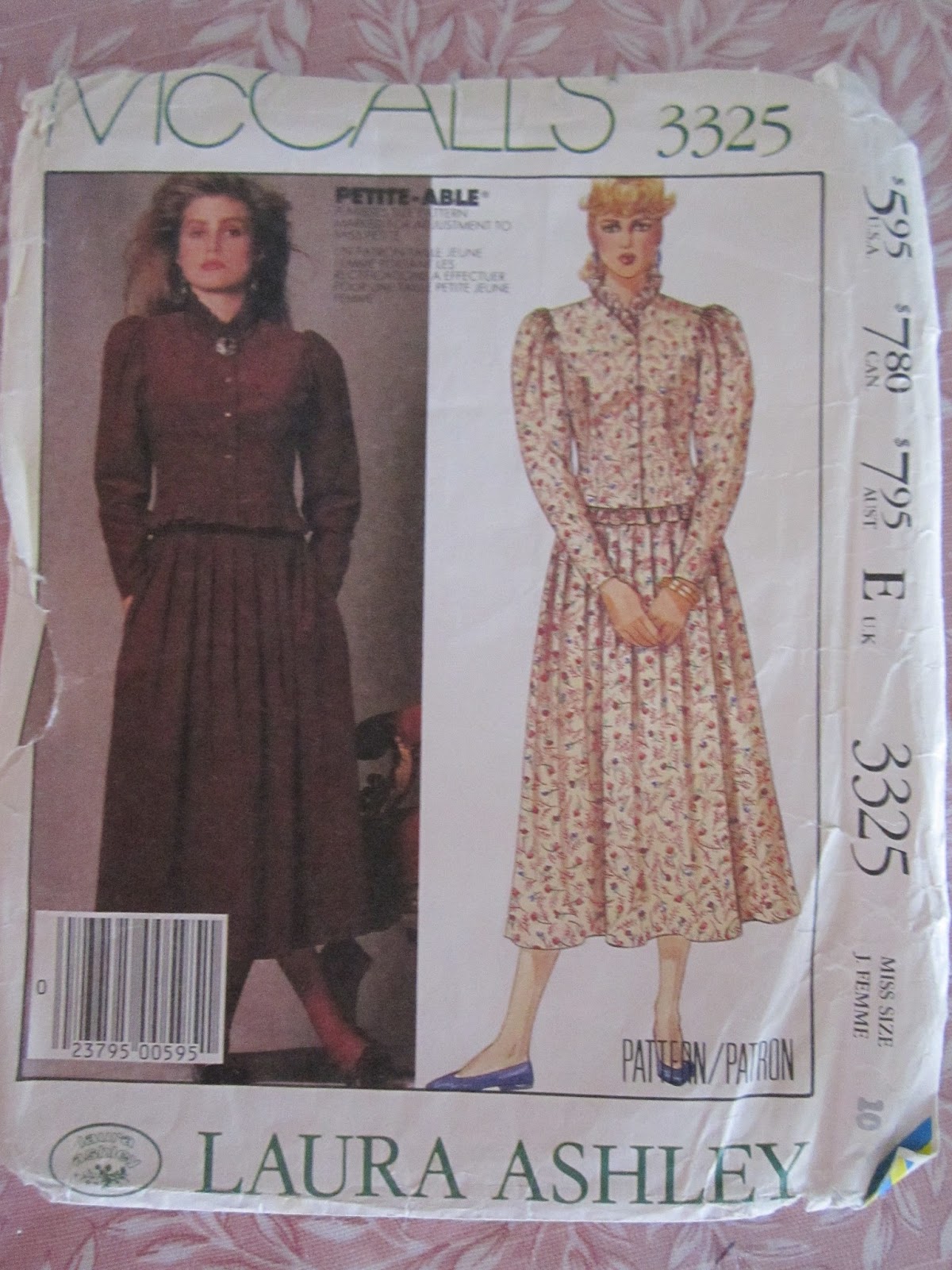
Here is the pattern I used,
and here is the sleeve. I like it because it has a sleeve facing at the wrist, and I could add piping there, too.
In case you want a puffed sleeve or wider sleeve from the existing pattern you are using, just down the top middle as shown in this rough drawing, and open up the cap of the sleeve pattern. Lay it on the fabric and cut around it. Add gathering stitches and pull them up to match the armhole.  A sewing hint: the double notches on a sleeve indicate the back of the arm, and the single notch is the front.  This comes in handy because a "foreign" sleeve from another pattern can be confusing. Just match your double notches to the double notches on the back dress arm hole, and the single notch to the front of the armhole.


There has been a discussion going on in my home about the way people dressed in the 1950's.  We did wear jeans, but only for farm work or to play in, or under our dresses in the cold weather. We were embarrassed to be seen in them and if we had to wear them under our skirts in the winter, we went to the ladies room at church and took them off before we entered the assembly to worship.  

At airports we dressed up to meet someone who was coming in, but also, we chose our outfits carefully for travel, and even wore gloves, although not always hats.

Around the home we had more casual wear but it could suffice if we had to go to the hardware store or the grocery store. All we did was remove our aprons. If we thought our house dresses were too sloppy or worn, we did not mind changing into something better.

It was considered respectful to dress up to visit someone in their home. I remember as though a line was drawn between the dates, the first time I saw young women show up to a formal event in jeans, shorts and sweatshirts. It was greatly disappointing because the lady who hosted the ladies tea had such an elegant home and it was such a privilege to be invited there.
There is a "pink lemonade"
 collection at Chadwicks, including tennis shoes. A pretty white blouse under this dress would be nice, or a cardigan sweater or blazer. This is another one of the garments I hope to make soon, for just a few dollars, including sleeves.


Monday, April 01, 2013

Adjustments in Life

The Doctor and the Doll
by Norman Rockwell

All my life I have had dentists, optometrists and doctors who were much older, and it was a source of confidence and comfort when I was younger. After my dentist, a military veteran, retired,  it amused me to see the young dentist who took over his practice,  looks like an 18-year-old. I am sure he is much older than that, but from my vantage, he looks very young.  He is very capable, though. 

 I do miss the stories of my previous dentist, who always had something to say about his experience in the military. He once described it as "hours and hours of sheer uneventful quiet, punctuated by sudden spurts of terror."  I smiled and answered, "That sounds like being a mother!"

I told this young dentist that I had to come in regularly to see if he was growing any older, since I see no signs of age.

I left a good review on the web after my last appointment. I had been quite apprehensive because it was serious surgery and I was relieved that it went well.  Later, when he and his wife saw my husband in the grocery store he told him that if I had any pain or any complications from my recent dental surgery, to be sure and come back in to his office.  Maybe he read my review.

It is still taking some adjustment on my part, to the new kids coming up in the professional world. I do admit they are expert in what they do and besides that, have the advantage of the latest technology and discoveries in the medical world.

The Rockwell painting of the doll doctor, reminds me of a relative who went into the doll-repair business. He and his wife had a little shop, where they repaired and sold old dolls they bought, many of them valuable antiques.  He wore a white jacket with a name tag, which said "D.D.S."  meaning, "doctor of doll surgery.  He replaced many an eye and fixed numerous joints on the jointed dolls, and even replaced hair.  

One day he had to visit his mother-in-law who was in the hospital, so he left right after work, wearing his jacket and doll surgery name tag.  As he left her hospital room and was walking down a long hall, someone stopped him and asked him if he would check on their mother, too.  He said he would, and he did. Someone who was also visiting asked him to visit someone else on the same floor of that hospital. He had a hard time getting out of there because people thought he was a "real" doctor.

Saturday, March 30, 2013

Beauty Lifts the Heart


I was given this lovely magazine, which contained no bad news ;-)

It featured photographs from Carolyn Aiken, of Aiken House and Gardens, listed on my blog roll.

I was particularly interested in the hay-bale cottage that the magazine featured. The owner shared how it was built.

I am blogging for the first time from my ipad, so I will make this short before I start messing things up.

If any viewer uses an ipad to blog, would you please leave a comment and tell me how to get the writing underneath the photographs, rather than on top.  I had to use my regular computer to straighten it out.

I do plan to post about the Passover and the Resurrection, after the sermon tomorrow.

While we do not know the exact date of His birth, we can just about calculate to the day, the time of his death, burial and Resurrection, as there is so much historical proof, and ways to count the days from the Passover, which Jesus celebrated when he was giving instructions to the Apostles, for observing His memorial, in the upper room.


Wednesday, March 27, 2013

Discretion

Woman Reading
by  Ricardo Lopez Carera, Spanish, 1866-1950

There is a great post on the blog, Adventures in Keeping House about discretion.  I am going to be discussing this subject in light of the New Testament in the Ladies Bible Class tomorrow. The author of the blog  has provided a definition of the word "discretion" and explained it at length in that post.

The discretion issue is something that is of prime concern for many people because it is like an endangered species; it is fading from practice. Discretion is a worthy and useful quality of the personality for everyone, but I would like to address the problem of women and discretion.

Proverbs 11:22 states that a woman without discretion is like a ring of gold in a swine's snout. (Put your finger over the verse citation and the verse will pop out.)  This means that some things will just not cover up bad manners. A woman can be properly dressed, have the latest hairstyles and her nails all polished, but if her speech is not polished and she says every crude or shocking thing that comes to her mind, it is just like dressing up a pig in jewels.

Discretion shall preserve thee; understanding shall keep thee. - Proverbs 2:ll


Woman in Pink Dress by Roberts
from the Australian National Archive

Discretion shall "keep" you means that if you acquire it, you'll be protected. In the prevailing culture around us, it is considered healthy to express things that would have gotten you a sound punch in the nose, back in the day, or "way back when."  Now everyone must be so honest that they speak things that are personal, even about bodily functions, that even 50 years ago was so unacceptable that if spoken, could cause the loss of a job, the loss of social acceptance or, in some cases, the loss of a fiance'.

The acquirement of discretion  should begin when a girl is young, but if her character training has been neglected, she may still, with determination and honesty, learn how to be discreet.

You can almost see the word "secret" in "discretion" and guess at its meaning: it is a quality of being quiet about some things that are not appropriate to speak of.  Lack of discretion is to cast all caution aside and speak of things that are offensive or are not appropriate for young ears, or that may be of a sensitive nature towards those who are suffering, or who would be embarrassed.
Ramparts
by Perugini


For some, just looking back at the previous century and the people's sense of decency will make them realize that we are slipping too far. Without any knowledge of past polite customs however, we still have the guidance of  the Bible on the subject of courtesy and propriety, good taste and upright behavior.

 There are some people who object to manners being taught because they think they are stiff, formal rules, but the Bible says to be courteous and tenderhearted and loving. I Peter 3:8

At the Garden Gate
by William Affleck


 Things that show lack of discretion are:

1. Subjecting others to embarrassment by not covering yourself appropriately, exposing too much: dressing immodestly.

2. Asking too many questions of a personal, or even impersonal nature, that keeps another person on the hot-seat trying to get the answers.  Questioning is not always healthy, and can make another person feel very burdened.  Questioning can become like cross-examination and make another person feel he is being put on trial. This is a type of impertinence.

3. Impertinence: This means to go beyond the limits by being pushy, demanding, or improperly forward. Forward is a word not used as much as it used to be. It was considered forward if a girl asked a boy for a date. It was considered forward if someone asked if they could come to your house for dinner or to ask for a gift.  It was proper to wait and be asked.
The Young Gardener
by George Leslie Dunlop

4. Impishness: Annoyingly playful, thinking you are cute, while saying things that put others on the spot, or that are witty and even base, and can be perceived as naughty and trouble making.

5. Impudence: The 1828 dictionary describes impudence as: not attentive to the consequences of words or actions; rash; heedless. The imprudent man often laments his mistakes, and then repeats them. Other dictionaries describe it as  a brash and brazen way of speaking and acting towards others. This is similar to pushy, arrogant behavior, as well as thinking you are awfully cute while you are doing it.

6. There may be a word for this, but I cannot think of it: the habit of making hasty, sharp replies. This can be perceived as a sudden rush to judgment of a matter before you have fully taken everything into consideration.

7. Imposing:  To lay a burden on, to obtrude (push) fallaciously (expecting something from someone, deceitful, misleading.)  Imposing today means to push your self on someone or take over something they are doing, or try to be the center of attention.

Training in discretion takes place best from childhood, but a habit can be broken, once the heart is penitent, the mind is teachable, and the soul is yearning for God.

To gain the quality of discretion, do a word-study of discretion from the Bible and write about your understanding of it in a notebook or journal.

Eugene de Blass


Acquire instead:

Innocence: Purity of heart, blamelessness, not guilty.  These words carry significance because the secret to being and looking innocent is to be blameless and free from sin.  To acquire innocence even after you have lost it, you can apply yourself to living in a pure way. In speech, do not use innuendos, tell off-color stories, or make teasing remarks that refer to bodily functions or private acts.  Living an innocent life will require removing things from your life that cause you to stumble spiritually, and things that pollute your mind and take you away from the joy of the Lord.
Afternoon Tea
by George Dunlop Leslie


Composure: When a person learns to live an innocent life, free from cynicism and suspicion, there will be a change in their composure. Composure is  similar to countenance, which the Bible speaks of. In Genesis, God warned Cain that if he would conquer his temper, his countenance would be lifted. Countenance refers to the expression on the face, including the look of the eyes, the smile, the set of the jaw. It can either be hardened or it can be sweet and innocent. Composure is effected by the way we think and live, so if you want a good composure, practice living innocently.  Think of the word "pose" when you think of composure, and it will help you understand how to be at ease around other people without being too casual.  Composure is closely connected to discretion. A discreet woman will be cautious about decisions and words and other things.

Leslie
by George Dunlop Leslie

To practice discretion and courtesy, avoid the "so-what-is-it-like" questions, as in the following:

So, what is it like to have a miscarriage?
So, what is it like to lose your house in bankruptsy?
So, what is it like to recover from_______?
So, what is it like since your son/daughter left home?
So, what is it like to be married to a man so much older than you?
So, what is it like to be a homemaker and not get a paycheck?
So, when are you going to retire?
So, what is it like, being a widow?

There are hundreds of these kinds of questions, which can be offensive to some people. You may think that asking what it is like to be retired is innocent, but it is better to allow people to voluntarily introduce the subject themselves, when it concerns them, rather than bring it up.

Why be discreet?

The Word of God impresses us that we must.
It protects the reputation of your family.
It protects the reputation of the local church to which you belong.
It protects the reputation of the church, worldwide.
It protects your children from growing up with a stigma upon them.
It protects your own credibilty and the trust others put in you.
It gives you dignity and preserves your reputation.
It protects the reputation of your children in the future.

As Proverbs says, discretion will "keep" (preserve, guard) you.

A discreet woman strives to be careful with her questions so that they do not make the other person feel uncomfortable or feel that their privacy is invaded.

In previous centuries during times of political danger, there was a saying: Loose lips sink ships.
This saying might be used to explain discretion more accurately. Sometimes we need to keep things to ourselves. Do not tell people where you keep your valuables, or even how much something is worth that you own, if it has a lot of value.  Information that gets to the wrong ears can be used as a temptation against you. You may tell a friend, but think of that friend telling someone else, and you will see how it could damage you.
Telling everything you know about the location of a ship during war, can cause the ship to be sunk when the enemy gets a hold of the information.

Another example that will help clear up any misunderstanding about discretion, is the one where a young couple wants to buy a house. They confide in friends that they are wanting to buy this house but have not made up their minds yet. They like the house and they like the price and really think it is a bargain, and express that they can't believe what a great opportunity it is to buy it. Behind their backs, the friends they confided in, buy the house, "right out from under them."

Young people need to be careful not to divulge to friends about their father's place of employment, the amount of money he makes or his status or his personal history.  Parents are very sensitive about the things their children say about them, and every child should be taught to be discreet.

Tuesday, March 26, 2013

From the Heart of Babes


Desinare Della Vedova   (Dinner for the Widow) by   Gaetano ChiericiItalian, 1838-1920
Please click here for a detailed view of the painting and then click on the painting again at allposters.

Today I have an interesting true-life happening to relate.  As you all know, a few days ago,  my father, a WW2 Veteran (USS Enterprise) died at the age of 87.  Anyone who loses a loving father will understand how hard it is to conceal the grief and loneliness that is felt.
Joe Brooking McGaughey in navy uniform, c. 1943 or 44
(b.1926, d.2013)
The name is pronounced, "McGoy."
Most people called him "Joe-B", and I often wondered why. I suppose, at the time, there were so many Joe's in the United States, that it was nice to be distinguished by having a "B" connected to your name. In some circles, if someone shouted "Hey, Joe!" half the men in the room would turn around and stand at attention. He was a painter of boat and sea-scenes and was related to the English marine painter, Charles Brooking.  Middle names were often chosen to preserve previous family names or maternal family names, and one of his grandparents was a Brooking.  My father was from a Texas family and learned to be resourceful through hard work and hard times in Texas. His father had been a cotton and cattle farmer.


My 6-year-old granddaughter told me how sad she felt, too, because it meant that when her grandfather was old, he, too, would die, and later on, her own father would die.

 She asked me, "When is your father's funeral?"  I told her it was on Thursday.

She then said, "I will wear my pink dress and I will bake a cake for the family."

"Oh, no, dear," I corrected her:  The funeral is in Australia on Thursday, and we cannot attend, because it is too far away to get there on time.

At this point she wept. 

Then, she asked, "Why can't we have the funeral here?"

I had been resigned to a grieve-as-you-go, existence, crying intermittently while doing housekeeping, laundry, dishes, cooking, and sewing.  This was the way I always had to do it, because my side of the family was never nearby. That is the way it was for a lot of women of my generation, especially if their husbands had pioneer spirits and wanted to travel far away from home base.

I argued with this little girl, back and forth a few times, offering my objections, showing how it was impractical. She would not accept it.

"We can't do it that way," I said, to which she responded: "We can."  She then began to collect the flowers in a vase, pick out her dress and hang it out to wear, and name the kinds of things she wanted us to prepare.

"That is a wonderful idea," I said.  "We could all choose a time to call all the relatives that live in this country and have a memorial for him in our living room!"

"No!" she said, "I want a real funeral like the one we gave to our friend, Judy.  I want flowers and singing and praying and a funeral sermon, and a meal provided for the family, just like they did for Judy's family."

I thought on that for awhile.

Because I was married to a minister who located us in far-away places, the congregations we served never knew who my family was. When my grandmother died, it was noted in one typewritten line in the church bulletin. It was too far away for me to attend the funeral or the memorial.  When my brother died,  it was announced during the announcement time when worship services ended.   

Other families in the local church had large funeral gatherings, listened to a funeral sermon (a funeral sermon is a speech designed to comfort the family), had the congregation sing the favorite hymns of the loved-one, listened to prayers that were offered, and then to a multitude of speeches about the character of the person, including special memories.  

Vases of cut flowers, and plants, filled the auditorium on these occasions, and sometimes our family was invited to take some of them home with us.

I began to think about why a "real funeral" is offered by the local church to the families of the deceased church member. It has a way of reassuring the ones who are left behind, and giving peace to the ones who are severely shocked and grieved.

My husband agreed with our 6 year old granddaughter, and he prepared his funeral sermon.  She busied herself trying to help the plan along.  A time was chosen for us to meet in the church auditorium. I gathered up the things that a normal grieving family would have taken to a funeral: photographs, things he made, letters he wrote.

A meal was prepared for a crowd of people, including punch, hot rolls, casseroles and salads. The table was arranged with the same care we always took for other members of the church. My 6 year old granddaughter did bake a cake for the family and placed it on a fancy pedestal cake plate with a dome. While she was helping to prepare food and gathering flowers, she said, "This will be the first funeral I have helped with."  She has grown up going to the funerals of the families of the church members and it has impressed her. She knows it is a loving thing to provide a meal for the family.

I rose early to unlock the two great doors of the large meeting house where we assemble for worship on the Lord's day, turned on the heat, turned on the lights, and set out the banquet supplies: plates, utinsels, napkins and punch cups.

At the funeral, although there were only about a dozen descendants in attendance, my husband preached the funeral sermon, saying we were here to honor the passing of his father-in-law, who died 2 days ago.  He related his own special memories of him and the conversations he had.  We chose the hymns he taught us when we were growing up: Jesus, Saviour, Pilot Me (my father was a seaman much of his life), and "Let the Lower Lights Be Burning."  Prayers were offered. Family members related Skype camera conversations with him and letters he had written, and personal experiences when visiting him.

Afterwards, we adjourned to the fellowship room, where a dinner was prepared for the family, and more conversation about him ensued. Then, there was the clean-up time, with washing the dishes, wiping the tables, covering the left-over food, and taking out the trash, the same way as any other family in the church at a funeral.

Since I had never experienced a funeral of any family member, I can say that now I know why we do this for the family. It does make some difference in the unsettled feeling that comes upon a grieving person. It is an acknowledgement of their passing, which is much different than just one line in the church bulletin, or telling someone you are sad today because you just heard your grandmother or brother died.

The service was video-taped to share with other relatives. I showed the whittled pegs he had made for nails to build the log house, called "the big house", in Alaska. The house was so well put-together, with no nails and no fastenings other than those carved wood pins, that when it was bulldozed down over 50 years later, it took several attempts before the remainder of it would even budge or come apart.
Some of my father's whittled pegs were very long. Here are a few shorter ones that I got out of the logs from the house he built. I plan to put these in special boxes to give as gifts for family members.  

Joe Brooking McGaughey (1926-2013) in Alaska on his "cat" looking thrilled to have started his own landscape business in the late 1950's.


I wanted to relate this because of the inspiration of this little girl. I hope in some way it plants a seed in the minds of people who are far away from their loved ones, to have normal ceremonies. In fact, I once planned a baby shower for a young woman. She, at the last minute, could not come, so I did not cancel it. The guests all shared the sandwiches and tea and enjoyed placing their gifts in a new laundry basket for the mother. (When you have a baby, an extra laundry basket is much needed.)  We went ahead and used the balloons and decorations, and enjoyed the event. Then we packaged up the favors and some of the foods, the gift bags, the flowers,  and chose someone to take it all to her house.

There are some things we do not have to miss-out on. It is a matter of thinking a different way.

I chose the painting, above, for several reasons. It looks like the mother is in grief and hardly able to focus on anything else, which is the way a grieved person feels. Sometimes tears flow so constantly that it can bring on illness. Sometimes you lose your appetite, or everything tastes like brown paper bags. Not that I've ever eaten brown paper bags, but that nothing has a flavor when you are in grief.   When death has come and taken our loved one, the earthly matters hold no value, and keeping house when your husband or child has died, does not seem to have a point.  The painting above shows the mind removes itself from the physical things of this world. The loved one is in another world, and the grieving widow is left in the physical world, yet is thinking about where her husband is.  The oldest girl looks like a 6-year-old looking for the brightness and goodness in life, yet somewhat connecting with her mother's grief without being quite as devastated. This is probably one little girl who would suggest that they put flowers on her father's grave.

If you save the picture and then use a magnifyer, you can see more details. In the background you see someone who might be the widowed mother and grandmother. Both women are thinking about their loss. They are there with the children, having dinner, but not really strongly focused on life at home. This really does happen in grief today.