Friday, September 09, 2005

Visible Success Part 4


I read about a woman who lived alone back in the early 1900's. Her relatives never thought she had done anything remarkable with her life, but after she passed away, they discovered in her house, stashed in the spaces between the walls, hundreds of beautiful oil paintings. They did not know that she was an artist. She painted for her own pleasure, and apparently did not want anyone to know about it. I thought this was remarkable, since some of our lack of motivation to do beautiful things in life, is due to the fact that we think we have to have approval, encouragement, and guaranteed success. We are so conditioned to having others agree or approve of our lives, that we often fail to do anything at all.

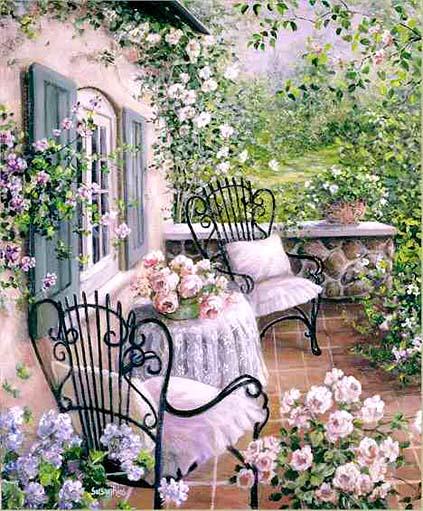
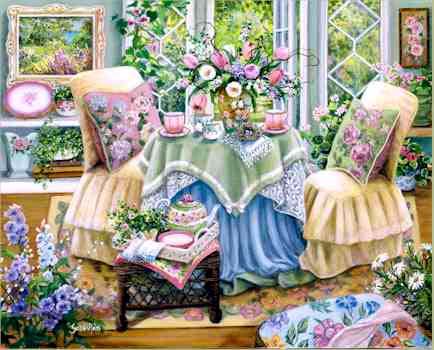
This is another painting by Susan Rios, called "Spring Tea" which you can purchase as a print at www.piersidegallery.com I like her attention to detail in the rooms in which people really live. I think if young girls gazed upon paintings like this, they would grow up holding the home in high esteem, and want to be keepers of, guardians of, and guides of the home.

Color and light are so important if you are spending most of the day at home. Dark, dreary rooms can really cause depression. You should have at least one room in the house you can sit in that has the right colors for you. You can tell what colors , objects, and styles help improve your mood, by the way you feel when around them. If they make you smile and if they make your heart sing, you know they are for you. The same can be said of other personal things like clothing, table settings, views, music and so forth.

Visible Success Part 3


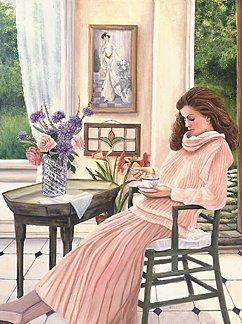
"The Sitting Room" by Susan Rios from Pierside Gallery online, is a great painting which in my opinion depicts the love of the home. Women who love their families and their homes, pay attention to details, such as the way a vase is placed on table, the choice of comfy cushions for one's back, and the co-ordinating colors.

There are many routine things that never seem to be completed, or long-term goals that seem impossible to attain, and that can be very discouraging. One habit that is good to have, is to give yourself little "success perks" throughout the day, so that, even if the major jobs are not finished, you've enjoyed small successes that will keep you from feeling defeated.

At the arrival of each paycheck of the family income, I would strongly suggest putting aside an amount for hothouse flowers for the month. I've heard of clubs you can belong to, whereby you pay so much a year to have the bouquet of the month delivered to the home. Such a living treat can bring great joy to the homemaker. If you don't like flowers, use the money for some other weekly enjoyment. Don't live in depression. Give yourself a present every day.

With so many women staying home these days, one of the most needed services, in my opinion, is interior decorating and organizing. There are now "organizers" that you can hire, to come and help you function in your home more efficiently. It would be nice if there were also people who would come once a month and help arrange and decorate or improve one area of your house, be it a pantry, the refrigerator, the desk, one wall, the coffee table, or anything else.

There are book clubs that base their success on their many free offers. If you join, you get 3 free art and craft books, provided you agree to buy 2 more, throughout the year, or something like that. Wouldn't it be great if someone would invent a nation-wide business of interior-decorating, with the same scheme: you get 2 or three free perks, provided you agree to pay for 3 more decorating, cleaning, or organizing jobs throughout the year, at an affordable price. It seems that the only people who can have re-decorating or decorating done for their homes, are the very rich. While keeping the prices within reason for the average homemaker, this could possibly be a profitable business for an enterprising person.

In England, there is a company that people can subscribe to, which sends out little gifts and helpful things to the homemaker, each week. I think this is a wonderful idea, but there is nothing wrong with rewarding oneself with something to enhance the home.

Visible Success Part 2


This picture is called "Sharing the Gift" by Susan Rios, and goes well with the theme of making room for wholesome, instant pleasures in daily life. Purchase this on the web at www.piersidegallery.com

There are some things that we can do daily to give ourselves and our families some instant success and feel like we are truly living life, rather than just hoping for something interesting or dramatic to happen "someday."

I believe that God daily provides simple pleasures for us to take that we, in our earnest quest to find something "important" overlook.

The easiest and most obvious place to begin to improve life, is in the dwelling place. Three simple things might help:

Clean it, decorate it, and share it. People love seeing how someone else has "done" their home. Home interior videos are sought after, for personal inspiration, and home interior sites are some of the most visited places on the web. You've heard of house tours. You can film "before" and "after" segments, and use them for future teaching. Young girls in high schools long for beauty and inspiration in their lives. You never know how your influence might spread and what cheer you may put in the heart of someone who needs it.

Simple, inexpensive ways to get the instant lift you need when you think you need something in your life at home are:

Light a scented candle...buy several hothouse flowers and put them in a vase...drink from a pretty glass or cup...go to the dollar store and get a new frame for a photograph...paint one wall each day... clean up your yard...decorate the front porch and front door...buy a special laundry detergent...mop the kitchen floor with a berry-scented detergent...dress up even if you aren't going anywhere...write a poem...sing all the verses of a hymn...write a story of the fantastic day you would have liked to have...sketch a picture of something in your house...rent a good movie and invite someone over to watch it with you...send a "thinking of you" card or a note of appreciation to someone.

It isn't wise to go for long periods without success. To much disappointment can really dull the soul, so be sure to add instant success moments to your life. It reinforces the fact that life is good and beautiful and joyful, and worth living. As the writer, Thoreau said, "Do not despair of life. You have no doubt, force enough to covercome your obstacles. Think of the fox, prowling through wood...for something to satisfy his hunger. Notwithstanding cold and hounds and traps, his race survives. I do not believe any of them every committed sucicide."

In talking to a very depressed girl recently, who suggested it might be better to die than face the days ahead which offerred nothing better than dullness, I suggested that if someone should attempt to choke her, she probably would do everything in her power to resist! We don't have to endure daily failure. We can treat ourselves much better than we do. There are any number of things that can help relieve daily routine and give us the meaning in life that we are supposed to have.

One woman I met, years ago, sent an invitation to an "open house" at her own home. It was such a success, that the next year, others asked if they could have an invitation. She then began having one each year, much to the delight of those in her sphere.

See part 3

Visible Success (Part 1)


The painting here is from the site which sells Susan Rios paintings. The story that goes with it suggests that the house is ready for guests that will be arriving soon. While she is waiting, she gives the entry to the home a last minute touch. Visit http://www.piersidegallery.com/artists/rios/ for more of these wonderful paintings of homelife, which can be purchased online.

Most people live with lifetime plans and dreams always lurking in their heads. To some, it becomes pure frustration and torture when, year after year, their hopes and plans meet with failure. Sometimes, not only do our life purposes and desires fail to be fulfilled, but while we are hard at work to realize those dreams, other areas in our lives seem to deteriorate or get bleaker.

A person can experience some instant fulfillment of something in their life, through the often overlooked avenue of the dwelling place.

Most people have a place to live, and even those who do not own their own homes, have a place they call home, in which they are free to behave and live as they please. Our problem is, that sometimes we think that fulfillment and accomplishment has to happen somewhere else. We come home only when we don't have something "better" to do. What a pity, it is not the opposite--that home is the place we can think better, work better, and be nicer people.

This wonderful place, be it humble or grand, can be the source of great success right now. It is a place where you can be your own boss. It is a place where you can store your stuff. It is a place where you can think and dream and create without dictation.

The house is the easiest thing to re-create. You can always

Clean up the clutter,

Wash things, dust things, wipe the picture frames, and make things sparkle,

rearrange something,

set the table with the best you have, (whether a meal is being served or not)

bake something, and

invite someone over to eat it.

Goals like losing weight, rennovating, living in the house in the country you dream of, building a career out of your hobbies, or becoming a mentor can take loads of work, waiting time, patience, and persistance, but there are a lot of things that take place in the home, which can give you instant success...no waiting.

See Part 2

Thursday, September 08, 2005

Distinctive Dress


From Mary Brooks Picken's book, written in 1918:

"In giving instructions to classes of young women interested in knowing dress in its highest sense, I have frequently found it helpful to suggest hat they dress up their friends, and you may do the same with profit. Take some member of your own family for instance, your mother, and design for her a dress that expresses her motherliness--her type. Then, choose a color that will help make her hair appear the softest and her eyes the kindliest.

Try this. You will find it easy to think of the color and plan the fabric, for, usually, the material most suitable for one's mother has a smooth surface, is soft in texture, and is subdued in color.

When you begin to consider her figure, you may find that the bust and hips are large in proportion to the height, that the hips are large in proportion to the bust, or that the back length is long in proportion to the front length. Then you have a problem of lines.

For many years, mothers who have acquired a little more flesh than is becoming have found it difficult to procure appropriate clothes.

Manufacturers of stout women's apparel have frequently said: "Camouflage the stout woman"; that is, get materials that have large figures and indistinct colorings in patches so that the silhouette of the body will not be in evidence and that the optic nerve will not be able to conceive how large the figure actually is.

But few would like to camouflage their mothers as regards dress. They would rather have a dress simple in color and design and plan it to hang from the shoulder--a dress that has a soft belt coming around in a way that will give length to the waist line and not tell every one precisely within one-fourth inch where the waist line begins and where it ends.

One girl who tired this method fo learning lines designed some dresses for her mother, who weighed nearly one hundred and eighty pounds and was only five feet three inches in height.

One of the most successful dresses that she made was of silk, a maroon-and-taupe stripe. The stripes were irregular, and there were two maroon stripes to every one of taupe. The dress was made in Russian-blouse effect, with a simple straight skirt, the Russian blouse coming almost to the knees. A long collar of flesh-color crepe was used for the front, coming down in a V. The sleeves were close-fitting, with a little plain cuff of crepe. The waist line was finished with a belt, the stripes encircling the waist, a maroon stripe in the center and a taupe one on each side. The belt, which was narrow, crossed in the back and looped at the left side front. It went around the figure twice--at the normal waist line and below it--and thus gave length to the waist line. Its crossing in the back took away the severe plainnes of the back, and yet did not interefere with the length.

The plain, straight sleeves did not emphasize the heaviness in the arm, and the crepe collar gave just enough coloring on the face. The line of the collar gave a long neck line, which helped avoid emphasizing the roundness of the face.

When this woman sat down in this costume, it was graceful and comfortable. The lower skirt fell gracefully down to her ankles, making it much more pleasing than if she had had a tight skirt that would draw up around her figure. This girl--this designer--knew that a dress should be as beautiful when the wearer is sitting as when she is standing.

So becoming was this dress for the mother that the daughter made some house dresses of chambray, gray-and-white stripe for one and blue-and-white for another. But she clung almost slavishly to this one design of dress. She gave as her reason, "I know it is best."

She did not cling to stripes, however, because I once saw her mother wearing a very dark-blue silk that was just as pretty as the stripes, but the lines of the dress were almost identical with the one I had seen made of the striped material."

Comment: If anyone will take the trouble to research the daily costume of Queen Victoria, they will observe that, although she was quite stout, she never resorted to sloppy clothing equivilant to the sweatpants, tee shirts, and flip-flops that many overweight women use as their uniform today. It is possible to dress well, no matter what your size. We need not add to society's woes by becoming lazy in our choice of clothing.

I recently learned from a friend, the story behind the "trains" that you see attached to the dresses in many of the paintings of women in previous centuries. The train is now usually only seen on wedding dresses. It was originally designed for the women in the nursing profession, so that they could bend over the beds of the patients, and do their various tasks, with modesty. That way, their legs would not be exposed when they leaned over. Interesting.

Clothing Distinction


From "Secrets of Distinctive Dress", written by Mary Brooks Picken in 1918

"There is a wealth of beauty in fabrics and they offer an excellent opportunity to express individuality and good taste in dres for the house, where so many people seem to think "it does not matter what you wear, so long as you are home." The simplest materials, such as the inexpensive cottons--voile, crepe, chintz, and zephyr gingham--lend themselves delightfully to home dresses.

I know a woman whose first-floor rooms are very artistically furnished in blue and gray, whose boudoir is in rose and ivory, and whose sewing room--"her workshop" she calls it--is in softest gray. This woman, with this attractive, agreeable home, finds it necessary to do a great deal of the work of keeping it up herself.

In the morning, she will come down with a little dress of unbleached, unstarched, smoothly ironed muslin. It may have a little cross-stitching of blue or a little soft lace collar, but it is so simple that it does not interfere with the surroundings, and no matter whether she is in the living room, in the dining room, or in the kitchen, she makes a pleasing picture.

In the afternoon, she may bein a little rose-colored or cream dress of soft voile, or it may be white, or it may be a light pink; but it is of a color sufficiently indefinite and of fabric soft enough not to conflict with the tints and shades and soft drapery effects in her rooms.

Comments: Homemakers today lead such full, busy lives, they barely have time to stop and think about what they are wearing throughout the day. To make things easier, I have an idea of wearing a basic and plain muslin A-line dress, or skirt-blouse combination-- or any non-iron, loosely flowing garment that does not cling or pinch, making movement easier in the myriad of tasks that must be done. At home, cover it in a colorful jumper-style apron that reflects your own likes and tastes. When going out in public, remove the apron and add a cardigan jacket that makes it look a little more formal or business-like. Later at home, when receiving visitors or relaxing in the evening, pull over a soft sweater, or exchange the skirt for one that is less practical and maybe more silky.

VALUE OF INTEREST IN CLOTHES


From a book by Mary Brooks Picken in 1924 titled "Harmony In Dress"

VALUE OF INTEREST IN CLOTHES

12. Giving Pleasure Through Costume -- Costumes have, like all successful things, a direct purpose. They are created to contribute to the charm of the wearer and to the grace of the occaison. A woman may consider herself fortunate, indeed, who can select her wardrobe so carefuly as to have a correct and becoming frock appropriate for each occasion.

Frocks should please one's friends as well as oneself, and the woman who wishes to express good taste in dress should vary her costumeas as much as her purse and good judgment will allow in order to avoid any possible sense of monotony.

13. Interest After Marriage. -- Then, when the day of days arrives for a girl and the trousseau is to be selected, only the best and most becoming garments are to be considered for this great event. However, whether the incentive to keep herself attractive will remain with this girl-woman depends largely on her character, or position in life, or both.

If she is a woman of the true-mother type, she will feel that it is not enough to win the admiration and respect of her mate. She must retain her spiritul and physical attractiveness in order to keep herself young in the eyes of the one she most desires to please. It is not enough to win if she lacks the desire or the power to hold what she has gained.

14. How can a woman hope to keep the joyful respect and admiration of her loved one if she allows herself to degenerate into frowsiness, to wear curl papers, caps, and mussy negligees all day long? Really, this condiion is not a stimulus to happiness. To come home day after day and find an untidy, unattractive woman, so entirely concered with the cares and burdens of the day that she has lost all sight of the need for keeping herself attractive, shoud not have to be the lot of the husband who has, perhaps, already had his share of a day's unpleasantness.

A prominent club woman, in speaking of her efforts to convince wives and mothers of the great necessity for keeping themselves attractive, gave many pertinent illustrations. She said that the broad-minded women in the group were deeply appreciative of the awakening it gave them; but other women resented it and decried the power of beauty and attractiveness, insisting that their husbands were just as devoted to them as ever and that they had no time nor money to spend in making themelves butterflies.

15. Means of Retaining Interest. -- The question pften arises as to why we lose this vision and sense of the true value of things. Why have we ceased to value rightly the great power and influence over others that lies in a pleasing appearance and a charming manner? Throughout all ages of human activity, we know that interest has preceded success; no matter how insignificant the task of the thing, we must think about it, plan for it, and some people say, actually "love it into being." We must be interested in being attractive to know all the virtues of attractiveness.

Occasionally we should go away from our families, familiar surroundings, and associates and get an entire change, thus renewing our interest in the life outside our own circle of interests. We thereby obtain a perspective of our own position that will help our vision and sense of values; and we touch new minds and new interests and realize more than ever the happiness to be derived from just being pleasing."

Comment: I feel sorry for this generation, that did not enjoy the feeling of distinctive clothing on their backs. No matter how poor we were, we always enjoyed getting used clothing, washing it, ironing it, mending and repairing it, and hanging it in our closets. We wore it with delight, adding matching clips or ribbons in our hair, a little decorative trim to our shoes and socks, and a smile. Contrast this today's "slop-chic," where a girl's clothing makes us draw a horrified breath of shock when she walks by.

Tuesday, September 06, 2005

The World Revolves Around the Home


"White Cottage Door" by Dwayne Warwick. Type in the artist's last name at www.allposters.com and see his other vivid paintings.

I doubt very much that people want to live in an office or a place of employment. Ultimately, whatever their career or other interests, people long for a home. It is interesting to observe, that much of the commerce we around us is centered on things to enhance the house and the life at home.

Saturday, September 03, 2005

Five O'Clock Tea


This picture can be purchased at www.allposters and is called "Five O'Clock Tea" by Mary F. McMonnies.

Wednesday, August 24, 2005

Here Because of Love

John Nash: 1994 Nobel Prize in Economic Sciences Acceptance Address

Nash: Thank you. I've always believed in numbers and the equations and logics that lead to reason.

But after a lifetime of such pursuits, I ask,
"What truly is logic?"

"Who decides reason?"

My quest has taken me through the physical, the metaphysical, the delusional -- and back.

And I have made the most important discovery of my career, the most important discovery of my life:

It is only in the mysterious equations of love that any logic or reasons can be found.

I'm only here tonight because of you [his wife, Alicia].

You are the reason I am.

You are all my reasons.

Thank you.

See also http://homeliving.blogspot.com/2005/11/powerful-equation-of-love.html

Guiding the Home Part 2


There are some people who have an excellent way of keeping the right focus on things, when explaining the Bible. They neither take it too literally, nor too liberally. Such are those who attempt to explain things concerning the role of women. There are those who would, in their attempt to justify insisting on sending their wives to work, say that the Proverbs 31 woman went to work. Based on the verse about her making things for the merchant, they insist that she sat in a shop all day and sold the things she made. Others say that she herself was so industrious that she stayed up late at night to make things to sell.

Some people would like it to say, "She runs from her job to the grocery store and daycare and plops into bed exhausted, day after day. At the end of a lifetime, her husband is proud of her because she helped him pay the house payment and the car payment. Without her, he would have lost it all."

My opinion is that if this woman were immitated literally, it would wear out one woman in just a few months. I've heard this passage explained as "seasons" or stages of a woman's life, and, as time passes by for me, I have discovered that this can be true. There is a time to be nursing your babies, and a time to be showing your children how to make things and sell them. There is a time to be looking after your mate, a time to plant a garden, a time to re-decorate, and a time to sew your family clothing. There is a time to be sick, and a time to rest. There are creative stages of one's life. There is a time to collect, and a time to stop collecting. There is a time to learn and a time to teach. One cannot possibly do everything in a lifetime that this woman portrays.

Some people insist that this woman was a real-estate agent during the day and stayed up in the night sewing. Instead of enjoying the painting, they are caught up in the brush strokes. This is just an example of a woman who does not waste time "hanging out" like many young girls today. She is concerned about how her family fares, and how her children turn out. She cares about her house.

The most sensible explanation I've heard on this, is that the woman represents the value of a woman. She is important not for the amount of income she brings in to "help out" but for the values and beliefs and standards she brings to the home. These are the things like thriftiness, wise use of time, beauty in furnishings and cloth, availability for helping others, and for teaching her children, and so forth. I don't think Proverbs 31 is about earning an income, as much as it is about having worthwhile goals and standards in life. Sometimes people try to read more into this passage than is intended, in order to shame women into thinking that besides taking care of the home and the children and husband, she should also be making some money.


The painting is called "Add a Little Love" by Carolyn Watson, and can be purchased at www.allposters.com.

What is needed, truly needed today, in the home and in society, is not more wage earners, but more love. When women left the home in pursuit of a wage, something very dear was lost. I feel sorry for the generation today that never knew what life was like when mosst women were home, investing in the lives of their husbands, children, parents, and church members. It would take more effort than I have time for, to describe what life was like in those days. There is an attempt to reproduce this and restore the family, for which I say hooray. It is truly a quiet revolution, that is totally without selfish ambition or love of money.

Monday, August 15, 2005

Guiding the Home Part 1


It is a very sorrowful thing to know that so many preachers have ignored the scriptures. Fearing loss of their popularity, or that the church income may diminish, (maybe from the financial contributions of the working women in the congregation?) they often design their sermons around the way people are living, rather than the way they should live.

One particular subject that is causing a lot of confusion is the question of women being at home, guarding the home, (these days, someone really needs to be there, to literally guard the place), putting their talents and time into homemaking and taking care of their husbands and/or children.

Many of these men are too young to remember the sermons that used to be preached on the subject. They don't know how this subject was preached in the past. Some of them came from homes where their own fathers were preachers, and their mothers worked outside the home. They've grown up in a world where the mother working outside the home looked normal to them, and the stay-at-home mothers seemed strange.

They didn't see the demise of the home, like many of us who are growing older, have seen, when women left the home to pursue careers. They didn't see churches where people grew up and married someone else in the church and raised a happy family. They didn't see a time when children who were rebellious against their parents were considered "delinquent." Now, it all is portrayed by the counselors and the schools as "normal." It is the parents, and particularly the wife, if she is not working outside the home, who are considered abnormal.

Some people who have had these family upsets, have gone to counselling, and been told that the problem was a financial one, and that the wife needs to get a job. There are even husbands who want their wives to go to work, because they want the extra money. They reason that the wife can have her own income, and the husband will be able to pay his bills better, or even get that boat or extra car or or trip he's been wanting.

Sometimes when I've been ill and had to be recumbant, I've given into watching some of the court drama t.v. shows. It is shocking to me, although the younger generation may think it is quite normal, how many men sue their wives because they didn't pay their share of the rent! Or, many boyfriends sue their girlfriends because they bought a car together and the girl didn't pay her share of the payments. Some men even divorce their wives because the wives won't get a job, lost their job, or cannot work anymore due to injuries or illness. You could quit school, and simply sit and watch those court dramas day after day and get an adequate education in how to live in order to be successful in life, e.g.:- Just don't get involved with people that have these twisted values. Find out what they believe, before you form any kind of relationship with them.

Its just terrible the way things are going. Some men don't have any dignity whatever, and it doesn't seem to bother them a bit that they are not only not protecting women, and not looking after them financially, but they are also suing them for not "paying their share."

When I was growing up, such a thing was unheard of. Almost all men, with any Christian sensibilities, had an intense pride in looking after women and children. They would have hid with shame, if they had failed in this, or if they had sent their wives out to work, or borrowed money. It would have been admitting they weren't good providers, and that, of course, is a standard that they understood from the scriptures. There is a clear command for the men to provide for their own. There is no such command to the woman. Her work, however, is just as valuable, which is the whole point of Proverbs 31.

In part 2, I'll discuss how people are now twisting Proverbs 31 to suit themselves, making claims about this example, that would justify their way of life. Even the preachers are doing it.

Check out I Timothy 5:14. Although some versions say "widow," the original Greek is "women."
This is the command to younger women, spelled out. For older women, see Titus 2. Ministers need to highlight these scriptures with a bright yellow pen.

I don't want to leave on a sour note, so I'll assure you that there is hope for the future, and that we can change things, and be an influence on future generations, to teach things that are true and lovely, and prevent this downslide in character, in our own families.

continued in Part 2.

Saturday, August 13, 2005

Folkwear Walking Skirt


This, and other patterns can be ordered from catologs like Folkwear, Harper House, Truly Victorian, or Past Patterns.

Friday, August 12, 2005

Burda Pattern 2493


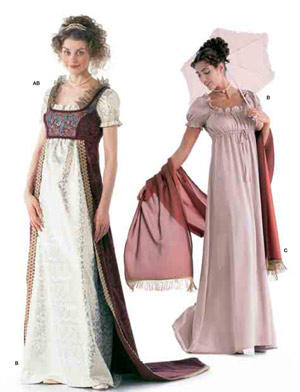
There is also a site called "Fabrics for Burda Patterns," with prices similar to local fabric stores. All my Burda patterns are in English, from JoAnn Fabrics. The pieces in the picture are included: the long vest coat, and the scarf. You will have to sew a muslin first to see if the neckline is high enough when you lean forward. Just add inches at the top of the pattern to get a more adequate neckline.

Thursday, August 11, 2005

Separate

The most commonly misspelled word on the web, I believe, is "separate." It is often spelled as "seperate," even on many savvy sites that sell merchandise. It is easier to remember the spelling if it is pronounced properly. Instead of saying "sep-ur-it," say "sep-are-ate."

Wednesday, August 10, 2005

Free Range Housewife


I know a woman who has taken her tiny yard and turned it into an English garden; the type that you walk around in just to settle your mind.

Her work is centered at home, where she guides the family atmosphere, family activities and social life. She guards the care of the home and monitors the family income so that they have a profit at the end of the week, instead of over-extending themselves.

She likes to find substitutes for costly things, and she enjoys doing things herself. Instead of paying money for baked goods, she has learned to make them herself, which saves paying extra for labor.

Rather than being confined to someone else's place of employment, or someone else's schedule, she has free range of her home and her life. She is free to come and go, as she feels necessary. She can rest if she feels a fatiqued, and she can be as creative as she wants with her yard and house. She has a car, which gives her the freedom to participate in things outside her home, that she enjoys. She particularly likes to quilt, so she loves finding fabric stores that sell interesting fabrics.

There are times when she likes having guests, and there are times when she doesn't want anyone to bother her. She is free to follow her preferences in that regard. If she were employed by a company, her time would be regulated by someone else, and her range would be limited to the areas dictated by the paycheck.

The penned up chickens have to wait until the farmer opens their door and lets them out to range freely and eat the fresh grass. The housewife is only limited by her own desires. If she sings, or digs in the garden, sews, prepares the evening meal, has company, or washes the clothes, she is still free. The choices of when and how to do them, are all made by her. Her drive, and her ambition, is to be the best custodian of her own home.

Anyone who has bought a home, after renting, will know the difference in the feeling of pride of owning something, compared to living on someone else's property. It is this feeling of motivation that the free-range housewife has. A person tends to take better care of things that belong to them, whether it be the lives of others, time, or property.


The painting is called "Cahala Lilies" by Donny Finley and can be purchased at www.allposters.com

Sermons from the 1930's


I was asked to write something about the principle of submission. I don't think I have actually written about this, since I felt there was already so much good material about it available in books and on the web. When we were growing up, we didn't really see it as a problem, as it was such a way of life for Christian women. Even those who did not embrace any religion, saw the power in submission and used it for good.


Personally, I have a lot more fun, and it is a lot more relaxing, to leave the theology and preaching up to the men and just blog about the solutions I have been finding to the many aspects of home life. However, this will be a theme article that will be placed on the side, so that I won't have to write any more about it.


So little conflict was there over this subject, that we never knew it as an "issue" that it has been made into, today. However, feminists will make an issue out of everything that they can, in order to keep conflict stirring; keep life unsettled, keep people nervous, and destablize the culture. To us, it just meant being kind and loving, being nice, not arguing about every little thing, not constantly contradicting your husband or ruling over him. It meant not nagging him or criticising him. It meant discussing things at length with him but leaving the responsiblity on his shoulders. It meant being a good advisor but not insisting on having things your way all the time, unless he left it up to you. It was a peaceful way of having a good marriage and cooperative children. Today there is so much heated debate over it that even preachers do not want to approach the subject.


This is a sermon copied from a sermon book that was published in 1947, a year before Peter Marshall preached his sermon, "Keepers of the Springs." There were similar sermons by other preachers, and in the 1960's, when the immodest fashions appeared and many women left their posts and went to work, some of these preachers were still alive and preaching. They fought the prevailing culture, valiantly. Many of them were ostracised by society for their sermons and some of them were forced out of the pulpit by change agents in the church.


This sermon was written 60 years before the popular books on womanhood were written. This is how people thought "in the olden times," and they did not apologize for it.


I was thinking back about how preaching used to sound and what preachers used to be like. They were strong and manly and bravely stood up to the impudence that was entering the church. The preachers sounded fierce, it is true, but the people were generally calm. Today, the preachers all sound like calm, soothing counsellors, and the people are uneasy.


from "Sermons on First Corinthians,"by George W. DeHoff, Murfreesboro, Tennessee , published in 1947 (preached in earlier years)


"Many women resent the idea of being subject to man. They think it is a great thing if they can act like men. In this, they are wrong. Nothing can be sweeter than a womanly woman. Nothing is more repulsive than a manly woman. A woman who tries to be like a man is a disgrace to God and man.


Today,, many women think it is wonderful to smoke like men, curse like the men, drink liquor like the men, wear clothing like the men, and cut their hair like the men. Woman is sweeter and more precious than man. She is superior in a great number of ways. In attempting to be like men, she issimply coming down from the lofty pedestal of a queenly woman and becoming a second-rate, bareheaded, bobheaded, cussing, smoking, beer guzzling imitation of what God would have her be. It does not take a preacher to say these things. I hear unsaved men from one end of this nation to the other saying the same thing. Even worldly men are alarmed at the place to which women have fallen.


The Bible teaches that a man cannot do as he pleases. He is subject to Christ. He cannot live as he would like. Christ is ever uppermost in his heart and life. He puts Him first in everything.


The Bible also teaches that woman is subject to her husband. She loves him, puts him first, her whole life is bound up with his, and she is ever anxious to honor and respect him. The Bible teaches that man was created first and the woman was taken out of him (Genesis 2:23). The husband is to rule over his wife (Genesis 3:16). The idea of inferiority being taught here is just plain nonsense. The man is to protect and defend his wife. It is his responsibility to care for and "give honor unto the wife as the weaker vessel" (I Peter 3:7). (This is a great sacrifice on the part of the man)


The woman who marries a man, takes his name. Young lady, do not marry a man unless you are proud to wear his name and accept him as your head. Otherwise, it is far better to remain single where you can run things to suit yourself!


Lest someone rebel at the idea of subjection, Paul reminds us that Christ is subject to God. He humbled Himself. He became for all eternity subject to God. It is His glory to fill that place of subjection. Just so, it is a man's glory to be subject to to Christ, and a woman's glory to be subject to her own husband. Those women who would have it otherwise may do so, but they will not have happiness, nor will they have the respect of right thinking people."

Monday, August 08, 2005

Home Away From Home


Almost every married couple has stayed, temporarily with a set of parents, for various reasons. Whether it be waiting inbetween moves, economics, or care of the elderly, here are some ways, from my own experiences, to make it pleasant and less of an inconvenience on all sides.

On the part of the new bride, it can be pretty depressing not having your own place, with your own things about you. That being said, I'll move on to something more positive. The in-laws or parents may look at your visit as an intrusion into their privacy, and a strain on their resources. They probably do not have the energy they used to have, and this might make them uneasy and critical. It isn't easy to accommodate someone else in your home for an extended time.

In view of that fact, I found the best way to get along is to be of some use, if you can. I was good at reaching up to cabinets and places that my M.I.L. could not get to. She looked forward to my coming, because she knew I would wash and wax her old floor, and clean her cupboards that she never got around to cleaning. I got the idea when I was staying with her, that I wanted her to give a good report about me, and be able to tell her friends that she really missed my help and my companionship, so I set about to making her life at home easier, while I was there. I could hang out her wash, wash dishes, clean windows, and do a lot of things that would spare her time later on.

She loved for me to sew for her, and always proudly wore my hand-made dresses. I found that the more positive things I did for her, the more cheerful and optimistic she became. My main objective was to make sure that her life was made better by my having been there. I'm not saying it was all pleasant. Sometimes an irritation would snap be back into realizing what my mission, while there, really was.

My own son-in-law lived with us for a period of time, also, and although I missed my leisurely ways, and found it very taxing, and crowded, I noticed that his attitude was to bless our family by his presence. While he lived with us, he installed a new faucet that had a long neck so that we could get larger things into the sink. He built shelves above the windows in nearly every room. He bought us an air conditioner and installed it. He made us a skylight in the kitchen, and added a room on to the house almost completely by himself. Now, everywhere I look, I see evidence of his visit, in the repairs and additions that surround me. Even though they have their own place to live, they visit often. He has a policy of honoring us, by "paying" for their visit. He recently bought us a canopy swing, so that we could enjoy the view outside in the summer. He also does things like replace an old hose, patch a ceiling,or buy some groceries. I've seen a lot of sacrifice on their part, but they also have been blessed in many ways, in return.

To make a situation like this work, it would be nice if the husband and wife had their own room, and if this were not cluttered. Keep your posessions out of the way and keep the room very clean. You'll reap less criticism if you'll make your presence pleasant, and keep your things out of the way.

If you are at home with the M.I.L. , a project, such as scrapbooking, is a good idea to keep your mind off the inconvenience of things. Your M.I.L. might also enjoy looking over the pages you've done each day, and it will become something that will keep her from becoming too negative. The colors and the themes of scrapbooking these days, are a real boost to the mood.

In the meantime, the husband should make it a priority to get you into your own dwelling as quickly as possible. It isn't good to impose upon older people. I used to think I would want my children to live in the same house with me, but, I found that they make more noise, and stay up later than I do. I would love to have them live next door, but not in the house all the time. I think they should have their own bathroom, bedroom and kitchen, just so they can be as casual as they like, without being self-conscious.

The main point is to be careful about the memories you create. When you leave, will there be bitter feelings? The best thing is to try to make life better for her while you are there. Do good, and worry about the consequences of it later. Don't say "Well, I used to wash her dishes, but she never thanked me." That doesn't matter. It is what YOU do that counts, and what will give you the clearest conscience.

The name of the painting is "A New Place" by Susan Rios, and can be purchased online.

You can comment on this by writing me at ladylydiaspeaks@comcast.net

Tuesday, August 02, 2005

Grandmother's Apron

I was unable to find the author of this piece:

The principle use of Grandma's apron, was to protect the dress underneath, but along with that, it served as a holder for removing hot pans from the oven.

It was wonderful for drying children's tears, and on occasion was even used for cleaning out dirty ears.

From the chicken-coop the apron was used for carrying eggs, fussy chicks, and sometimes half-hatched eggs to be finished in the warming oven.

When company came, those aprons were ideal hiding places for shy children. And, when the weather was cold, grandma wrapped it around her arms. Those big old aprons wiped many a perspiring brow, bent over the hot wood stove.

Chips and kindlling wood were brought into the kitchen with that apron..

From the garden, it carried all sorts of vegetables. After the peas had been shelled, it carried out the hulls. In the fall, the apron was used to bring in apples that had fallen from the trees.

When unexpected company drove up the road, it was surprising how much furniture that old apron could dust in a matter of seconds.

When dinner was ready, Grandma walked out onto the porch, waved her apron, and the men knew it was time to come in from the fields to dinner.

It will be a long time before someone invents something that will replace that "old-time apron," that served so many different purposes.

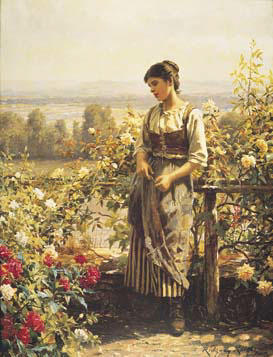
By the way, the painting is called "Ray of Sunshine" by Daniel Ridgeway Knight, (1839-1924), a Pennsylvania artist. To see more of his art go here bertc.com/subtwo/knight.htm or here www.kodnergallery.com/docs/Featured/ridgewayknight.htm . Dutch people settled in that area, and much of the crafts, art, architecture, and so forth, is called "Pennsylvania Dutch."