Monday, May 08, 2006

Frazzled By the Age of Fifty


If you are a young homemaker, taking on part time work, full time day-care in your home, or sales, I want to warn you to be careful. If you haven't read the partial list on the previous article, of things that need to be done to the house, for the family, or for yourself, please go and read those things and make a mental checklist of your life before you take on the world's work, or before you decide to "help out" with the finances. If you have an able-bodied husband whose back is not broken, then do let him be the provider. It builds him as a man and draws out the qualities he needs to be the masculine protector and provider.

In one interview I had with a new homemaker, she gave her reason for wanting to quit her job and be a full time homemaker: she said that over the years she had observed that women who stayed at home and managed the house had a serenity and a more gentle countenance and a contentment that the women and work lacked. She wanted that femininity in her life. Being the manager and guide of the home increases a woman's femininity.

You might look at other's homes with envy and wish you could have a house like theirs or children like theirs, but how do you think their homes got that way? I've been called crazy, for sure, for being a full time homemaker and not working out after my children grew up. Yet my home is usually available for any one who needs some hospitality or a cup of tea, and I'm able to concentrate on improving it through cleaning, arranging and de-cluttering. While someone is standing there telling me I'm crazy, I can point to the very place they are standing and ask if they think a crazy person cleaning and arranged it, and if they are eating scones and jam made by a deranged person.

These homes that you admire so much did not get that way through neglect. Homes get that homey feeling from the presence of a woman who is not always pressured for time, who is not always rushing around. The stay at home wife has time to think about what she is doing. If she never sits still long enough to observe her home, she does not "feel" it. She needs to feel the atmosphere of her house in order to understand it and change things that need to be changed.

If you work to earn money, whether outside or inside of your house, you will serve your family with a divided heart. One or the other will not be done well. You cannot serve two masters successfully. Usually, the one that "pays" will get the most attention. Money talks, but it is often hollow talk. The money you make while neglecting your family, your house, and your life, will often make itself wings and fly away. You probably won't be able to point to very many things that you have, that you got from earning money. Mostly, it pays for things you cannot put your hands on.

You can live without the newspaper, magazine subscriptions, trips to the races, movies, cable television, extra telephone services, and most other unnecessary expences. The best things in life are not things. Family values are not having nice cars and a house in a neighborhood like everyone else. It is better to have nice, respectful children and a family where there is lack of stress, than high house payments and car payments.

If you take on extra work besides the house and the family,, it steals your time and your mind away from doing the best that you can at anything. It cheats your family of the attention they need and creates frustration and pressure in their lives and yours. Some people think you can just go to work and earn a lot of extra money to hire other people to clean your house, decorate your house, care for your children, and feed your husband, but the whole point of being a homemaker is to put your own heart and your own special touch into the home. You can of course hire others to do this work, but you may lose the homey look in exchange for the institutional look.

There is an article on this blog somewhere, where I state that I've never yet seen a woman living under a bridge because she quit her job to be a full time wife, mother and homemaker. Things have a way of working out when you do the right thing. We must be willing to do what is right, no matter what the cost. We are too busy thinking about "things" that will nto get paid for if we do the right thing, but what good is a car or a house paid for if you lose your sanity, lose your children, and have a total collapse while trying to "do it all?"

There are plenty of people that can do all that extra work, but there isn't anyone else that can be the wife, mother and keeper of your home. No one else will do. You are it.

If you'll check out some of the decorating magazines on the newsstand you'll find that people are able to live beautifully in less than perfect houses. Some designers have even made an art-form of the shabby look, the sparse look, the old look, the cast-off look, the hand-made look, the freebie look, the Wal-Mart look, the dollar store look, and even the rich look on a budget. Some people have made beautiful havens to live in, from dwellings that are not listed in the top ten places to live.

When you try to earn a living while being a homemaker, it steals your time and your mind away from your home and family. It cheats your family of the attention they need and creates frustration and pressure in your life.If you keep on going this way, you will be frazzled by the age of fifty and not be any good to anyone.

Women are the weaker vessel, but that doesn't mean she is weak in her role. Her strength is made for making a wonderful home and guiding her family aright, but she will break down if given pressures that she was not intended for. If you keep taking on extra work, you will not be able to give your best. I've always said that if a married woman will work, the man will let her, and he will not feel the pressure he needs to feel in order to recognize his responsibility to earn a living for his family. It may entail letting a bill go unpaid, and letting the phone go dead before he will open his eyes, but if you continue to stand in the gap and earn money for something like this, you will never be relieved of the responsibility. I know there is an awful lot of sarcasm directed at Fascinating Womanhood, but if you will read carefully the section about the man's responsibility, you will see more clearly.

There is nothing wrong with earning money, but if you are to be a devoted wife, mother and homemaker, the money-earning should be done in liesure and not under pressure. There is an old saying, "A penny saved is a penny earned." Think about this. Your money doesn't have to be spent. It can be saved. And, it is more than a penny earned if it is saved. It can earn interest when invested properly. I hope to write more about this concept later. So, I hope you will give up all those extra responsibilities and put your home and family first.

Friday, May 05, 2006

Home Organization


Someone wrote to us about becoming organized at home. While there is no one way to be clean and organized at home, there are a few ground rules that can be followed. Every homemaker is different and has different likes and dislikes, and different methods of keeping house. There are a lot of helpful things on the web and in bookstores for women who find themselves overwhelmed or giving up.

The first practical thing you can do is clear out all the clutter. If you have a garage or one room you can put everything in, it is a great help. Clear out all the rooms except for the furniture that is necessary or beautiful. Then, clean these rooms. As you need something, go to that spare room and get it. Find a place for it and keep it there when it is not being used. Make everyone in the family practice this habit. The less you have, the easier it is to be organized, and the better habits your family has, the easier it is on you.

In this modern era there is a gross misapplication to the woman's role in the home. Sometimes people get to reading the Bible and without real study, assume that the woman has no say whatever in what goes on in her home. A closer reading of Titus 2, with the original Greek words, brings out the meaning of the phrase "guide (or guard) the home," strongly. It means "to rule." If she wants order in her home, she simply has to insist on her rules being followed. She can't have people in the family running all over the place leaving things helter-skelter however they wish, and then expect to have peace of mind. Most of the nervous conditions and stress that women suffer are due to not having control over their own house. Think about that word "rule," in context of management or control. We all have to have control over the clutter, control over the noise, and control over the condition of the house. We have to have respectful children and a husband who reinforces these values and backs up the wife in her effort to have respect and order in her life.

As a family, we are all in this together. We can't have the wife struggling over in one corner trying to get above the mess, all on her own, without the others understanding her role and working toward her goals. It is just as fruitless to do that, as it would be to ignore the husband in his efforts to keep a job, and not keep his goals in mind either.

In an effort to really rule the home, a woman need not think that she dominates. She is just doing what she is supposed to: managing her home. It is her job. No one has the right to interfere with that job, any more than she would want to interfere and mess up other people's jobs. It is her duty, and it is wrong to thwart her in that effort.

I've been blessed to have a really understanding husband. He just wants to do whatever it takes to make me happy. He doesn't like me to be frazzled and stressed out. He wants to know what it is I will need to reach my goals. He doesn't want me to be frustrated with the home. He will do whatever it takes to make it easy for me to love my job.

In ruling her area, a woman must have obedient children, and working children. They can't be allowed to sit around watching television or out playing sports while she struggles alone with the home. The children must be taught how the house is managed, and they cannot do that if they are just laying around. Even very young children can help the house run smoothly. My daughter, whose sons are very young, folds the laundry and then engages each boy to carry stacks of clothing and towels to the appropriate room. They love this work and to them it seems like a game.

Just because a homemaker doesn't bring home a paycheck, does not mean this is entirely her job. Even a man at work is dependent on many other people to help him do his job. The family should all chip in and do her bidding at home. If there are things that are making her unhappy, such as a yard that needs to be cleaned up, or vacuuming that needs to be done, it doesn't hurt the family to help. The mother is there to organize it and plan it. She is responsible for getting it done, even if she has to appoint others to help her.

In order to give a woman peace of mind in the home, she should never be accused of being a freeloader, not paying her way, or not earning a living. The Biblical mandate to provide for the family was given to the husband, never to the wife. She is to be wife, mother and homemaker. His job is to earn the dollars and his wife is to manage the home with those earnings.To make her also "pay her share" as they are saying these days, is to load her down with double work. She would work all day at someone's place of employment, and then come home exhausted, with the house to manage and meals to provide. In marriage, it is better if both of them are not exhausted all the time. The wife at home, with no added burdens, will have the health and the stamina to do a wonderful job, and the husband will be glad of it.

In "the old days" before a lot of you were alive, a man would never ask his wife to get a job outside the home. To do so would be admitting that he could not be a good enough provider, and that would have been a shame. He would have been embarrasssed if his wife went to work. He wouldn't have been able to hold his head up in society. If the wife went to work, she also would have been embarrassed. It might have made others think that she could not manage her husband's money, or that she was extravagant, was gambling or in debt, or wanted things to add to collections. If women want peace in their lives, and don't want to end up on sedatives, they need to return to this simple way of life.

Thursday, May 04, 2006

Home With A View


Here is a new painting. Don't show any real artists...it was just for fun and relaxation. Getting it to a smaller size on the computer caused it to be a bit warped in certain areas, and a bit stretched out in others, and the colors are not as vivid.

I have no clue what I am doing and I don't follow directions very easily. I found a similar picture on an old postcard of the late 1800's. I thought this house was probably a farm house of the 1920's.

painting by Lydia 2006

Wednesday, April 26, 2006

Small Houses of the 1920's


We've been reading about house-building in America in the early 1900's. The President of the U.S., along with others, developed a plan for smaller homes to be built so that everyone could have a house. If you got the houseplans, nine other little booklets were included, dealing with landscaping, gardening, interior decorating and home improvement. They were considered "small" because they were a departure from the grand Victorian homes of the 1800's, but by todays standards, they are large. After reading this article, you may begin to notice quite a few of these houses in your town. These were also called "bungalows," miniature Victorians, and miniature southern colonial.

This blue house is from http://www.bearcreekstudio.com/images/house1.jpg

President Harding, at the dedication of the "Home Sweet Home" at Washington, stated:

"The home is at last not merely the center, but truly the aim, the object and the purpose of all human organization. We do not see to improve society in order that from better homes we may bring forth better servants of the state, more efficient cannon fodder for its armed forces; rather, we seek to make better homes in order that we may avoid the necessity for conflict and turmoil in our world.

"The home is the apex and the aim, the end rather than the means of our whole social system. So far as this world knows or can vision, there is no attainment more desireable than the happy and contented home."

(Interior sketches from http://www.historictempletonmccanlessdistrict.com/interiors.php)

From a newspaper of the year of this housing project; (Can you imagine a newspaper writing this today?"):

"Of the man's part in the building of a home, all that the normal man does, in the struggle for life, is really that he may have a happy home, wehre he can rear his family, give them such advantages as his means can afford, and start them in their own lives with such aid as will best help them.

"The crowning joy of the typical man is in the home, to which he can repair when his day's work is done.

"But whatever the joy which the man gets from a happy home, it pales into insignificance when compared with the radiance which it brings to the soul of the gracious personage who, by her own competence, her own self-sacrifice, and out of the depths of such love as is beyond the comprehension of any man, makes the home what it is, and where she reigns supreme.

"No other ideal has the beauty of the ideal home. No other purpose can be nobler than increasing their number and their comfort. No other theme could be more inspiring."
More information here from other sources:

The Better Homes Campaign
Better Homes in America, Inc., a private organization founded in 1922, spearheaded a national campaign for domestic reform focused on educating homeowners about quality design and construction. Promoted by The Delineator, a popular Butterick publication for women, the organization gained the support of U.S. Secretary of Commerce Herbert Hoover and formed a nationwide network of local committees that encouraged both the construction of new homes and home remodeling projects. A national demonstration home, "Home Sweet Home," a modernized version of songwriter John Howard Paynes's Long Island birthplace, was constructed on the National Mall in 1923, and "Better Homes Week" activities and competitions were held nationwide. Annual competitions recognized the work of architects, such as Royal Barry Wills of Boston and William W. Wurster of San Francisco, whose small house designs would influence popular taste nationwide for homes described as New England Colonial or Monterey Revival.(117)


from another source:

Better Homes MovementThe Better Homes Movement was a nationwide campaign initiated in 1922 in the pages of the Butterick Publishing Company's household magazine, The Delineator. The campaign celebrated home ownership, home maintenance and improvement, and home decoration as means of motivating responsible consumer behavior that also expanded the market for consumer products. In cities and towns across the country, annual campaigns--or "better homes demonstration weeks"--encouraged citizens to own, build, remodel, and improve their homes and distributed advice on creating home furnishings and decorations. The Guidebook for Better Homes Campaigns in Rural Communities and Small Towns shows how the campaign sought to communicate its ideas. School Cottages for Training in Home-making shows how high-school courses incorporated the ideas of the campaign.

The Better Homes Movement received broad support from both government and industry. President Coolidge served as honorary chairman of the Advisory Council of Better Homes in America, and Secretary of Commerce Herbert Hoover, a prime mover in that organization's formation, was president of its board of directors. The movement sought to educate consumers, but it also served the interests of powerful groups and organizations. The connection between the campaign's educational and commercial concerns is illustrated by Herbert Hoover's essay "The Home as an Investment," in the Better Homes in America Plan Book for Demonstration Week, October 9 to 14, 1922.
See also: "Homemaker-Consumer Life in Washington, D.C., 1922-23" from the Anna Kelton Wiley Papers.

Published in 1922 by the Bureau of Information of Better Homes in America, this pamphlet consists of one letter, a plan proposal, and nine essays prepared by government and other authorities on the significance of Better Homes campaigns and on various phases of home- building. The first two essays, written by President Calvin Coolidge and Secretary of Commerce Herbert Hoover, encourage home ownership and discuss the home as the foundation of American social institutions. Other components include a blueprint for Better Homes Demonstration Week from October 9 to October 14, 1922, and essays on house construction, interior decoration, and the impact of zoning on the home. An organizational chart for Better Homes in America, with its National Advisory Council and Bureau of Information at the top and seven subcommittees at the bottom, appears on page 10.
NOTES

This is just one example of the 1920's houses. There are many different styles.

Tuesday, April 25, 2006

Homespiration


When your life is based in the home, you might as well make it the most wonderful place on earth. There are certain elements that make home life different than anything else. Some things that change the over all look and atmosphere of the home are surprisingly simple and only require a few cents and a little bit of effort.

*Use all your senses--touch, smell and taste, sight, and sound, and get an over-all feeling for your home. Use a combination of old and new, handmade and purchased items to give it that homey feeling.

*Use colors in the house that make you like best and feel happiest around.

*Make the most of light. Don't block windows where there is a pleasant view to certain spots of your yard around your house. Arrange furniture in such a way that it takes advantage of the daylight, or the sunset.

*Line up books according to their subject and size, or for a change, try putting them in color categories, according to the color of the binding.

*Add interesting touches to your house cleaning: a photo in a shelf of books, or a left over gift-wrap inside of a drawer. The number of things you can do to make things beautiful while putting things in order, is limitless.

*Clean up the living room on your way to retire at night. When you get up in the morning, your mood will not go down immediately, as it often does when we wake up to piles of disorganization.

*While reaching into a space such as a cabinet or refrigerator to get something, take a second to neaten and discard empty containers.

*Think about breakfast the night before, so that it can be planned to be more leisurely even if you have a time limit. Set the table and prepare what you can ahead of time to be retreived easily from the fridge.

*If you'll allow yourself time in the morning to prepare your appearance for anything (company, being called suddenly outside the home), you will set your mood on the upside in the very beginning of the day. If possible, dress to compliment your home. Home sewing is a great advantage, in that the sewer can sew clothing for inspiration as well as use.


*When you change your bedding, engage the help of someone to turn the mattress around so that it has equal wear and tear all around it. Make a decorative pillow to add to the newly made bed. I used to make these pillows whenever my husband had to go on a trip, and now I enjoy quite a number of them on the beds, from a birdcage shaped cushion to a large pink pig, and satin heart-shapes with ruffles for the guest room.

*If you haven't pruned your apple tree, you can cut down the shoots just when the buds appear on them, bring them into the house and perch them in a large tin vase on a table, to watch them unfold into those enchanting pink apple blossoms.

*The dollar store has a scented cleaning product that doesn't seem as toxic as commercial products, which comes in lime, berry, vanilla or other scents, which you can put on a cloth to wipe your sinks, cabinests, floors,or just about anything except wood, in the kitchen or bathroom. Get one in the color that goes with your decor, and it helps make cleaning pleasant.

*If you don't like to burn candles for light and scent, there are now battery opperated candles from www.victoriantradingcompany.com and some electric ones with scented bulbs from www.thecountryhouse.com

* If you have small trash cans in different rooms, always line them with a plastic bag. It is very unsanitary to put trash directly into a container, which collects mold and mildew and requires cleaning. You can purchase scented trash bags or use plastic grocery sacks which you can scent yourself by placing those "free" perfume strips on cards that you often get in the mail or in promotional sales flyers in the mail. Emily Barnes suggests you add a paper doily to the edge and fold the bag over the container, tying it down with a wired ribbon.

*Keep a basket or atrractive container by the front door to collect items that must be returned or delivered somewhere else. If you have a stairs, keep a container to collect items to go upstairs in one trip.

*Have an assortment of "house ingredients" to make your house complete: books, lamps, pillows, wrought iron, shiny metal, lighting (lamps, candles, etc), wood, rugs and floor coverings, crystal and glass, ceramics, and cloth items. Everyone has some of these things, and they can be combined to make your surroundings comforting and bright.

*If you have children, they need to grow up in the most cheerful atmosphere possible. YOU can do it better than anyone else. Create a decor that will having meaning to them. Take them on a house tour of your own dwelling, pointing out the reason that things are being used or placed where they are, where they came from, and why they were chosen. This "house appreciation" tour will increase their love for their home and family.

*Keep a house journal, with pictures of progress you have made. Include a pocket to keep purchase papers and care instructions, receipts and paperwor. Write dates that things were done, such as painting projects, furniture rearranging and replacements. This will be an inspiration later on. I know one woman who has a photograph scrapbook journal where she kept a running log of her husband's work on their house. She has photographs of all the things he made in his wood-working shop--shelves, a quilt rack, a table, etc., and his yard work from start to finish. This may not be feasible for everyone, but it is not too late to photograph a finished room and see how it looks, put it in a book, and enjoy it later.

*Plan to host something in your home at least once a season, whether it be a celebration, or a teaching opportunity of art, sewing or crafts, or a friend for tea. These kinds of things increase the meaning and purpose of home living and motivate the homemaker to maintain it make it attractive so that others can learn from her example and be comforted by her hospitality.

*Besides keeping a daily list of things to do, and a daily routine, set out work reminders or work stations in various rooms that will beg to be done. For example, put your peat pots and seeds beside the kitchen sink when you have finished cleaning the kitchen. This will remind you to get that job done sometime during the day. Put a pile of unfolded towels from the dryer in the bathroom. That will remind you to fold them the next time you are in the bathroom. Set out a sewing project in a neat basket, or letter writing materials on the desk with the letters you need to answer. Put hooks and decorations that need to be hung, in the room that they need to go, so that it will jolt your memory as you walk through.

*The most neglected rooms in the house seem to be the bedrooms, laundry room, pantry, porches, offices and spare rooms. We think that no one will see these rooms so we may not pay particular attention to their organization or decor. However, they will have an effect on your mind and your mood. Cleaning them and arranging them will add to a sense of well-being in the home.

I'm not an expert on home organization and still have a long way to go to get caught up after the children have grown. I am just learning many of these techniques as I've been able to take a more critical look at my house. When you are home most of the time, you might as well make it as pleasant as possible, and if possible, better than anywhere else you've ever been. If you can look at work as an opportunity to improve your home and your own stamina, it will increase your willingness to do it.


photo from www.bhg.com

Saturday, April 22, 2006

Family Education


There is a lot of talk about "homeschooling" going around, and for the sake of understanding, we did "homeschool" our children. However, the term "homeschooling" does not accurately describe the experience at all. For us, it was family based learning.

We didn't always stay at home, or even learn at home, and we didn't conduct it like any school. Wherever we were, we could learn, and we looked for opportunities not just to collect knowledge, but to experience life, grow in wise behaviour, and develop our thinking so that we could understand the things that confronts us in life. We thought about the pioneers and how the children participated in life with their parents, erstwhile learning to read and write in the evenings by lamplight. This seemed far more balanced that constantly doing paperwork.

"School" in Greek is "schule," which means "spare time." In bygone days, people would take some leisure time to go and listen to lectures on various subjects such as science, mathematics or philosophy. We had this "spare time" concept in mind, when we nurtured our children. (Today, not everything has to be learned in a place set apart for book-learning. Knowledge is accessible and widely available in many forms!)

Life was to be lived, and school was reading and writing about the life we were discovering. Once the children learned to read, they were encouraged to research from books and magazines, the things that fascinated them, whether it be a country of the world, a language, art, music, science, writing, landscaping, or publishing.

Every day was filled with purpose, and that is why family-based learning continues to affect my attitude and my life as a grandparent. Even when the children are grown, there is so much to look forward to. When our family-based education was completed, I felt that we were just getting started, but it really had never ended. By showing the children how to research something, or how to overcome a problem, or see a project through from start to finish, we gave them the tools for victory in their lives. Each child was taught to have a strong sense of purpose, which to this day remains our basis of stability, from the age of 2 to 62. (the exact ages of the youngest to the eldest in our combined families).

One thing that I observed about many people who were just married was that they were depressed. When I inquired about their backgrounds, I found that all of them were highly socialized in their youth, with full schedules of activities. Family-based learning, however, was more of a natural socialization, brought about by their service to others, hospitality, classes they took in music or art, and their own businesses which brought them into contact with customers. They didn't have years and years of forced socialization. When the socialized children married, they had greater difficulty settling down and being quiet at home with one person.

A habit that helped our family a great deal was a forced "quiet time." A few hours a day, usually during the hot afternoons, they were each to find a place by themselves and either take a nap, lay down, read, write, or just stare into space for awhile, and be quiet. At first, they didn't like this, and it was their mother who fell asleep, while they crept around doing things. Eventually they came to look forward to this quiet time and now as adults, say that those were the most precious hours of their youth.

Another rich experience that we enjoyed was daily walks. There was a special technique to this. Everyone had to observe what was going on around them and use all their senses to experience it. And, not only would the physical sensations of the walk be important;-the spiritual benefits as well. When we arrived home, they were encouraged to write in their journals everything that happened on those walks, both within their minds and in nature, which included little drawings and colored illustrations.

I wasn't always actively looking for "lessons" and it wasn't a drill-seargant type of education, but when there was an opportunity to expose my children to something good, I took it. Walking past a store, I might notice an advertisement for a free classical concert in a local park. One advantage of home based learning, is that you are not confined to the classroom and can get up and go when you want to. There might be a nice sunny day where good common sense dictated that it would be better to take a sketchpad and some paints to a scenic area outside and learn about art. A cold, gloomy day may have triggered off a lesson in hospitality. (People need hospitality more on dark, dreary afternoons).

Family-based learning, or "parental schooling," is very flexible and enables the children to live a real life and learn how to have a good family of their own someday. Instead of waking them up in the dark hours and rushing them "somewhere else," they learn to be content where they are. One of the things that many people suffer when they settle down to home life as young married couples, is restlessness. If you get up in the morning and go somewhere else for years and years, it is difficult to overcome this tendency.

We found that a study of our society of the 1800's yielded a great insight into how life was conducted when people were more family oriented. This might be a study worthwhile for other families, to discover how our forebearers of the Victorian era conducted their daily lives, what they ate, how they dressed, their recreation, their crafts, hobbies and art, their family celebrations, and their businesses.

As a result of our family based learning, our children have had a rich education. When they were a certain age, they were encouraged to order as many books as they liked, from several catalogs, on the subjects that interested them. In the early 80's there wasn't as much available to the homeschool community, so we used a catalog called "Dover." One of our children ordered some books about Leonardo Da Vinci and Michaelangelo.
(One of these artists was the inventor of the paint-by-number method).

There are those who say that education cannot be accomplished unless a child sits in a room with 25 other children and listens to one teacher. They insist he must also be in that school building daily for 5 hours. This does not guarantee that the student is absorbing what he is learning, nor does it prove that the mind is engaged fully all of the time. Family based learning, in our experienc, kept the mind alert to the conscience--to the needs of others, to personal responsibilities and to the presence of God.

Sometimes people were very concerned that being cooped up together we would grow tired of one another and just quarrel all the time, but they inteacted together just fine and retreated to private places when they wanted to be left alone. One cannot say that going to school in a group was any more exciting. Often those children grew tired of the same group and even dreaded facing them day after day. We found home a place of forbearance, with a chance to start afresh with each other the next day.

As these elements of family learning were translated into the home, respect for life and property increased. Our home became a most desireable spot. We shared our values and preferred one another's company for an outing, a conversation or a tea party. The house was a place of beauty and order. The way we spent our time had meaning. Home was a place where we were happy.

(More to come)

"Into the Garden" by Susan Rios

Wednesday, April 19, 2006

Feedback


I thought this letter would help others gain insight into the reason for homemaking. Even when we are unable to make things really nice, due to unforseen interruptions, our presence is greatly felt and needed in the home. I found an interesting story about kitchens here www.journalofantiques.com/ May03/
Mrs. Sherman, I cannot restrain myself any longer! I must thank you, and thank you again!

I have been reading your columns for some years now and always look forward to them for the inspiration you provide. You truly understand what makes a woman happy and successful as far as homemaking is concerned: love. It is love for my family, loved ones, and community, and for myself also, that is my motivation to provide a home which is clean, pretty, and full of good things.

It is the simple joy of my table, set with lovely linens and flowers, and dishes filled with good and nutritious food. Or my living room, filled with clean and comfortable furnishings, not costly and pretentious but homey and warm, inviting family and guests to linger over tea and good conversation. My linen closet contains pretty pressed and folded linens with which I can decorate my home in any season, for any manner of affair. And so I thank you, for the understanding and shared joy of these small things that you show in your writing. And for understanding, too, of the richer rewards of such efforts and simple joys: a happy and contented family, a community enriched by loving communication, sharing our lives and our gifts with others.

Finally, I thank you for the fact that you understand that homemaking is but one facet of the complete person that we are. I don't feel that because I delight in arranging flowers I cannot likewise enjoy reading books on philosophy or gaining a deeper insight on current events. Nor do I feel that my life is narrow and selfish; in fact, my role enables me to give of myself and my talents as I know I could not do if I worked a full-time job. And everything that I say about myself is equally true of all the women who, like yourself, are at home. And so, I thank you, for helping others to understand us better, and to give us the inspiration that we sometimes need.

All my best,

Sophia

Photograph by Lisa Hollinger

Monday, April 10, 2006

Good Attitudes About Home


This poem and thoughts are from a booklet by Mary Brooks Picken, which is titled, "Thimblefuls of Friendliness" and was written 1924.

"Stepping Stones"

"Isn't it strange that Princes and Kings
And clowns that caper in sawdust rings,
And just plain folks like you and me,
Are builders for Eternity?
To each is given a bag of tools,
A shapeless mass and a book of rules,
And each must make ere life is flown,
A stumbling block, or a stepping stone."

I heard a young woman say the other day, "Oh, I give up. What's the use of my trying to be anybody or trying to have nice things? My ambitions only make me restless and miserable."

But we all know that ambitions once entertained are hard to lose. The farther you come from attaining them, the more miserable you will be. Hence the need of continual effort.

To the woman who says, "What's the use?" one might say: "What's the use of working, of washing the dishes, of getting up in the mornings, of liking air and sunshine and pretty things?

There isn't any real use, perhaps, in it all, but it is, oh so satisfying, to go into a kitchen to cook dinner where everything is happily clean and in place.

What a satisfying, luxurious feeling it is to crawl into a well-made, cozy, bed.

What a delight to don fresh, clean clothing.

What a self-respecting feeling one has when one puts on a well-made dress that is appropriate and becoming.

And these things take time and effort, but they pay double in sheer pleasure.

And we should use our energies to make happiness come for every effort, pleasure for every thought that we give to family, home, or clothing, and thus make of all our responsibilities stepping stones to success, via happiness.

For surely, when we are happy, we are successful, at least in that little domain where we are queen. No matter what our environment, no matter what our circumstances-a singing teakettle, a cozy fire, some one to care for, some to care, a conscience that does not disturb--all these help in our walk up the steps to divine content.

For some of us it may seen a long journey but trying makes it interesting. And we have the satisfaction all the way of having done our best with our "bag of tools", our "shapeless mass", and "book of rules."

When I was growing up, I knew many girls to get out of work by not wanting to do it. Sometimes I thought my mother pretty severe because she expected us to wash the dishes. It was part of the work for my sisters and me. She expected us to arrange the table, make the beds, peel the potatoes, help on wash day, and iron the plain things. It never occurred to us to say, "I don't want to do it." I admit many times I didn't really want to, but I should only have made myself ridiculous by saying so.

Self-pity was not scarce with me sometimes, especially when there was an all-absorbing book that I wanted very much to read or a guest who had interesting things to tell after dinner that I wanted very much to hear, or when the call came on a sleepy morning to get up quick and help with breakfast. But now I realize that having to do things, being expected to do them without any alternative was good for me.

Girls who grow up and take the mother place in the home understand little girls and little boys who don't want to do things. Yet they know from experience that success and a happiness within come from learning, as children, to do the things they don't want to do when they don't want to do them."

Note: I find some things in this book to be very much like "Beautiful Girlhood," which is available online, and is free domain. My daughter copied off some of the chapters to give to a woman to help her teach young girls.

Go here http://library.timelesstruths.org/texts/Beautiful_Girlhood/ and read some excellent and timeless instruction that will fill the heart with love and contentment.
=========================

Saturday, April 01, 2006

A Place to Relax

Before I get started here I'd like to thank everyone for posting links to their blogs. While women today may not have the benefit of mothers and grandmothers who were dedicated homemakers, they now can glean from other women through these blogs. These are very helpful when you feel like "talking over the fence" with someone.

I can remember women visiting throughout the week and talking about child-care, cooking problems, or sewing. In the 60's I first heard the most disparaging remarks about such conversations. Women who had been to college returned home saying things like, "After all the education I have received, I'm not going to spend my life in conversations about baking cookies."

Isn't it interesting that even the educated women at work really want to talk about babies, recipes and home decorating., or finding a husband and settling down to matters at home. They didn't end up, after all, spending their lives talking about all the things they learned in their education.

When you need a place to relax, consider something just outside your front door: a porch area or a little place along the side of your dwelling, where you can have some pots of fragrant flowers, and a place to sit and let your mind rest. I was recently given a plant called Daphne. It is the most fragrant bush. Planted near the entrance of your house, it will give you a whiff of the most elegant perfume as you walk in.

I see www.ladiesagainstfeminism.org (LAF) is updated today. Lots of good articles there and if you click on "more headlines" at the end of the front page, there is a cute video you can watch online, from one of the articles.

Wednesday, March 29, 2006

Developing Good Family Relationships


The contents of this article will in no way do the title of it justice. These are just a few observations about keeping peace, love and respect in the home. The subject is so complicated that books can be written about it, but in general, there are some simple things that help keep strife from the family unit.

My first experience of homelife was my own childhood, plus hearing my mother talk about her own childhood. One thing that I appreciated and gained the most from, was my mother's approach to faults in the family. After stern reprimands and discipline, followed by an explanation of what she expected from us, she would never bring it up again.

She wouldn't allow us to bring up past resentments, either. She moved on, and she wanted us to do the same. If we repeated the same errors, she rebuked us, but didn't go on and on with a long list about how we never learned and we always failed and we drove her crazy. That is one thing that I've come to appreciate more and more. She believed that each day was a new beginning, and she didn't wake up mad at us all for the previous day's folly. She had seven children but that each day was brand new, with its own problems looming ahead, and she didn't believe in dragging up the past to burden the new day. If we became melancholy or depressed over quarrels or discipline, she taught us, by her own example of "starting over," how to bounce back.
It was considered very wrong to hold faults over people's heads forever. We were supposed to forgive and give them the benefit of the doubt. If the wrong was repeated, we were to refrain from saying, "There you go again."When I hear people say that today, I know they are keeping score of wrongs, and collecting bitterness; bitterness that will harm the harborer, as well.

Bitterness and resentment were not part of our mother's personality. You knew that you always had a brand new chance with her the next day. You knew that you were brand new, to her, every time she saw you, and that she had faith in your better side. She didn't tell people that you were problem or that she was having problems with you or that you had this fault or that fault, because she knew that it would be hard to erase that image in people's minds, and that it gave others an unfair advantage over us kids. Instead of clinging to a perceived evaluation of any of us, she steered us a different way when we were not doing quite right. For example, if we were picking on someone in the family, she would try to make the other person look better in our eyes, by saying, "He might not be feeling well today. Maybe you should comfort him."
(Eph 4:32 And be ye kind one to another, tenderhearted, forgiving one another, even as God for Christ's sake hath forgiven you. )
She and my father had the same kind of relationship. The forgave each other immediately when one of them erred. They overlooked a fault. They didn't nitpick or find fault with one another, and they tried to teach the children the same behavior. To overlook a fault, you can still acknowledge it, but you forgive almost as immediately as you notice it. Overlooking a fault means that you regard the other person as better than yourself (even if he isn't.) Col 3:12 Put on therefore, as the elect of God, holy and beloved, bowels of mercies, kindness, humbleness of mind, meekness, longsuffering;

I've known families that harbor grudges from the past. When these brothers and sisters become adults, they continue to fume, fuss and feud. There is never any peace, and someone is always mad at someone else. They have a long list of offenses which they've kept from the past 10 or 20 years. They wait, ready to jump on the next offense, and add it to the list. Then they may say, "That settles it. You are never going to change. I am finished with you. Stay out of my life." After that, all they do is talk about how they "aren't speaking" to their brother or sister. They didn't wipe the slate clean when they went to bed, and the next day they added more offenses, til by the time they were adults, they had a huge bag of dirt to carry around. Our parents didn't let us go to bed angry, and they didn't go to bed angry, either. Time was spent correcting bad attitudes so that we wouldn't go to sleep with the guilt of these things still on our consciences.
(Eph 4:26 Be ye angry, and sin not: let not the sun go down upon your wrath)

I think it is very unfair and unforgiving to remind family members of something they have done, and then make it a stereotype of their personality, labelling them with things like, "liar, gossip, headstrong," etc. It plants the idea more firmly in their minds, and they will find it difficult to get out of that mold. These kinds of labels cause problems clear into adulthood. They should each be given the chance to have a new day and a new beginning." 2Co 2:7 So that contrariwise ye ought rather to forgive him, and comfort him, lest perhaps such a one should be swallowed up with overmuch sorrow. "

Sometimes, grown children are still mad at their parents for some offense that happened in their childhoods. This was the kind of childish behavior my parents forbad when we were growing up. They knew they weren't perfect, but they wouldn't let us run them down. We weren't allowed to keep score of wrongs. We were told to forgive, and if we brought it up, our parents would say, "I thought you forgave her for that, a few days ago. It doesn't exist anymore, then."

If any of us woke up the next day with a resentment from the past, she would remind us that it was in the past, and we couldn't bring it back up again. She wouldn't let us dwell on it, nurse an emotional wound, or harbor a hard feeling. She made us get on with our lives.

We had a proper understanding of forgiveness. We knew it didn't always mean that someone else was right and you were wrong, but in forgiving someone, it meant that you were free of the burden of bitterness. We had to give the other person the responsibility to change themselves, if they wanted to, and not feel that we had to change them. It would have been a terrible mental burden to take on the changing and perfecting of another person. It was much easier just to change yourself!

We developed from her a sense of people's feelings. It was better to automatically forgive, or overlook a fault, than to bring it up and cause hurt feelings. For the sake of peace, we weren't to bring up anything against anyone, but forgive them on the spot.

Learning to look on the good side of each other, was to prepare us for many things in life. One thing that it does it adult life is this: Someone tells you what a rotten, stinking, horrible person you are, and you don't respond in kind, neither do you defend yourself. You may ask them to stop, but it is up to them. You don't hound them down and insist on an apology or make them repent. Instead, you forgive them before it escalates and before you get bitter. What they do, is up to them. During their bitter outbursts, you think, "I understand these accusations. Sometimes I do that, myself. "

If you resist and fight back, the fighting only escalates. If you don't respond with the same degree of heat, and you plant immediate forgiveness, it is better for you. The next day, your own attitude is that it is a new day and the past is forgiven. The other person may not have this same religious view, but it doesn't matter. Eventually they will be won over to your side. I've seen this happen over and over again. Eventually the other person feels safe enough with you to renew communication with you.

Our parents wouldn't permit mutiny of any sort, however, and declared martial law, or all out war, on their part, in order to put the troops back in line. They were the authority and they didn't permit any enroachment on their territory or anything that would tear down the home or the family, including quarrelling, fighting or attacking. That is not to say that we did not do these things: we certainly did. They were always met with consequences.

Anger and bitterness and seething resentment only makes you unapproachable. Your goal has to be one of reconcilation, and if you keep this in mind, you'll be able to respond more peaceably. Besides this, if you were taught from childhood that you have to own up to the things you say and do, you will have had enough experience facing an apology, that you don't want to say things that will eventually require a painful apology.

One thing I noticed that this training produced was truthfulness, even in anger. When some people get angry, they bring up any old exaggerated ridiculous thing, but we were more likely to tell the real truth when we were angry. As adults we could overlook irritations and faults of people around us. Not that it made us neglectful in correcting our own children, or to warn people of danger and put a stop to things in society that weren't right, but that it prevented us from creating constant conflict around us.

One way in which she would distract us from sullenness and resentment, was to introduce something productive that would benefit us all. We did a lot of reading, and learned to write stories. We were encouraged to pursue painting and other arts. Focusing on things that were good and useful and helpful to others did us a great deal of good. Work was also a option, which our parents used liberally, saying, "If you've got time to criticise, you've got time to work." My parents themselves, did not dwell on criticism, argue or start fights.

In teaching us right attitudes toward one another, my parents did not spend hours and hours of time talking to us about it. They stated their facts, and aside from a few reminders, that was that and that is the way it was. They didn't allow us to go around and around in circles arguing with them. Some people may wonder how in the world they did that, but you have to understand that in those days, most parents were like that. It was the way they were raised, and that is how they raised their children. There were deeper reasons behind it, of course, which can be addressed at another time.

Forgiveness is a powerful tool and we learned a lot about it. Living in close quarters, it is sometimes tempting to find fault with another member of the family. Maybe they clear their throat too much, sniff irritably, or have a nervous habit. Maybe someone sings out loud and another one doesn't like the tune. Or maybe they get into your stuff. We were taught that each one of us was a precious gift from God, and when we became tempted to hate, to just imagine how sad we would be if that brother or sister were to become very ill or have a tragic accident and lose their voices or their sight. This is not to say that we didn't hit or pinch one another once in awhile, but it was not allowed to continue, or passed off as "sibling rivalry."

We were taught to feel pitiful towards our siblings, and realize that their faults were an opportunity to forgive. Warned against self-righteousness and feelings of superiority, we were able to check ourselves. We weren't allowed to complain about a brother or sister unless we were perfect, and who is ever perfect? We could not take the splinter from their eye, while having a beam in our own. This belief reduced the tendency to be critical, condemning, and judgemental.

This wasn't a perfectly faultless family. In comparing notes with my brothers and sisters, we discovered that we each had a different viewpoint of how much we were disciplined. The older ones thought they were reprimanded and lectured the most, and the younger ones, very little. This is no doubt due to the fact that once you get the cooperation of the older ones in the family, the younger ones follow more willingly. One of the younger brothers said that he learned to avoid trouble by watching the older ones get into trouble and getting corrected for it.

We did argue and fight and do things we should not have done, but our parents used these things as a springboard to teach us right behavior. I really appreciate the fact that even now, our parents do not dredge up a list of past offenses and use them to demoralize us. It is so important that children, and adults be given forgiveness so that they can get on with their lives, and not be sick with the anxiety of having someone resenting you or keeping score of wrongs.

Please don't get the idea that we had a peaceable family all the time. We were children, and we were immature. It was a training ground. Our parents were diligent and did not just pay attention to our behaviour. There was a lot of "war" because our parents made it very uncomfortable for us when we created problems. With seven children, you can only imagine what would have happened if our mother let us get out of control. Our attitudes had to change, also, so it often caused many a pang, and may have even taken a whole day to learn a lesson, but the next day was a chance to begin again, without the past clinging to us. It wasn't always a peaceful home.

In real life, families do fight, (children should never be given the idea that it should never happen; to do so gives them a warped view of family life, and can harm them in their future homes. They just need to learn to bounce back from serious disagreements and quarrels, not hold bitterness.) but it is the parents that should do the correcting, and the children should not be allowed to attack their parents or fight amongst each other. The parents have to take control and monitor the situation. It won't always be a pleasant, quiet atmosphere, but in the end, it brings "the peaceable fruits of the spirit." (Heb 12:11 Now no chastening for the present seemeth to be joyous, but grievous: nevertheless afterward it yieldeth the peaceable fruit of righteousness unto them which are exercised thereby. )

Not all the lessons were actually learned at the time. It has been many years since I was a child, and some of the lessons I can only now understand. The ultimate goal was to have a peaceful home where members of the family stuck up for one another and stood united during problems.

I love this aspect of beginning each new day fresh, with the past behind us. It gives the family members a clean slate. It gives them hope and the ability to do well with their talents and abilities, unhindered by the burden of all their past sins. They didn't have to go around with a knot in their stomach, knowing that someone was mad at them or not speaking to them.

Pouting was not tolerated, nor holding grudges. I do not think any of us ever developed the habit of pouting or giving someone the silent treatment or being "in a funk" like people do today. I don't think we even knew how to do it. Our parents thought pouting and the silent treatment was not honest. We may have tried it a time or two, but quickly abandoned it rather than endure reprisals.

This is one of the things that I learned in my childhood that I truly appreciate. It makes me smile to know that every day we can wake up looking at each other as brand new people. It gives us a way of looking at people that is good and healthy, rather than with criticism, suspicion, or skepticism. It was good to grow up knowing that people weren't watching us, always waiting for us to trip up, or make a mistake. It gave us the freedom to develop good character. When you know someone is always upset with you, or holding a grudge, it can make you very nervous.

I was able to "live off the fumes" of this family experience (that is an expresson we use here sometimes). I tried to pass this attitude to my own family, because I believed that freedom is one of the most valued things in a person's life. If you give them forgiveness and allow them to start each new day fresh, they will also less critical and able to overlook faults.

We learned through this attitude that many things we thought were faults, weren't really faults. They were often false opinions we had formed, based on our own critical attitudes, and in themselves, not really much to get upset about.

We were a noisy family, and we did argue, fuss and fight. We didn't always cooperate with our parents at first. Sometimes we really put up a fight! Sometimes it looked like we won the battle, but we always lost the war. But because of the constant attention to our attitudes, we left that home knowing what caused trouble and what caused peace. The Bible says that bitterness "causes trouble." (Heb 12:15 Looking diligently lest any man fail of the grace of God; lest any root of bitterness springing up trouble you, and thereby many be defiled)

I'm sure there are other families whose parents gave them something valuable like this. I've heard of others whose parents gave them the ability to endure great hardships, or whose parents passed down to them the opportunity to create work, or even wealth, from very little. You can talk about a trip to famous amusement parks, or great events, but the value of forgiveness or endurance far outshine the temporal value of financial achievement or accumulation of wealth.
Scroll down to comments to read about one of my brothers who ate my strawberry soaps, and me throwing him in the creek. While growing up, we did not allow the family to deteriorate into picking fault with one another, but we developed things to do of a constructive nature. That being said, it was understood that when a brother absolutely refuses to do what is right and if a brother was engaged in something that was a bad influence or a bad example, or if he continued to disturb others, or his nature seemed to always cause trouble, we were encouraged to be silent around him or avoid being in his presence. "Cast out the scoffer" the Proverbs say, "And there will be peace."


Eph 4:31 Let all bitterness, and wrath, and anger, and clamour, and evil speaking, be put away from you, with all malice

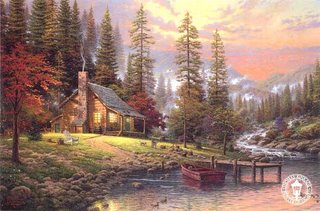
This painting by Thomas Kinkade looks a little bit like the homestead where we grew up.

Monday, March 27, 2006

Housekeeping Site

We have closed the comments off for awhile, since we are too busy right now to monitor them.

For anyone who is interested, there is a site that has a few interesting lists for housekeeping that needs to be done, for particular rooms. http://www.simplehousekeeping.com/default.aspb after you have viewed the page, click on "daily schedule" in green.

If that link does not work, try this http://www.bhg.com/bhg/story.jhtml?storyid=/templatedata/bhg/story/data/cleaningroutines_06052002.xml&catref=cat590050

Take a look at http://www.bhg.com/bhg/category.jhtml?categoryid=/templatedata/bhg/category/data/HomeCleaningGuide_CleaningTheHouse.xml where there are lists like "Making A Home, " "Cleaning Tips" and "Organizing Tips." Most of these pages allow you to print them for your homemaking textbook.

More tips for homemaking under difficult circumstances here http://www.familyandhome.org/ps/ps_housework.htm

Monday, March 20, 2006

Doing Your Best


If you are new at homemaking, you don't have to think that everything has to be done perfectly. However, it should be done the very best you can.

An example of this matter being confused, is the following:

A young woman who accepted an invitation to a Tea, enjoyed it so much, that she asked how she could do it, even though she didn't have the experience or the expertise.

In order to put her mind at ease and encourage her to practice hospitality, her hostess told her she didn't have to go to all that trouble, and that just a muffin and a beverage would suffice.

When others attended her luncheon, they were awfully disappointed. Why? Because this woman herself was capable of so much better. She had not bothered to do her very best or to reach for the highest possible point of achievement that she could. She was getting by with as little as she could, and taking the easy way out.

And, why do you suppose people thought she could have done more?

1. She had attended a lot of lunches hosted by others, and had plenty of time to observe.
2.She had the facility of a nice home, and the space and kitchen to do work in.
3.She had other interests which she spent a lot of money on, and knew how to do well.
4.She was of a certain age, beyond childhood, and was not helpless, nor penniless.
5.Her very best was not offered.

The hostess that advised her, certainly did not intend for her to do a lackadaisical job. She was only trying to give her some beginning steps. So, in all that we do, let us do it well and to the best of our ability, using our creative talents.

It is one thing to offer up something when you really have nothing, but if you truly are able to a little more than the basics, a little more than just to get by, or a little more than "necessary," then you should.

In judging your own housekeeping, just do as well as you can in your circumstances. There is no use getting by with a swipe and a sweep at the house, unless you have special problems. We can each put our whole heart and soul into what we do. We are generally much happier when we know we have done our best, and put our full talent into something. People who just do what they can get by with, in anything, will never be completely happy or fulfilled.

That is why I say, when you are homemaking, that you should not just clean something, you should beautify it. Your finished job should send a message. It should say "I love my family enough to provide a place for them that is lovely and comfortable."

It is the same way with what we wear. Intentionally or not, it sends a message.

One of the reasons for good housekeeping is to win others over to your side, and to your way of life. It is a way of speaking without words.

I don't want to imply that housekeeping is the main reason for being at home, or that doing a poor job is a result of laziness, but that our attitude can be detected through the evidence of our work. As stated in a previous article, there will be times when it is impossible to pay attention to details of housekeeping. What I'm saying here is that when you are able, you should do your best. You'll one day be called to account for it, and you are creating memories for your family. You might be surprised years on down the road when someone says they were influenced by your attitude toward your responsibilities.

Saturday, March 18, 2006

Your Comments


Your posts are so much appreciated, but please note the following:

The blog here is designed to uplift and encourage those ladies whose dream it is to have a nice home and family, even if they have made mistakes in the past. We would like to keep it from constantly veering off into debates with feminists. If you want to debate or object, please post your feedback at www.ladiesagainstfeminism.org on the feedback section.

Only comments on the articles that you can see on the page before you here will be posted. We can't be bothered to dredge up old stuff that has already been commented on.

We very much value you posting your blog sites. It is nice to know there are so many wholesome, cheerful blogs out there.

We are for marriage, home, family and honoring parents. We know there will always be broken homes, but we want to encourage women to try as best they can to get as close as they can to these ideals, no matter what situation they are in.

Thanks so much.

Lydia

Wednesday, March 15, 2006

Living On One Income


I was interviewed (or roasted, depending on how you look at it) on a radio program today. The questions were incredibly boring and dumb, and they never got around to talking about anything other than the one income family. Every caller thought I was crazy for insisting that a woman, even with several children, could manage a home and family within her husband's income. I've covered this subject many times, and there are many resources on the web regarding frugal living for women who want to stay at home and manage their families, while their husbands provide the living.

Listening to the callers questions, I got the feeling that it was not the "high cost of living" that prevented women from living on their family income, earned by the husband, but the cost of high living, that prevents them from living at home on one income.

One woman who called stated that it was impossible to live on a husband's income unless he was making so many grand, a year. My reply was that it was possible, if you didn't try to have all this world's goods. The problem is these women want to start at the top, not at the bottem, where they can work their way up to a better standard of living and double their husband's income by staying out of debt, looking for bargains, or innovating and making things yourself. I wasn't able to ask these women questions such as:-

Do you make your own meals, or do you depend on ready made? This doubles your expense.

Do you make any of your own clothes, buy discount or second-hand? Buying at exclusive stores can really put a burden on your family economy.

How many vehicles do you have? Each car requires fees like insurance, tags, and licenses, plus the cost of oil, gas, and maintenance repair.

How high are your house payments? Instead of buying "up" and having to fall a long way down when your salary is cut or your job is eliminated, buy "down", fix up the house, and sell it for a profit when things get tight.

There are many things you can eliminate, which amount to hundreds of extra dollars a year. The newspaper alone can amount to $75.00 a year, and so can T.V. guide, even if you just buy it once a week at the grocery store. Cable television costs money you could save or use to pay a more important bill.

The main concern that women who called the show had, was that they could not live on one income. My answer is that if you try to do it, you can. I've never seen anyone who tried to do it and was determined enough, ending up living on the street, or sleeping under a bridge. They say "If I do this, it won't work," but most have never really tried it. I believe you have to work a plan before the plan will work, but most people want to live as they please and then add more income to their family so that they can just keep on living that way. If they start at the top, living the high life, it is a long way to fall if they get sick and can't work, and if you work your way up without debt, living frugally at first, you can stay at the top for a long time, with the security of savings, investments, and income.

I know two women I've spoken about before, but I'll give you the story again.

This woman married at the age of 15. She never worked outside the home, and her husband was not skilled, being only 17, but he had a job. She still has the household management book from their first year of marriage, where she kept a record of her husband's paychecks, and the bills they paid. In a pocket she collected pictures of things they wanted to have for their home. They had children right away, and she still managed on her husband's income. Eventually he became skilled in his job, and was advanced. They had a bigger salary, and his wife put some away in savings. Couples can live on one salary if they don't insist on having all this world's goods right away. After a number of years, she was able to put a downpayment on a house, and although it wasn't a very nice house, she fixed it up, and eventually sold it, to buy another house.
The only bill they had was their house payment, because she did not use a credit card, and they managed their money well.

The other woman whose husband had nothing but a bicycle when they got married, managed the money from his salary, and combined with tax refunds, managed to buy him a farm. Today he is one of the most successful farmers in his area. When they first moved out to this piece of land, there was nothing there but an old run-down shack, with only a water spigot outside as their main water supply for drinking, cooking, bathing, and laundry. She had to clean out that old place, which was over run with vegetation and animals, and make it possible to provide shelter for them while they were figuring out how to build a real house. She was willing to put up with the lack of comforts because it meant they would not have to pay any rent. The women that I talked to were not willing to find a bargain or fix it up. They want to start out their married life living in luxury. They won't "put up" with anything. Today, this woman lives in a beautiful home with all the ammenities, but she got there debt-free.

Now let me say something about parents and grandparents in the scheme of things, particularly regarding the family income. When I mentioned the parents as a resource in helping out the family income, the radio interviewer said, "Oh yes, sponge off the parents, sure, sure." But let me tell you that now that the shoe is on the other foot, and we are the grandparents, how they feel about it.

Parents and grandparents, who love their children, and whose children aren't living a wild life, spending foolishly, will want to see their children successful. The want to help out. They want to give, especially when they see your good way of life. It is a source of great pride to them to help you in your goals of having a good home and a stable family. The want you to have a nice couch and a stove that works, and they want you to be able to pay your heating bill. The are glad to help, and it isn't sponging at all. This is what we have waited for all our lives, and this is how we want to invest our money. We would rather give it to our children than anyone else. You can also save a lot of that money, and continue living frugally, so that you'll have an investment you can depend on later. Some people save all the children's birthday money, and all the money that their parents gift them with, and buy interest-bearing certificates, which provide them with income later on. This is only one benefit of having a right relationship with your parents and your husband's parents.

Our daughter stays home and guards her husband's earnings by refusing to go into debt and only shopping for discounts. Anything you spend, or charge, beyond your husband's income, will threaten your position as a homemaker. The more you spend, and the more you charge, the closer you are to having to go to work. If you really want to stay home, you can. There are many women who are doing it. Being a stay at home woman is not so much a matter of economy as it is of philosophy. To a large extent, your beliefs will rule your actions.

The most I've ever been ridiculed is about this economy thing. "How in the world did you stay home and raise a family when your husband was making a welfare-size salary?" I would ask in return, "How do welfare recipients manage to stay home--both the husband and the wife, on a welfare sized income?" Maybe we could learn a lesson from them. If they can do it, then I can do it.

Some first steps toward that endeavor might be:

-Visit homemakers blogs to find out why and how they are able to stay home
-Learn to make a dollar stretch.
-Stay out of debt, or get out of debt
-accept help from parents, if they want to offer it.
-Learn the secrets to good economy from others who have succeeded at it. It does not necessarily mean a top-notch salary. Many people with high salaries cannot make it, due to lack of good economic practices.
-Understand the meaning of "contentment."
-Be creative in substituting things
-Be innovative and enterprising.


painting: April, by Susan Mink McColclough

Thursday, March 09, 2006

All the Pretty Houses


It is not my intention to keep busy women on the web too long, but I found a website maker called "Cottage Collections," and followed up on on their home page creations. It reminded me of my daughter's intense interest in house-drawings and floor plans, when she was growing up. She had a pad of graph paper and never tired of sketching houses and their inside layouts. If you don't have time to go into the entire websites here, at least look at the pretty drawings of the little cottages, and some of the other sketches. On some of the sites, after you click on the house, it takes you to a colorful living room, as well.

http://www.ticklemepinkboutique.com/
http://www.thedecalcottage.com/
http://www.creedcounselingcottage.com/
http://www.centsiblychic.com/
http://www.shabbyfufu.com/
http://www.millanisantiquecottage.com/
http://www.vintage-rose-cottage.com/
http://www.victoriarosecottage.com/
http://www.theoldpaintedcottage.com/
http://www.teapartyny.com/

painting: fireside tea by susan mink colclough, from allposters fine art.

Here are some more:
http://www.romanticroseboutique.com/index.asp
http://www.wildrosecottage.net/
http://www.lilacsandroses.biz/
http://www.theladyroseshoppe.com/
http://www.vintagecottagebythesea.com/
http://www.vintagecottagebythesea.com/links.htm

--all are a joy to behold, for women who love their homes.

Wednesday, March 08, 2006

Family Traditions


On the left you see a table spread for a reception that we provided for a few friends. A small pedestal dish contains what we call "Papa's Mints," which are a popular tradition in our home. It began one day when I could not find a special butter-mint that my husband remembered as a child. Most of the commercial mints of this nature were not a soft, melt-in-your-mouth confection that I was looking for. I shall include the recipe for these, at the end of this article.

After making these mints, they were placed inside a clear glass container. I offerred them to members of my family, and thought nothing of it until their next visit when they went straight to the kitchen and looked for the jar. "Where are Papa's Mints?" they asked, from the youngest, aged two, to the oldest, Papa himself, age 62.

Traditions in the home aren't really something that you decide to establish. They often come as family members become fond of something. You may sing a lullabye one night, or tell a story, and the next night, behold, they all remember, and want you to do it again. This is the way the private and unique family traditions are established. These traditions are the things that bond the family together forever. While the calendar may call the population to observe holidays with names like Groundhog Day, your own family can make their own calendar with their own celebrations. This is the way that people come to say things like, "We always go to Papa's house to help make apple cider when the apples begin to fall from the tree."

There are other traditions that develop without us even knowing it: sayings that begin in early marriage, and family rhymes that happen by accident.

Two traditions I like are special foods and special songs, so here I will post the mint recipe, and after that, a special lullabye. It is possible we may be able to provide the tune for it by clicking on a place where it is sung, later.

Papa's Mints: Mix 2-1/2 confectioner's sugar (600ml) with 3 Tablespoons (50ml) butter, 2 Tablespoons (30 ml) cream, and 1/2 teaspoon (2ml) peppermint flavoring. You may substitute flavoring if you like, for spearmint, wintermint, --even cherry and other flavors. After mixing, you can divide it several ways into small bowls and add coloring. Mine that are pictured are left plain. Roll into a rope about 1/2 inch (1.5cm) in diameter. Refrigerate until firm, and then cut into slices however thick you want them. Let stand on waxed paper several hours or over night. This mixture may also be pressed into candy molds.

Slumber My Darling - a little known composition by the Stephen Foster, (1826-1864) best known for "The Old Folks at Home." This is a favorite of our family, and our son in law played the guitar and sang it during the reception. You can hear a line or two sung here http://www.americanrootspublishing.org/media/slumbermydarling.mp3 and you may be able to download the entire song sung by Alison Krauss from the web. The sheet music can also be obtained from ebay, Amazon, and other locations.

Slumber my darling, thy mother is near

Guarding thy dreams from all terror and fear.

Sunlight has past and the twilight has gone,

Slumber my darling, the night's coming on.

Sweet visions attend thy sleep

Fondest, dearest to me,

While others their revels keep

I will watch over thee.

Slumber my darling, the birds are at rest,

Wandering dews by the flowers are caressed.

Slumber my darling, I'll wrap thee up warm,

And pray that the angels will keep thee from harm.

Slumber my darling till morn's blushing ray

Brings to the world the glad tidings of day

Fill the dark void with thy dreamy delight--

Slumber, they mother will guard thee tonight.

Thy pillow shall sacred be

From all outward alarms;

Thou, thou art the world to me

In thine innocent charms.

Slumber my darling, the birds are at rest,

Wandering dews by the flowers are caressed.

Slumber my darling, I'll wrap thee up warm,

And pray that the angels will keep thee from harm.

On the web are various commentaries about blogging. Some of these articles on quite prominent sites, even news sites, dismiss them as housewives writing down their daily activities, and hardly worthwhile. I would not discount these blogs, for they are more important than people think.

Since many young women these days have not grown up observing their mothers at home from sunrise to sunset, these blogs provide an insight into how life at home operates. Cleaning, organizing, meals, childcare, marriage, and managing finances are things that are learned almost unconsciously when growing up with parents whose goal is to have a happy, contented family. Some people may not have experienced that.

The Christian homemaker's blogs give the new homemaker some idea of the purpose and progress of life at home; some model to follow. Rather than being trivial, these weblogs, even in their simplicity, contain wonderful words of life. They bring hope and reassurance to many a young woman who feels she is pioneering an area that is not charted.

I know that I, as a homeschooler in the late 70's and early 80's felt, without a guide before me, frightened and lost, without direction, and the world against me. I could at least look back a generation or two further and remember that American education and economy was largly family based at one time, and they succeeded. Schools do not prepare us for this kind of life, because homemaking is not regulated by time slots, subject matter, report deadlines, bells or attendance.

Most young people experience leaving the home as soon as they wake up. After many years of this kind of conditioning, it can be quite a challenge to stay home and pay attention to the tasks at hand. These daily homemaking blogs can be quite informative and motivating to new homemakers. It is help available at your fingertips. They can get a lot of ideas about the traditions of home life from opb's--other people's blogs.

If you know of, or have a homemaking blog, please post it in the comments.

Click on the dining room picture for a larger view.

Home: The Great Society


The following is a true story of several families, but combined, to protect their identites:

Our family visited a married couple in their eighties, who had raised 7 children. I intended to ask the man about his life and career, but he distracted me quite a bit by telling me about his family. Throughout our visit, he would hold up seven fingers every chance he got, and remind us that, "I have 6 sons and 1 daughter." In this declaration there was something beyond personal pride, that was an affirmation of a lifetime achievement.

At 82, he could hoist a canoe on his back, and was as strong as an ox. We followed him down the steps of his steep incline to the lake, where he launched the vessel. While on the short canoe trip with him, he spoke quite a bit about the experience of raising children.

Having grown up in a family of 7 myself, I was drawn to his perspective. Like us, throughout this endeavor, they had endured a lot of sarcasm and ridicule regarding their large family. I wouldn't want to repeat here some of the unkind remarks levelled at us when I was growing up. Listening to this man's description of his children and their life together as a family, renewed my pride in my own childhood.

While the society around him scoffed and sneered and wondered what in the world that family could be thinking, by having "all those children," he and his wife were busy about getting those children taught and prepared for life. They were always home as a family at mealtimes. Evenings were spent somewhat noisily, together creating their own fun and recreation. His house bore the marks of an active bunch who liked to do everything from playing table tennis to drawing pictures.

One of his sons learned to repair things around their house and eventually earned his living as a carpenter. He helped a neighbor build a new house. Another son who was interested in plumbing, developed his own plumbing business, and was hired by another neighbor to install all the plumbing in a downtown business. A third son became an electrician.

The fourth son always loved working in his family's yard, and gained a keen interest in plants. He grew up wanting to have his own gardening business. He eventually became the owner of a gardening center and an expert on plants and gardening in his area. His business provided landscaping for many new and older homes.

Two of the younger sons, who were born later in this man's life, and were more acquainted with the new technology, became accountants and business managers. They later joined forces with the other sons and helped them manage their businesses. The daughter? Well, she became an interior decorator, and when she married and had children of her own, they all helped their uncles decorate those beautiful homes they were building, wiring and plumbing.

People around them had no trouble accepting a classroom full of 30 children, with only one teacher, yet could not understand how two parents could manage 7 children, yet these parents accomplished a great deal through these children just by their rich home life. They created their own society within that family and that home, which generated benefits to the larger society. Those who made snide remarks or doubted that this family could survive, were brought to their senses as they observed the inner workings and the relationship of this family, which year after year assembled at their parents house for family celebrations, sharing both joy and sorrow.


Although this man had worked for many years in a lumbering company, our visit with him that day never yielded any information about his brilliant career. He would only talk about his children.

Today, the pride of this man is his children, and the pride of his children is their father and mother.

You may not be married, or even have children, but still, home provides the best opportunity for good society. Its influence flows outward into the community and the impact is always felt in the world.

Painting by Myrick, from allposters.com

Monday, March 06, 2006

Nothing Has Changed


It seems like nothing changes in our lives at home, and therefore nothing of significance about which to write.

I still spend most mornings catching up on correspondence, because I don't like to start the day with anything too dramatic, too loud, or too sudden. I sip my of tea in a favorite old china cup at the dining table and work my way through piles of papers. I still can never just write a "plain" letter; it must have glitter and stickers and artwork all over the page, so it still takes me twice as long to write a thank you note as it could, and makes ten times the mess to clean up later on.

The church still meets in homes for mid-week services on Tuesday nights. Our teacher, an elderly man, from whose mouth never comes a word that is not packed with wisdom, (he is no idle talker or jester) assigns a word to study from the Bible each time. This makes excellent use of concordances. One week, it may be the word "wisdom," and the next "understanding." This week, our word is "heart." On Mondays, the phones begin ringing with people trying to find any member of the class who remembers what Tuesday night's word is, without having to actually call the teacher and admit they have forgotten and haven't studied it til this late date.

Speaking of words, has anyone noticed how popular words and signs are these days? Just about any shop you enter, or any catolog you receive, has words for sale. Many of them are cut out of word, letter by letter, to hang on a wall as you would a picture or painting. Others are written with paint on old pieces of wood or ceiling tiles, and any other surfaces that can be found, from rocks, stepping stones, drift wood, and even discarded household items. The most popular words are "dream" and "inspire," but I have seen "grow," "bloom," "plant," and others. One particular sign that amused me, said simply, "Be nice." How often have you mothers said that to someone? Next to it was one that said, "Grow Up." Since our word study classes and my exposure to the words for sale all over the place, I've become enamoured with words. If you are one of those who correspond with me, don't be surprised if I send you a word. I've got quite a few favorites:

Believe
Sing
Laugh
Smile
Love
Serve

I'd be glad for you to list words you like in the comments section. I've been making words myself to hang up in various places in my home.

My husband still likes to relax in the evenings with a Dickens classic --he likes Chuzzlewitt, Our Mutual Friend, The Old Curiousity Shoppe, or Bleak House, for some reason. Although I don't really relish them as well as others, I sit in the same room with him, with a little heater at my feet and cut out words: contentment for a little girl, made with card stock and pink glitter, relax for a stressed out woman, or hope for someone in uncertainty..amazing how the things you learn as a child can fill your time later in life: letters, cutting and gluing..

My kitchen still needs an extreme makeover, but I manage to cook some gourmet meals with the one skillet and saucepan I have, (refusing to buy anything new til the stove is replaced and other things refurbished), and the bare chimney from a previous stove hanging meaninglessly from the ceiling, along with the old watermarks from leaks, and the peeling ceiling tiles. In spite of these defects, people insist on following me in there and won't stay seated in the living room til dinner.

Our family conversations still begin in the morning and end in the evening, as we like to explore every aspect of whatever subject has come up, usually about marriage, home and family. One of our sons bought us all cell phones, and we use this wonderful technology for these off and on conversations. While we are quite keen on new things, we like to remind each other that it all should be based on the values of the old paths, in order to get the best use of them.

Our youngest son, who lives at home, still has a room packed with every imaginable man-thing. I still check on it regularly and make sure everything is picked up and cleaned up. He has every imaginable tool for constructing a house, and every nail or bolt, flashlights, camping gear, landscaping books, and every book and video available about the outdoors and country life, anywhere from Alaska to Australia. I recently decorated this room in avocado green, a color I had detested for years, but found went so well with his collections of wood and rocks.

The dog, Molly, a companion I reluctantly accepted, which had been passed from owner to owner, still resides under the desk where the computer sits. Since we live in a country area, it seemed only humane to let her live out here with us, as long as she didn't bother anybody and kept out of the main part of the house. When her owner, Master Stevie, left, her habits changed quite a bit, so I suspect that deep inside of her was always a basic instinct to do whatever she wanted, despite her training.

When Stevie was here (our son) he was in the habit of giving her a treat after she had been outside in the cold chasing off wild animals and "protecting" the property. Almost as soon as he left, she figured out that these two old folks in charge of her, were a real soft touch. After being let out, instead of doing her job to earn her treat, she began to turn around and beg to come back into the cold room where she resides, but still perched expectantly for the treat.

Over time, she managed to just go to the door, whine to get out, then, without even leaving, turn around and ask for the treat. Now, just days before Stevie returns home, she does not even bothers to ask to go out to earn her living, but just begs for the treat. A simple lesson in welfare, here, folks.

I still have a daily routine which, if not followed, leaves me a little disoriented. I begin at the furthest end of the house, making beds and putting books away, and work my way to the kitchen at last. Personal experience has shown me that if I begin with the kitchen, I will never leave it.

The living room still faces the beautiful view of the farmlands, and the furniture is arranged just the same as it was years ago. I decided that although variety is nice, this is one room that cannot change. Every time I threaten to change the decor, the family says that there are too many memories connected to the way it is. I love to see the grandchildren come into the house and look around to see that every object and piece of furniture is where it was the last time they visited. The familiarity of it seems to settle them.

My aged Auntie still phones me once in awhile and still asks, "What's new?" and I still say, "Nothing much," as I hold the phone to my ear and iron my husband's shirt. In this world of rapid change and uncertain loyalties, I think it is nice to be able to tell someone that everything with us is the same. It must be awful for old people to be constantly hearing of the younger generation's upsets and heartaches. And don't young people ever long to go to an old family home where things will always be there, and the old folks will always be the same?

The crack under the door still remains, where the mouse comes in and out as it pleases, and we can still hear a frog in the bathroom. I've never been able to catch either one of them, and think it is less trouble not to do so. They can both take care of themselves, but if I go to the trouble to get them, I shall have to put them somewhere, and that would be one more thing to do on my list.

picture: "Coming Home" by Susan Rios