Sunday, January 29, 2006

Doing Something Worthwhile at Home


Count That Day Lost

If you sit down at set of sun
And count the acts that you have done,
And counting find
One self-denying deed,
One word
That eased the heart of him who heard,
One glance most kind,
That fell like sunshine where it went--
Then you may count that day well spent.
But if, through all the livelong day,
You've cheered no heart, by yea or nay--
If, through it all you've nothing done that you can trace
That brought the sunshine to one face--
No act most small
That helped some soul and nothing cost--
Then count that day as worst than lost.
George Elliot


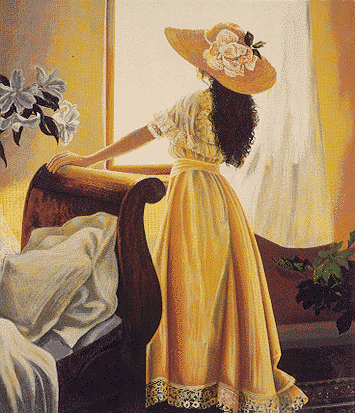
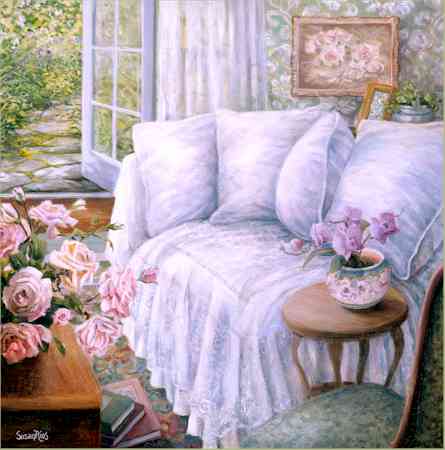
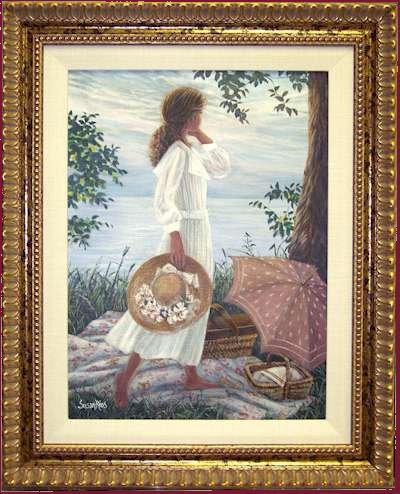
Painting "Days End" from www.susanrios.inc

comments: In this blog we tend to put down a lot of practical ideas for managing the home, and sometimes it is necessary to remind people of the most important reasons for staying home for a woman. Her presence in the home lights the way for the success of others. Her encouragement is needed, as well as her stability--her just being there is as important as any worker being present in the workplace, or moreso. It is her presence that gives the family a sense of well-being, of belonging, and of purpose in life. The new homemaker, no matter what her age, may not realize this, but if she will keep at it, she will see one day and be glad that she didn't give up her post and go to work for someone else.

There is an old story told of a mother who was doing some embroidery. Her little son was sitting at her feet and looking underneath at the messy threads criss-crossing in a tangled mess. "What are you making, mother?" he asked. "I'm sewing a basket of beautiful flowers," she said. "But mother, it doesn't look beautiful from where I'm looking," he complained.

"In a little while, I'll let you see it from above," she replied patiently. The little boy continued to watch and he still couldn't understand how his mother could be making something beautiful from such a lot of different threads and colors, for apparently to him, the threads were not in any kind of order.

Finally after awhile, his mother lifted him up to her lap so that he could see the beautiful picture she was making. "You see, " she said, "We can't always tell what the end result will be, for it often looks like we are making a terrible mess when we begin something worthwhile. When you are young, you don't always see the reason for things. You don't know you are doing things that will one day become beautiful."

Friday, January 27, 2006

A Few Opportunities at Home

The home has so many possibilities, it is a wonder that people spend so much time away from it. I just met a woman of moderate means, whose husband, for a hobby, installed a pond in their small yard. Surround by rocks and various shrubs, they spend happy moments in quiet thought and observation at this spot. They also have several bird feeders around the outside of the house, which keeps them busy filling and re-filling. These feeders can be clearly viewed from the windows of the inside of the house, so that the variety of birds can be enjoyed as they eat their lunch or sit in their lounge room. So there they have a little park, and a place to stroll around, with complete privacy.

One of the most useful things a new homemaker can develop is the art of sewing. Don't be scared off by those complicated sewing shows on public broadcasting. All you need to learn are a few basics that will carry you on throughout your home life. Learn the basics of hand-sewing, such as threading the needle, tying the knot, and sewing a seam. Useful for making everything from table cloths and napkins, to curtains, these can later be substituted with basic sewing machine knowledge. Again, all you really need to know is how to sew a seam.

In spite of the many books and programs there are about sewing, I've personally found that the most useful way of developing sewing skill is to use a sewing pattern from the fabric store. These include step-by-step instructions, which, if followed carefully, can help you add to your sewing skills. A lot of things that experts are making a big deal out of now-a-days, such as pin-tucks, ruffles, zippers, button-holes, or collars, are more easily learned from these sewing patterns. They come in brands such as Butterick, McCalls, Simplicity and more.

If you start with the home decorating type of sewing, you will get better results the first time you sew. This is because home decor items like cushions and table dressings and tea cozies, usually involve basic shapes of squares and rectangles and simple hems, whereas clothing requires attention to curved areas and different types of folding before sewing.

I think sewing your own clothes is a great beginning for self-reliance. That way, when the styles go wacky and wierd, you can sew up a skirt in the pattern you like, adding a little length or some trim to update the look. When you sew, you don't have to say, "I can't find anything to wear," because all you have to do is buy a pattern and the required amound of fabric, and follow the directions on the paper which is included in the pattern.

Study the pattern first to get an idea of what you will be doing. The best way to do this is to get a cup of soothing tea or your favorite drink, have uplifting music in the background, and read the instructions while reclining in a comfortable chair. Read every part of the pattern envelope and the instruction sheets, including definitions and layout instructions. Then read the step-by-step sewing program.

Another thing that can be done at home is old-fashioned cooking. Eating at home is better for you if you use real, natural foods, as close to their original form as possible. Instead of buying frozen mashed potatoes or frozen cooked rice, get the raw ingredient and learn to cook it yourself. In grocery stores today, there are free recipe cards in the produce section for ways to use all those fresh fruits and vegetables. One might wonder why anyone would bother to cook from raw ingredients when it can be bought so conveniently already prepared. It is because the prepared ingredients can often be inferiror (you didn't pick it yourself or ascertain its freshness or firmness, for example), and is always loaded with extra salts and other things that you can't pronounce. Why not choose it and prepare it yourself so you will know what you are eating, and preserve your health for years to come.

By the way, we'd appreciate it if you wouldn't post on articles that are a year or more old. It is a bother to bring up the old subjects. If you missed the current subjects, it is too late to leave a comment, as I don't have time to dredge up old stuff. So the one who is trying to post about how bad things were in Germany during the era of the castles... Sorry ;-)

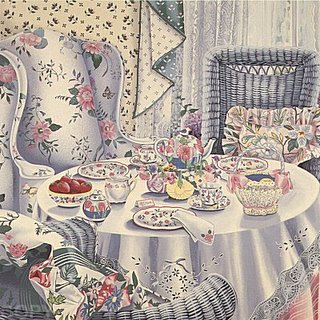
A Sweet Remembrance from www.susanriosinc.com

Wednesday, January 25, 2006

The First Year Home


We hope to have a series of articles for those who are home for the first time. It is at this early stage of homemaking that many women give up and go to work. They don't like it at work but they don't know what to do at home. We'll be giving you some ideas that other people have discovered that make it worthwhile to be the full time manager of the home and family. Even if you haven't got any children, there is surprisingly a lot to do.

My first days at home had an air of loneliness. I had come from a big family where we were active and noisy, especially in the evenings around the fireplace. I always had plenty of company when cooking or cleaning up the kitchen, or doing the laundry. Now, I was alone with my husband, who was "the strong silent type," as he would be described. (His job required a lot of public speaking, and when he came home, he wasn't much of a conversationalist. He later objected to my description of him as a strong silent type, claiming he wasn't so strong.) It was difficult not to have a talkative companion when he was home, but it was worse when he was away, for I missed my noisy, bustling family. I think a lot of newly married women experience this. For that reason, I strongly advice the newly married couple not to move away from the towns where they grew up, too impulsively. Stay around awhile so that you can have the company of his family or your family, to help with the times when you need fellowship and support.

There is a lot to do, but being absolutely on your own if your husband has to be away, can be de-motivating. I once had a visit from my grandmother when I was a newly-wed. She wondered why I was so sad and lonely. "I can't understand you young people," she said. "When my John was away, I used it as an opportunity to clean the floors and do the laundry, re-arrange things, or write some letters. He didn't like me to be doing housework when he was home, and this was my chance."

I looked around our small apartment and just didn't see much to do. However, we were invited to the apartment next door, which was identical to ours, and had my eyes opened! This woman was my age, and she and her husband were at about the same stage of life as we were. She had transformed that apartment into something totally unrecognizable as an apartment. Although it was the same as ours in layout, she had, by using all her grandmother's linens and things from the fabric store, make it look like a real home.

Her management wasn't just applied to the inside of her small living areas; she paid special attention to the lanai and the front door area that belonged to her apartment, making sure it was neat, set with a beautiful potted plant and a greeting on the door. Their deck area was also kept clean and attractive looking, rather than heaped with storage items or trash, like so many others. Throughout the day she swept her eyes around the rooms of that little place and checked it, corrected things and went about the serious business of her life. She kept a notebook of expenses and was always looking for a bargain. For such a one so young, she must have had good training in her own home.

Most brides I knew at the time kept their wedding gifts and their hope chest items packed away if they were in a temporary residence, packed away until they could move to their real home. This girl had the table spread with an embroidered cloth, two places set with beautiful dishware, candles and other things displayed in attractive containers, and fake velvet drapery she had made herself with yardage and fringe.

Unlike other just-married women, she stayed at home and prepared menus, lists, and meals for her and her husband. They often invited others in to share meals. She kept busy sewing and creating but it wasn't all for pleasure. They lived on one small salary and she worked hard making it stretch so that she wouldn't have to leave her home and get a job, and so that her husband wouldn't have the pressure of debt. She also did a lot of things for her husband, who wasn't always able to do errands because of his schedule of work. She did his banking, picked up things he needed at the store, went to the post office, and took the car in for repairs.

When she got up in the morning she prepared a substantial breakfast, and saw her husband off to work. Later she cleaned it all up and got herself ready to go out to the market. She may have stopped by her husband's work and had lunch with him or left a home made lunch for him. When she returned home, there was laundry and ironing and correspondence to see to. There wasn't an idle moment in her time, yet she found plenty of time to rest and was never stressed.

I like the paragraph from Taylor Caldwell's article about her aunt:

"Aunt Polly...would then come home.... to prepare fragrant tea and bake luscious scones to be eaten with homemade strawberry jam. Though she had no modern washing-machine and used flat irons and hung out her laundry and had no vacuum cleaner and other "aids," she managed to look serene and rested at all times...I would visit Aunt Pollie for the soothing joy of being in a real home, among soft voices and gentle music, among frangrances and graciousness, and topping it off a real British Tea, produced apparently without effort. "

When her husband was away, this woman took a nap so that she could get revived for the evening. While he was worn out and tired, she was still able to provide a home cooked meal for him and still have a little energy left to be good company for him. I did noticed that he helped her quite a bit, but she did not require it.

A lot of women think there is no sense staying home if they can't have a salary, but staying home is like earning another income. It all depends upon how you manage the money and the things that you have. Many of the things that you are doing at home, would have to be hired out to someone else, and that is a big drain on your finances. Staying home and doing it yourself is always more economical, and you can get a feeling for your own home and family that you would not, if others were taking care of it.

We'll have more ideas for your first year at home, whether you are a newlywed or not, to come.

Painting from www.susanrios.inc Check out this site for prints and cards--beautiful to hang on the walls of your home.

Monday, January 23, 2006

Keeping Your Marriage


Obviously, most people repeat the lines "better or worse" during their wedding ceremony. Too often these days, the couple interprets it as meaning "only when things are going well for us." or "for me."

Marriage is serious business. You must stay in it even if you don't like the person anymore, or if you've grown apart. You cannot quit your marriage if you meet someone you like better. You can't give it up because your wife got sick and can't work anymore, or because she lost her looks and got fatter. You can't quit even if you are arguing a lot. If you are tired of being married, you still can't quit. You can't divorce because of financial pressures or poverty. You can't abandon your marriage even if you think you were married too young or too quickly. Many couples married during the war in the 40's in a hurry, without much of a wedding, and lived to see their 50th and 60th wedding anniversaries.

Just apply the above childish attitudes to your college or your work and see how it would turn out if you applied the same mentality to that commitment.

Everyone should be aware that there is a strong pressure being applied from all different sources on your marriage relationship. Remember that the enemy is not the people around you as much as it is the philosophy behind it all--divisiveness. You'll see it on television, read it in magazines, hear it conversations---the little snide comments criticising wives or husbands, putting them down, and ridiculing the marriage relationship. Add to that the in-law jokes and the sit-coms that portray in-laws as outlaws, and you can come away feeling that there is a war going on in your home.

Remember to speak only good of your mate to others, and to remind your mate to only speak good of you. Make that a hard, fast rule and don't let anyone believe for a moment that you are unhappy with your mate, or they will come right in there and put a wedge between you. Even jokes sometimes can lead others to believe you don't love each other.

Marriage is for better or for worse, but many people want to bail out when the "for worse" part comes. And what is the outcome for all this effort? Each time you overcome diversity in marriage, you strengthen it. Staying in it through thick and thin, increases its chances of survival.

If you don't bail out when there is trouble, but are willing to see it through, no matter what the cost, you will reap results that will make you glad you stuck it through. Later on when you are older, you'll have something to give you credibility: an enduring marriage. This makes you a good example to younger folks. This helps your family become stronger. Instead of his kids and her kids and separate birthday parties, you'll find a wholesome family attending all your social events. Instead of brokenness in the home, you'll be able to use your knowledge to reinforce the marriages of others.

So maybe you are wondering what the larger significance of a lifetime marriage is. It is significant because a nation of strong marriages will have strong families whose loyalties cannot be divided by new philosophies or twisted values. The enemies of our country know this and are ever seeking to find ways to convince people that marriage isn't worthwhile; that it is archaic and not to be taken seriously. The one thing that is necessary to control a nation is to break up the home.

Jane Adams, wife of John Adams, the 2nd President of the United States, wrote to her son when he was an ambassador in Europe, " The habits of a vigorous mind are formed when contending with difficuties." The challenge of marriage is to make it the best you can, and to present something good and beautiful to the world. This can often be achieved by the simple act of loyalty in word and deed. Those who stay together through all difficulties can develop good minds and good judgement.

Marriage is more than two people loving each other. It is the building of an estate together, and, in some cases, a family dynasty, a society in itself. Several couples I know who had problems, stuck together and came out much further ahead than their friends who decided to call it quits. Now they have their property paid for, and it is worth much more than it was 40 years ago. Divorce puts you debt and makes each party poorer. Marriage is not just about property and money. It is also a strong, protective barrier against outside stress and attack. The longer you are married, the more seriously you'll be regarded. How can anyone be trusted in business or with heavy responsibility that requires patience and longevity, if they leave their own mate?

There is an attack on older marriages these days. People who have been together 20 and 30 years or more, are getting divorced. They feel that the marriage is "dead" and that they must "move on." They believe that the person they are married to now is not the same person as when they married him. (Let us hope that he isn't, in some respects!)) If you abandon your marriage, you miss out on the different, progressing stages of married life that benefit you both physically and emotionally. Marriage was designed by God as a support system for one man and one woman, throughout the varying changes in their lives. Leaving the marriage only results in stunted growth. Marrying again and again leaves the marriages in a perpetually infantile state of maturity.


Note: I realize there are a lot of innocent people who have been divorced against their will, through no fault of their own. I'm not condemning the divorced, just the action of divorce, which devastates so many for generations.


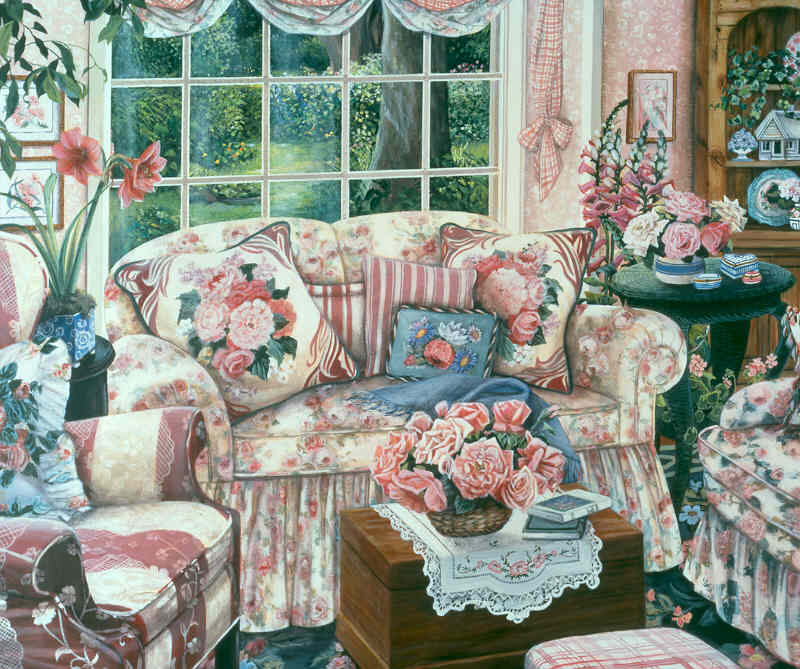
Cherished by Susan Rios from www.susanrios.inc

Keeping the Home


There are many people checking daily for a new article, and I always feel sorry when I don't have the time to post something to lift everyone up. I am trying to keep up with my home home and the extra things that need to be done.

Presently I am getting things ready to give to my grown children, for their homes and to pass on to future generations: scrapbooks, photographs, household items from their grandmother's estate, and childhood mementos. I hope to add things to three trunks or wood boxes, until everything is accounted for. It has been quite a job, since for years, I was so busy with the children and the house, that I shoved things away without sorting them.

Here might be a warning to some of the younger women, not to let it mount up into such a problem that it bogs you down later on in life when you might not have the mental or physical stamina to do it--to keep things sorted into items you want to keep, and separate from current projects you are working on. These things will truly catch up to you one of these days, if you don't.

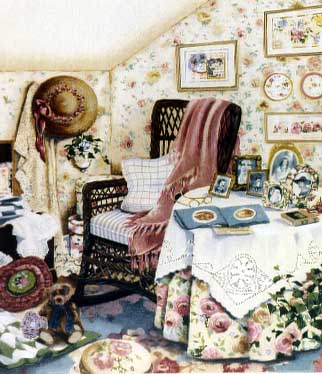
Attic Memories by Susan Rios from www.susanrios.inc

Saturday, January 21, 2006

Pictures


I get inquiries all the time concerning the source of the pictures we post on the blog. Some of them come from the fine art section of Allposters. The Susan Rios prints are available to purchase at the following places:


www.piersidegallery.com/artists/rios
http://www.susanriosinc.com/
www.artcentergallery.com/gallery/susan-rios
www.villagegallery.com/rios.html
www.chatsworthflorist.com/susanrios.html
www.leslielevy.com/lim_ed_view.php?view=4&id=srios
http://www.helenjonesgallery.com/rios.htm
http://www.helenjonesgallery.com/national.htm
http://www.larrysmithfineart.com/rios__main_page.htm
http://www.larrysmithfineart.com/rios_abovethegarden.htm

When you visit these places, be sure to check out Thomas Kinkade, Sandra Kuck, and Robert Duncan, who have galleries there, too, including Thomas Kinkade. I think it is wonderful that these artists make it possible for their paintings to be enjoyed and appreciated online by so many people, and also that the subject matter shows the love of home and family, with the beauty of the earth.

Lydia

"Above the Garden" by Susan Rios.

Tuesday, January 17, 2006

More Hours in My Day


Emilie Barnes' website http://www.morehours.bizland.com is very encouraging to women who want to be good homemakers, wives and others, while adding meaning and beauty to their lives. Click on the side subjects on the left and go through all of these. Her book, "The Spirit of Loveliness" has great ideas about making every room in the house a joy to be in, as well as the outer perimeters of the house--the garden and the front porch. No matter how small your dwelling is, it is the homemaker's responsibility and domain. She, and she alone, is responsible to give it the atmosphere she desires. She may use the help of members of her family, and websites such as Emily Barnes , but it is her duty to see that it is done. No one else is going to do it unless she can afford to hire someone.

I recall dreaming, when I was a child, of having a place of my own, but as time went by I met with disappointment after disappointment. We were not going to get our "dream home." We were never going to have things exactly as we liked it. By reading some of these inspirational books about the home and family, I learned how to create that dream within the circumstances that I was given. You can do this too. No matter where you are, your place of living can be made peaceful and lovely.

Most women get bored and discouraged with the cleaning and organizing of the home. This is where beauty can be added to motivate them to do the less pleasant tasks. Scented soaps for the bathroom, a sparkly candleholder for the dining room, and a bouquet of flowers for the coffee table, all add that little reward to cleaning each room. These can all be bought at dollar stores throughout the world, or you can innovate with things on hand. Nothing can stop you, if you really want to be a good homemaker and have a beautiful home. He who is faithful in little, will be faithful in much. Take care of what you have now, and you will find that one day you'll be in charge of something greater. We must all be good stewards. It brings great rewards.

I've listened to women complain that they never had anything nice. They wanted a nice home and a good family, but they didnt' work for it. Now, they are envious of those who had these dreams. The ones who made it, stuck to their principles and stood by their commitment to the home and family. The ones who gave up, did not mulitiply their blessings.

Anything that is worth doing at all, is worth doing well.

Good, better, best;
Never let it rest,
Til your good is better,
And your better, best.

Tuesday, January 10, 2006

The Wife, by Washington Irving.

Country Cottage, by Joshua Fisher

(Keep in mind the expressions and customs of the era, when you are reading this. Sometimes moderns misunderstand the intentions of such literature, and draw all kinds of wrong conclusions because of words that are rarely used today, which had different connotations in the 18th century! Indeed, sweeping judgements about the relationships of men and women of the past, have been formed because of literary expressions which were never intended to mean what people think today)


Irving, Washington (1783-1859) - An American historian, biographer, and essayist who also served as ambassador to Spain (1842-46). He was the first American author to achieve international literary renown.

The Wife (1819-20) - Part of "The Sketch Book of Geoffrey Crayon, Gent.," Irving's popular collection of short stories, folklore, travelogues, and essays. The author tells the story of his friend's financial misfortunes and the torturing thoughts he has of sharing his disgrace with his wife.

1819-20 THE SKETCH BOOK

THE WIFE


by Washington Irving

The treasures of the deep are not so precious
As are the conceal'd comforts of a man
Locked up in woman's love. I scent the air
Of blessings, when I come but near the house.
What a delicious breath marriage sends forth . .
The violet bed's not sweeter.
MIDDLETON.-

I HAVE often had occasion to remark the fortitude with which women sustain the most overwhelming reverses of fortune. Those disasters which break down the spirit of a man, and prostrate him in the dust,seem to call forth all the energies of the softer sex, and give such intrepidity and elevation to their character, that at times it approaches to sublimity.

Nothing can be more touching than to behold a soft and tender female, who had been all weakness and dependence,and alive to every trivial roughness, while treading the prosperous paths of life, suddenly rising in mental force to be the comforter and support of her husband under misfortune, and abiding, with unshrinking firmness, the bitterest blasts of adversity.

As the vine, which has long twined its graceful foliage about the oak, and been lifted by it into sunshine, will, when the hardy plant is rifted by the thunderbolt, cling round it with its caressing tendrils, and bind up its shattered boughs; so is it beautifully ordered by Providence, that woman, who is the mere dependent and ornament of man in his happier hours, should be his stay and solace when smitten with sudden calamity; winding herself into the rugged recesses of his nature, tenderly supporting the drooping head, and binding up the broken heart.

I was once congratulating a friend, who had around him a blooming family, knit together in the strongest affection. "I can wish you no better lot," said he, with enthusiasm, "than to have a wife and children. If you are prosperous, there they are to share your prosperity; if otherwise, there they are to comfort you."

And, indeed,I have observed that a married man falling into misfortune is more apt to retrieve his situation in the world than a single one; partly because he is more stimulated to exertion by the necessities of the helpless and beloved beings who depend upon him for subsistence; but chiefly because his spirits are soothed and relieved by domestic endearments, and his self-respect kept alive by finding, that though all abroad is darkness and humiliation, yet there is still a little world of love at home, of which he is the monarch. Whereas a single man is apt to run to waste and self-neglect; to fancy himself lonely and abandoned, and his heart to fall to ruin like some deserted mansion, for want of an inhabitant.

These observations call to mind a little domestic story, of whichI was once a witness. My intimate friend, Leslie, had married a beautiful and accomplished girl, who had been brought up in the midst of fashionable life. She had, it is true, no fortune, but that of my friend was ample; and he delighted in the anticipation of indulging her in every elegant pursuit, and administering to those delicate tastes and fancies that spread a kind of witchery about the sex.- "Her life," said he, "shall be like a fairy tale."

The very difference in their characters produced an harmonious combination: he was of a romantic and somewhat serious cast; she was all life and gladness. I have often noticed the mute rapture with which he would gaze upon her in company, of which her sprightly powers made her the delight; and how, in the midst of applause, her eye would still turn to him, as if there alone she sought favor and acceptance. When leaning on his arm, her slender form contrasted finely with his tall manly person. The fond confiding air with which she looked up to him seemed to call forth a flush of triumphant pride and cherishing tenderness, as if he doted on his lovely burden for its very helplessness.

Never did a couple set forward on the flowery path of early and well-suited marriage with a fairer prospect of felicity. It was the misfortune of my friend, however, to have embarked his property in large speculations; and he had not been married many months, when, by a succession of sudden disasters, it was swept from him, and he found himself reduced almost to penury. For a time he kept this situation to himself, and went about with a haggard countenance, and a breaking heart.

His life was but a protracted agony; and what rendered it more insupportable was the necessity of keeping up a smile in the presence of his wife; for he could not bring himself to overwhelm her with the news. She saw, however, with the quick eyes of affection, that all was not well with him. She marked his altered looks and stifled sighs, and was not to be deceived by his sickly and vapid attempts at cheerfulness.

She tasked all her sprightly powers and tender blandishments to win him back to happiness; but she only drove the arrow deeper into his soul. The more he saw cause to love her, the more torturing was the thought that he was soon to make her wretched. A little while, thought he, and the smile will vanish from that cheek- the song will die away from those lips- the lustre of those eyes will be quenched with sorrow; and the happy heart, which now beats lightly in that bosom, will be weighed down like mine, by the cares and miseries of the world.

At length he came to me one day, and related his whole situationin a tone of the deepest despair. When I heard him through I inquired,"Does your wife know all this?"- At the question he burst into an agony of tears. "For God's sake!" cried he, "if you have any pity on me, don't mention my wife; it is the thought of her that drives me almost to madness!"

"And why not?" said I. "She must know it sooner or later: you cannot keep it long from her, and the intelligence may break upon her in a more startling manner, than if imparted by yourself; for the accents of those we love soften the harshest tidings. Besides, you are depriving yourself of the comforts of her sympathy; and not merely that, but also endangering the only bond that can keep hearts together- an unreserved community of thought and feeling. She will soon perceive that something is secretly preying upon your mind; and true love will not brook reserve; it feels undervalued and outraged,when even the sorrows of those it loves are concealed from it."

"Oh, but, my friend! to think what a blow I am to give to all her future prospects- how I am to strike her very soul to the earth, by telling her that her husband is a beggar! that she is to forego all the elegancies of life- all the pleasures of society- to shrink with me into indigence and obscurity! To tell her that I have dragged her down from the sphere in which she might have continued to move in constant brightness- the light of every eye- the admiration of every heart!- How can she bear poverty? she has been brought up in all the refinements of opulence. How can she bear neglect? she has been the idol of society. Oh! it will break her heart- it will break her heart!-"

I saw his grief was eloquent, and I let it have its flow; for sorrow relieves itself by words. When his paroxysm had subsided, and he had relapsed into moody silence, I resumed the subject gently, and urged him to break his situation at once to his wife. He shook his head mournfully, but positively. "But how are you to keep it from her? It is necessary she should know it, that you may take the steps proper to the alteration of your circumstances. You must change your style of living- nay,"observing a pang to pass across his countenance, "don't let that afflict you. I am sure you have never placed your happiness in outward show- you have yet friends, warm friends, who will not think the worse of you for being less splendidly lodged: and surely it does not require a palace to be happy with Mary-"

"I could be happy with her," cried he, convulsively, "in a hovel!- I could go down with her into poverty and the dust!- I could- I could-God bless her!- God bless her!" cried he, bursting into a transport of grief and tenderness. "And believe me, my friend," said I, stepping up, and grasping him warmly by the hand, "believe me she can be the same with you. Ay, more: it will be a source of pride and triumph to her- it will call forth all the latent energies and fervent sympathies of her nature; for she will rejoice to prove that she loves you for yourself.

There is in every true woman's heart a spark of heavenly fire, which lies dormant in the broad daylight of prosperity; but which kindles up, and beams and blazes in the dark hour of adversity. No man knows what the wife of his bosom is- no man knows what a ministering angel she is- until he has gone with her through the fiery trials of this world."

There was something in the earnestness of my manner, and the figurative style of my language, that caught the excited imagination of Leslie. I knew the auditor I had to deal with; and following up the impression I had made, I finished by persuading him to go home and unburden his sad heart to his wife.

I must confess, notwithstanding all I had said, I felt some little solicitude for the result. Who can calculate on the fortitude of one whose life has been a round of pleasures? Her gay spirits might revolt at the dark downward path of low humility suddenly pointed out before her, and might cling to the sunny regions in which they had hither to revelled.

Besides, ruin in fashionable life is accompanied by so many galling mortifications, to which in other ranks it is a stranger.- In short, I could not meet Leslie the next morning without trepidation. He had made the disclosure.

"And how did she bear it?" "

"Like an angel! It seemed rather to be a relief to her mind, for she threw her arms round my neck, and asked if this was all that had lately made me unhappy.- But, poor girl," added he, "she canno trealize the change we must undergo. She has no idea of poverty but in the abstract; she has only read of it in poetry, where it is allied to love. She feels as yet no privation; she suffers no loss of accustomed conveniences nor elegancies. "

When we come practically to experience its sordid cares, its paltry wants, its petty humiliations-then will be the real trial." "But," said I, "now that you have got over the severest task, that of breaking it to her, the sooner you let the world into the secret the better. The disclosure may be mortifying; but then it is a single misery, and soon over: whereas you otherwise suffer it, in anticipation, every hour in the day.

It is not poverty so much as pretence, that harasses a ruined man- the struggle between a proud mind and an empty purse- the keeping up a hollow show that must soon come to an end. Have the courage to appear poor and you disarm poverty of its sharpest sting." On this point I found Leslie perfectly prepared. He had no false pride himself, and as to his wife, she was only anxious to conform to their altered fortunes.

Some days afterwards he called upon me in the evening. He had disposed of his dwelling house, and taken a small cottage in the country, a few miles from town.

He had been busied all day in sending out furniture. The new establishment required few articles, and those of the simplest kind. All the splendid furniture of his late residence had been sold, excepting his wife's harp. That, he said, was too closely associated with the idea of herself; it belonged to the little story of their loves; for some of the sweetest moments of their courtship were those when he had leaned over that instrument, and listened to the melting tones of her voice. I could not but smile at this instance of romantic gallantry in a doting husband.

He was now going out to the cottage, where his wife had been all day superintending its arrangement. My feelings had become strongly interested in the progress of this family story, and, as it was a fine evening, I offered to accompany him. He was wearied with the fatigues of the day, and, as he walked out, fell into a fit of gloomy musing. "Poor Mary!" at length broke, with a heavy sigh, from his lips. "And what of her?" asked I: "has anything happened to her?"

"What," said he, darting an impatient glance, "is it nothing to be reduced to this paltry situation- to be caged in a miserable cottage- to be obliged to toil almost in the menial concerns of her wretched habitation?"

"Has she then repined at the change?"

"Repined! she has been nothing but sweetness and good humor. Indeed, she seems in better spirits than I have ever known her; she has been to me all love, and tenderness, and comfort!"

"Admirable girl!" exclaimed I. "You call yourself poor, my friend; you never were so rich- you never knew the boundless treasures of excellence you possess in that woman."

"Oh! but, my friend, if this first meeting at the cottage were over,I think I could then be comfortable. But this is her first day of real experience; she has been introduced into a humble dwelling- she has been employed all day in arranging its miserable equipments- she has, for the first time, known the fatigues of domestic employment-she has, for the first time, looked round her on a home destitute of every thing elegant,- almost of every thing convenient; and may now be sitting down, exhausted and spiritless, brooding over a prospect of future poverty."

There was a degree of probability in this picture that I could not gainsay, so we walked on in silence. After turning from the main road up a narrow lane, so thickly shaded with forest trees as to give it a complete air of seclusion, we came in sight of the cottage. It was humble enough in its appearance for the most pastoral poet; and yet it had a pleasing rural look.

A wild vine had overrun one end with a profusion of foliage; a few trees threw their branches gracefully over it; and I observed several pots of flowers tastefully disposed about the door, and on the grass-plot in front. A small wicket gate opened upon a footpath that wound through some shrubbery to the door. Just as we approached, we heard the sound of music- Leslie grasped my arm; we paused and listened.It was Mary's voice singing, in a style of the most touching simplicity, a little air of which her husband was peculiarly fond.

I felt Leslie's hand tremble on my arm. He stepped forward to hear more distinctly. His step made a noise on the gravel walk. A bright beautiful face glanced out at the window and vanished- a light footstep was heard and Mary came tripping forth to meet us: she was in a pretty rural dress of white; a few wild flowers were twisted in her fine hair; a fresh bloom was on her cheek; her whole countenance beamed with smiles- I had never seen her look so lovely.

"My dear George," cried she, "I am so glad you are come! I have been watching and watching for you; and running down the lane, and looking out for you. I've set out a table under a beautiful tree behind the cottage; and I've been gathering some of the most delicious strawberries, for I know you are fond of them- and we have such excellent cream- and every thing is so sweet and still here- Oh!" said she, putting her arm within his, and looking up brightly in his face, "Oh, we shall be so happy!"

Poor Leslie was overcome. He caught her to his bosom- he folded his arms round her- he kissed her again and again- he could not speak, but the tears gushed into his eyes; and he has often assured me, that though the world has since gone prosperously with him, and his life has, indeed, been a happy one, yet never has he experienced a moment of more exquisite felicity.

-- THE END

The following is a list of other works by Washington Irving. He was best known for his story, "Rip Van Winkle."

AlhambraAnglerArt of Book-MakingAuthor's Account of HimselfBoar's Head Tavern EastcheapBroken HeartChristmasChristmas DayChristmas DinnerChristmas EveCountry ChurchEnglish Writers on AmericaInn KitchenJohn BullL'EnvoyLegend of Sleepy HollowLittle BritainLondon AntiquesMutability of LiteraturePhilip of PokanoketPride of the VillageRip Van WinkleRoscoeRoyal PoetRural FuneralsRural Life in EnglandSpectre BridegroomStage CoachStratford-on-AvonSunday in LondonTraits of Indian CharactersVoyageWestminster AbbeyWidow and Her SonWife

These stories can be read here :http://www.19.5degs.com/author/ebooks/washington-irving/28/0#list


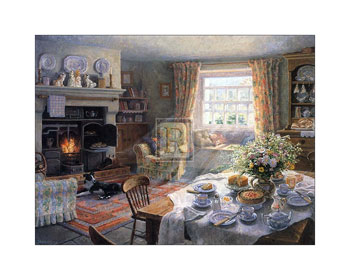
Tea Cup Cottage by Thomas Kinkade -- print available to purchase online

Inspiring Stories of Home and Family


Here's a great story from a reader! You are certainly free to add more stories like this if you wish. We are having a Winter's Tea here in January, for some young women, to encourage them to be keepers of the home, and the theme will be story-telling. I'm certainly going to include this one.

Hi Lydia, I read my boys a story this morning and thought of you during the part I'm going to copy below. It brought a lump to my throat and I commented to them how sweet I thought this part was. It came from a republished book from 1847 called "Boys of Grit who Changed the World" and this particular story was about the life of Hans Christian Andersen and the part following was about his mother. I hope you appreciate it as much as I did.

Joanna in northern Ca. :) The Andersens were poor-so poor that they lived in one mean room where there was little besides the shoemaker's bench, the rough bedstead, and a few homemade chairs. The father was a disappointed man, his greatest ambition in life had been to secure an education but his father had thought this was a very foolish idea and as a result the shoemaker, although an intelligent man, could neither read nore write.

Many years afterward Hans described the home of his boyhood. He wrote: "Our little room was almost filled with the shoemaker's bench, the bed and my crib. The walls were covered with pictures and over the workbench was a cupboard containing books and songs; the little kitchen was full of shining plates and metal pans or by means of a ladder it was possible to go out on the roof where, in the gutters between it and the neighbor's house, there was a great chest filled with soil. This was my dear mother's garden, where she grew her vegetables....my mother always kept our room clean and neat and took great pride in having the bed linen and the curtains very white."

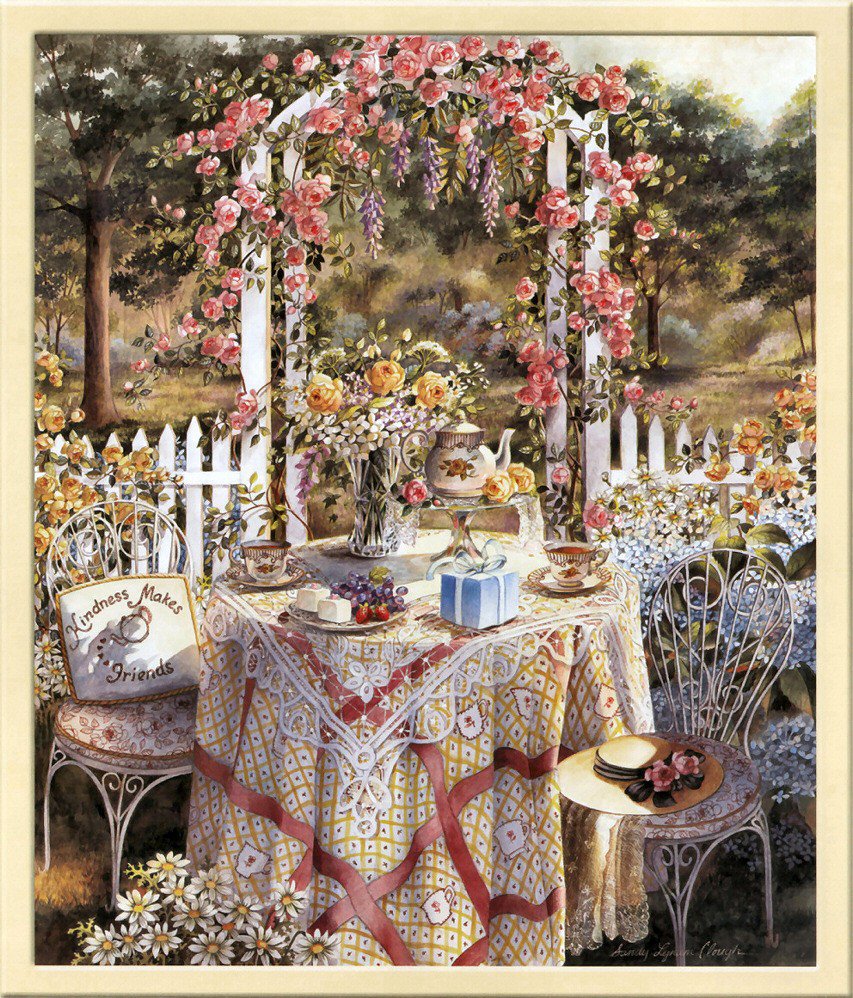
picture by Sandy Lynman Clought (http://www.sandyclough.com/Clough.htm) Click on for a larger, beautiful view!

Tuesday, January 03, 2006

Keeper of the Springs


Keepers of the SpringsBy Peter , c. 1942

(Peter Marshall immigrated to America from Scotland, possibly in the early 1930's. He loved his new country and reached many new opportunities in his life, but he saw the warning signs of women abandoning their responsibilities as wives, mothers and keepers of the home. In this sermon, he warns Americans of the tragic outcome, and shows the true greatness and potential of womanhood.)

Once upon a time, a certain town grew up at the foot of a mountain range. It was sheltered in the lee of the protecting heights, so that the wind that shuddered at the doors and flung handfuls of sleet against the window panes was a wind whose fury was spent.

High up in the hills, a strange and quiet forest dweller took it upon himself to be the Keeper of the Springs. He patrolled the hills and wherever he found a spring, he cleaned its brown pool of silt and fallen leaves, of mud and mold and took away from the spring all foreign matter, so that the water which bubbled up through the sand ran down clean and cold and pure. It leaped sparkling over rocks and dropped joyously in crystal cascades until, swollen by other streams, it became a river of life to the busy town. Millwheels were whirled by its rush.

Gardens were refreshed by its waters. Fountains threw it like diamonds into the air. Swans sailed on its limpid surface, and children laughed as they played on its banks in the sunshine.
But the City Council was a group of hard-headed, hard-boiled businessmen.

They scanned the civic budget and found in it the salary of a Keeper of the Springs. Said the Keeper of the Purse: "Why should we pay this romance ranger? We never see him; he is not necessary to our town's work life. If we build a reservoir just above the town, we can dispense with his services and save his salary." Therefore, the City Council voted to dispense with the unnecessary cost of a Keeper of the Springs, and to build a cement reservoir.

So the Keeper of the Springs no longer visited the brown pools but watched from the heights while they built the reservoir. When it was finished, it soon filled up with water, to be sure, but the water did not seem to be the same. It did not seem to be as clean, and a green scum soon befouled its stagnant surface.

There were constant troubles with the delicate machinery of the mills, for it was often clogged with slime, and the swans found another home above the town. At last, an epidemic raged, and the clammy, yellow fingers of sickness reached into every home in every street and lane.

The City Council met again. Sorrowfully, it faced the city's plight, and frankly it acknowledged the mistake of the dismissal of the Keeper of the Springs. They sought him out of his hermit hut high in the hills, and begged him to return to his former joyous labor. Gladly he agreed, and began once more to make his rounds.

It was not long until pure water came lilting down under tunnels of ferns and mosses and to sparkle in the cleansed reservoir. Millwheels turned again as of old. Stenches disappeared. Sickness waned and convalescent children playing in the sun laughed again because the swans had come back.

Do not think me fanciful, too imaginiative or too extravagant in my language when I say that I think of women, and particularly of our mothers, as Keepers of the Springs. The phrase, while poetic, is true and descriptive. We feel its warmth...its softening influence...and however forgetful we have been...however much we have taken for granted life's precious gifts, we are conscious of wistful memories that surge out of the past--the sweet, tender, poignant fragrances of love.

Nothing that has been said, nothing that could be said, or that ever will be said, would be eloquent enough, expressive enough, or adequate to make articulate that peculiar emotion we feel to our mothers. So I shall make my tribute a plea for Keepers of the Springs, who will be faithful to their tasks.

There never has been a time when there was a greater need for Keepers of the Springs, or when there were more polluted springs to be cleansed. If the home fails, the country is doomed. The breakdown of homelife and influence will mark the breakdown of the nation. If the Keepers of the Springs desert their posts or are unfaithful to their responsibilities, the future outlook of this country is black, indeed.

This generation needs Keepers of the Springs who will be courageous enough to cleanse the springs that have been polluted. It is not an easy task--nor is it a popular one, but it must be done for the sake of the children, and the young women of today must do it.

The emancipation of womanhood began with Christianity, and it ends with Christianity. It had its beginning one night nineteen hundred years ago when there came to a woman named Mary a vision and a message from heaven. She saw the rifted clouds of glory and the hidden battlements of heaven.

She heard an angelic annunciation of the almost incredible news that she, of all the women on earth...of all the Marys in history...was to be the only one who should ever wear entwined the red rose of maternity and the white rose of virginity. It was told her--and all Keepers of the Springs know how such messages come--that she should be the mother of the Savior of the world.

It was nineteen hundred years ago "when Jesus Himself a baby deigned to be and bathed in baby tears His deity"...and on that night, when that tiny Child lay in the straw of Bethlehem, began the emancipation of womanhood.

When He grew up and began to teach the way of life, He ushered woman into a new place in human relations. He accorded her a new dignity and crowned her with a new glory, so that wherever the Christian evangel has gone for nineteen centuries, the daughters of Mary have been respected, revered, remembered, and loved, f or men have recognized that womanhood is a sacred and a noble thing, that women are of finer clay...are more in touch with the angels of God and have the noblest function that life affords. Wherever Christianity has spread, for nineteen hundred years men have bowed and adored.

It remained for the twentieth century, in the name of progress, in the name of tolerance, in the name of broadmindedness, in the name of freedom, to pull her down from her throne and try to make her like a man.

She wanted equality. For nineteen hundred years she had not been equal--she had been superior. But now, they said, she wanted equality, and in order to obtain it, she had to step down. And so it is, that in the name of broadminded tolerance, a man's vices have now become a woman's.

Twentieth-century tolerance has won for woman the right to become intoxicated, the right to have an alcoholic breath, the right to smoke, to work like a man to act like a man--for is she not man's equal? Today they call it "progress"...but tomorrow,oh, you Keepers of the Springs, they must be made to see that it is not progress.

No nation has ever made any progress in a downward direction. No people ever became great by lowering their standards. No people ever became good by adopting a looser morality. It is not progress when the moral tone is lower than it was. It is not progress when purity is not as sweet. It is not progress when womanhood has lost its fragrance. Whatever else it is, it is not progress!

We need Keepers of the Springs who will realize that what is socially correct may not be morally right. Our country needs today women who will lead us back to an old-fashioned morality, to an old fashioned decency, to an old fashioned purity and sweetness for the sake of the next generation, if for no other reason.

This generation has seen an entirely new type of womanhood emerge from the bewildering confusion of ourtime. We have in the United States today a higher standard of living than in any other country, or at any other time in the world's history.

We have more automobiles, more picture shows, more telephones, more money, more swing bands, more radios, more television sets, more nightclubs, more crime, and more divorce than any other nation in the world. Modern mothers want their children to enjoy the advantages of this new day.

They want them, if possible, to have a college diploma to hang on their bedroom wall, and what many of them regard as equally important--a bid to a fraternity or a sorority. They are desperately anxious that their daughters will be popular, although the price of this popularity may not be considered until it is too late. In short, they want their children to succeed, but the usual definition of success, in keeping with the trend of our day, is largely materialistic.

The result of all this is that the modern child is brought up in a decent, cultured, comfortable, but thoroughly irreligious home. All around us, living in the very shadow of our large churches and beautiful cathedrals, children are growing up without a particle of religious training or influence. The parents of such children have usually completely given up the search for religious moorings.

At first, they probably had some sort of vague idealism as to what their children should be taught. They recall something of the religious instruction received when they were children, and they feel that something like that ought to be passed on to the children today, but they can't do it, because the simple truth is that they have nothing to give.

Our modern broadmindedness has taken religious education out of the day schools. Our modern way of living and our modern irreligion have taken it out of the homes.

There remains only one place where it may be obtained, and that is in the Sunday School, but it is no longer fashionable to attend Sunday School. The result is that there is very little religious education, and parents who lack it themselves are not able to give it to their children--so it is a case of "the blind leading the blind," and both children and parents will almost invariably end up in the ditch of uncertainty and irreligion.

As you think of your own mother, remembering her with love and gratitude--in wishful yearning, or lonely longing, I am quite sure that the memories that warm and soften your heart are not at all like the memories the children of today will have... For you are, no doubt, remembering the smell of fresh starch in your mother's apron or the smell of a newly ironed blouse, the smell of newly baked bread, the fragrance of the violets she had pinned on her breast. It would be such a pity if all that one could remember would be the aroma of toasted tobacco or nicotine and the odor of beer on the breath!

The challenge of the twentieth-century motherhood is as old as motherhood itself. Although the average American mother has advantages that pioneer women never knew--material advantages: education, culture, advances made by science and medicine; although the modern mother knows a great deal more about sterilization, diets, health, calories, germs, drugs, medicines and vitamins, than her mother did, there is one subject about which she does not know as much--and that is God.

The modern challenge to motherhood is the eternal challenge--that of being a godly woman. The very phrase sounds strange in our ears. We never hear it now. We hear about every other kind of women--beautiful women, smart women, sophisticated women, career woman, talented women, divorced women, but so seldom do we hear of a godly woman--or of a godly man either, for that matter.

I believe women come nearer fulfilling their God-given function in the home than anywhere else. It is a much nobler thing to be a good wife than to be Miss America. It is a greater achievement to establish a Christian home than it is to produce a second-rate novel filled with filth. It is a far, far better thing in the realm of morals to be old-fashioned than to be ultramodern. The world has enough women who know how to hold their cocktails, who have lost all their illusions and their faith. The world has enough women who know how to be smart.

It needs women who are willing to be simple. The world has enough women who know how to be brilliant. It needs some who will be brave. The world has enough women who are popular. It needs more who are pure. We need woman, and men, too, who would rather be morally right that socially correct.

Let us not fool ourselves--without Christianity, without Christian education, without the principles of Christ inculcated into young life, we are simply rearing pagans. Physically, they will be perfect. Intellectually, they will be brilliant. But spiritually, they will be pagan. Let us not fool ourselves. The school is making no attempt to teach the principles of Christ. The Church alone cannot do it. They can never be taught to a child unless the mother herself knows them and practices them every day.

If you have no prayer life yourself, it is rather a useless gesture to make your child say his prayers every night. If you never enter a church it is rather futile to send your child to Sunday school. If you make a practice of telling social lies, it will be difficult to teach your child to be truthful. If you say cutting things about your neighbors and about fellow members in the church, it will be hard for your child to learn the meaning of kindness.

The twentieth-century challenge to motherhood--when it is all boiled down--is that mothers will have an experience of God...a reality which they can pass on to their children. For the newest of the sciences is beginning to realize, after a study of the teachings of Christ from the standpoint of psychology, that only as human beings discover and follow these inexorable spiritual laws will they find the happiness and contentment which we all seek.

A minister tells of going to a hospital to visit a mother whose first child had been born. She was a distinctly modern girl. Her home was about average for young married people. "When I came into the room she was propped up in bed writing. 'Come in,' she said, smiling. 'I'm in the midst of housecleaning, and I want your help.' I had never heard of a woman housecleaning while in a hospital bed. Her smile was contagious--she seemed to have found a new and jolly idea. "'I've had a wonderful chance to think here,' she began, 'and it may help me to get things straightened out in my mind if I can talk to you.'

She put down her pencil and pad, and folded her hands. Then she took a long breath and started: 'Ever since I was a little girl, I hated any sort of restraint. I always wanted to be free. When I finished high school, I took a business course and got a job--not because I needed the money--but because I wanted to be on my own. Before Joe and I were married, we used to say that we would not be slaves to each other. And after we married, our apartment became headquarters for a crowd just like us. We weren't really bad--but we did just what we pleased.'

She stopped for a minute and smiled ruefully. 'God didn't mean much to us--we ignored Him. None of us wanted children--or we thought we didn't. And when I knew I was going to have a baby, I was afraid.' She stopped again and looked puzzled. 'Isn't it funny, the things you used to think? She had almost forgotten I was there--she was speaking to the old girl she had been before her great adventure. Then remembering me suddenly--she went on: 'Where was I? Oh, yes, well, things are different now. I'm not free any more and I don't want to be. And the first thing I must do is to clean house.'

Here she picked up the sheet of paper lying on the counterpane. 'That's my housecleaning list. You see, when I take Betty home from the hospital with me--our apartment will be her home--not just mine and Joe's. And it isn't fit for her now. Certain things will have to go--for Betty's sake. And I've got to houseclean my heart and mind. I'm not just myself--I'm Betty's mother. And that means I need God. I can't do my job without Him. Won't you pray for Betty and me and Joe, and for our new home?'

And I saw in her all the mothers of today--mothers in tiny apartments and on lonely farms...Mothers in great houses and in suburban cottages, who are meeting the age-old challenge--' that of bringing up their children to the love and knowledge of God.' And I seemed to see our Savior--with His arms full of children of far-away Judea--saying to that mother and to all mothers--the old invitation so much needed in these times: 'Suffer the little children to come unto me and forbid them not, for of such is the kingdom of God.'

I believe that this generation of young people has courage enough to face the challenging future. I believe that their idealism is not dead. I believe that they have the same bravery and the same devotion to the things worthwhile that their grandmothers had. I have every confidence that they are anxious to preserve the best of our heritage, and God knows if we lose it here in this country, it is forever gone. I believe that the women of today will not be unmindful of their responsibilities; that is why I have dared to speak so honestly. Keepers of the Springs, we salute you!

Our Father, remove from us the sophistication of our age and the skepticism that has come, like frost, to blight our faith and to make it weak. We pray for a return of that simple faith, that old fashioned trust in God, that made strong and great the homes of our ancestors who built this good land and who in building left us our heritage. In the strong name of Jesus, our Lord, we make this prayer, Amen.

Peter Marshall was the U.S. Senate Chaplain from 1946-48 during the presidency of Harry Truman, and died in 1949. He was born in Scotland and was known for his passionate preaching and deep conviction, as well as his picturesque speech.

Monday, December 26, 2005

Hand-Made, Home-Made


I'm very grateful for everyone's comments. I haven't had time to post them all, so if you don't see yours right away, please don't be offended.

My husband and I were discussing family living of the past, and the subject of gifts. One outstanding characteristic of those days was that not everything came from stores. Not everything was bought, but it was not because they didn't have money. They liked being creative and took great joy in using their artistry to make gifts for their family members.

Sometimes when I'm making something by hand, someone who happens by, will ask me why I bother, when these things are so available in the stores and can be bought. Why bake your own bread? Why make your own gifts? They don't understand it. It has something to do with a feeling you get from doing it, and the feeling you have for your loved ones.

And, lately, the things that people place the most value on, are those things left behind by their grandmothers, like quilts, hand-made furniture, paintings, personal letters, original poems and stories, diaries, and hand work of any kind. While they might enjoy having their grandfather's watch, the family photo album and scrapbook are equally treasured.

Even though the items were hand-made, neither one of us can recall that people felt pressured, stressed, or upset by the effort it took. Maybe it was because making things created an inner contentment in the maker. They were thoughtful people, appearing to be musing about something. While engrossed in hand-making an item, one would look up to focus on a far-away scene out the window. There was a two-fold purpose in this: one, to be able to work their creative minds, and two, to rest the eyes from close-up work. I don't know if people know that these days--that you have to look up from your typing or reading, and focus afar, for the health of the eyes.

Our fathers made things from wood, such as little shelves, toys, rolling pins or carvings, and yet, we can't remember hearing fits of temper over the work. Our mothers made tablecloths, napkins, dish towels, doilies and small carpets (which were in past times called "coverings.") At the treadle sewing machines or when hand knitting something, these women had an aura of calm. We couldn't recall them hurrying or trying to do things at factory pace.

I thought it might be interesting to find out more about things people made at home for ornaments or gifts. In my family, we used trash items such as empty egg cartons, tin cans, empty food boxes, or old cards and wrapping paper.

From the egg cartons, our mother showed us how to fashion silver bells which we used as ornaments to hang on the curtain rods so that they would sparkle in the windows. We just covered them with foil, put a bit of string in them with a wad of foil on the end for the bell.

You can make ornamental tea cups from egg carton sections, by using the cup part for the tea cup, and some of the flat lid for the saucer. Cover in any kind of thin wrapping paper, and decoupage it with glue, or, paint it and decorate with glitter. Make a handle out of some of the carboard or use metallic chennile wire.

Any empty container or box from the kitchen could be covered, painted, glitterized and used as buckets and baskets or treasure trunks holding even more gifts. Kitchen supplies such as applesauce and cinnamon, or waxed paper and parchment paper, were used to make everything from writing paper to scented ornaments.

We were enchanted with glitter, in those days. Glitter covered a multitude of crafting imperfections and the sparkle of it was very welcome in the dull winter climate that had hardly any light. Glitterized things would catch the light of the Coleman lanterns and the home seemed like an imaginary enchanted cottage. Old cards could be cut into shapes and the edges glitterized. We made our own greeting cards, so we used glitter liberally.

In the winter, fathers made sleds for their children, and in the summer, little sailboats to play with on puddles and ponds. Mothers made dolls by drawing out the shape of a doll on fabric from worn out pillowcases or clothing. These dolls had either yarn or pen-drawn hair and hand-sketched faces, sometimes embroidered. Now, there are dolls deliberately manufactured to look like these old hand made toys, but I am sure that as girls grow older, they would much prefer to have a sentimental, worn out doll made by their mother or grandmother's own hands, that would truly be one-of-a-kind.

I'm not suggesting that we should try to make everything we own, but that there can be purpose and satisfaction to making a few things, at our own pleasure and leisure, in this life.

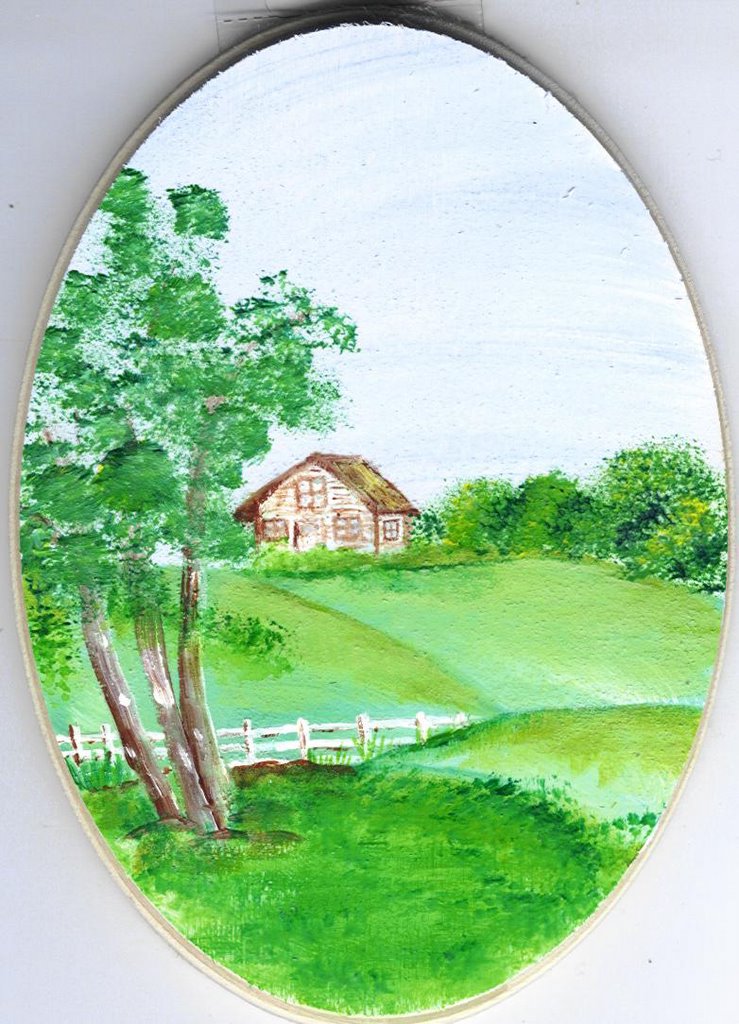
Painting: Acrylic paints on wood. (Click for a larger view)

Friday, December 23, 2005

Living Simply


One of the prominent reasons for stress in the home is disorganization. Sometimes when the house is in disarray, people's tempers run short, and everyone is cross. Sloppy living can sometimes lead to sloppy thinking and confusion. Confused thoughts seem to multiply as the mess multiplies.

It is difficult to have real peace of mind and a peaceful, happy home when disorganization reigns. Women of the past knew the value of cleaning out a desk drawer or straightening out a closet, when their minds began to swim in a muddle of confusion.

I heard many conversations while I was a child, about how women coped with confusion and disorganization in the home. This was long before therapy books, counselling, or tell-all TV shows existed.

"I just start sorting out a book shelf, or clean the kitchen," said one, and "I wash my hair," said another. Asked what they did when they were engulfed in loneliness or grief: "Clean house." It took me years to understand this, but it was something that was practiced in times past, that was constructive. Learning what to do with restlessness, discontent, worry or anxiety, is a lesson that future generations need.

I've tried to put together a simple list of things I've observed in families and homes where peace reigns.

1. Have an accounting of your own posessions and know where everything is, so that you can go straight to an item when you need it.

2. Have friends who build you up and give you energy and inspiration. Too much negative information from people whose lives are always fallling apart, can rub off on you.Daytime shows on television are full of people getting into trouble, getting out of trouble, and getting back into trouble. If you wouldn't allow such troubles in your home, it is wise not to let it broadcast into your living room.

3.Simplify by getting rid of things you do not really need and could do without. I'm not talking about a few good heirlooms from your grandmother's estate, but the unimportant things that are never used and don't have a purpose in the home.

4. Create beauty and order in the home by learning a little about colors and interior decorating. This is a worthwhile investment because it results in many happy, contented hours at home.

5.Do something creative in your life every day--sew, write, paint a picture, arrange flowers, build or craft something, or just arrange a table;--engaging the mind with creativity organizes your thoughts.

6.Treat your family members as though they were the most precious people on the earth, even when they are out of sorts.

7. Don't get caught up in the frenzy of "getting somewhere" in life. As soon as you get there, you will only find somewhere else better to go. Instead, concentrate on building character qualities that will get you anywhere.

8. Read something to improve your mind each day.

9. Don't have too much to do. Too many social obligations, or too much activity can burn out your creativity and cause depression.

10. Instead of pressuring yourself to give people "things," write them notes or letters to build them up.

"To live content with what you have;
To seek elegance rather than luxury,
And refinement rather than fashion;
To be worthy, not reputable, and wealthy, not rich;
To listen to stars and birds, babes and sages with open heart;
To study hard;
To think quietly, act frankly, talk gently, await occasions,
Hurry never;
In a word to let the spiritual, unbidden and unconscious, grow up through the common--
This is my symphony." -- William Henry Channing

"Keep your life free from the love of money, and be content with what you have." Hebrews
13:5

I certainly don't want to be insensitive to those who are starting out with nothing, nor imply they shouldn't have goals toward getting the things they need to set up housekeeping, but the less you have, the easier it is to find it when you need it. Being organized can eliminate a lot of the pressures in life.

Poster by Judy Gibson

Thursday, December 22, 2005

Yearly Reports


I've been getting all those reproduced letters that come once a year, from friends and family, which list all the events of their lives over the past year. I don't know about you, but I am affected quite negatively by these yearly family reports, for some reason. Since I haven't heard from them all year, the changes unsettle me and some of them leave me in a state of shock.

I don't send out these yearly progress reports, because there is so little to report around here. This year, as in other years, there has been no trauma or drama and nothing much is really happening. Our lives remain placid and uneventful, but I suppose it is better than the alternative. I am sure that major changes are looming on the curve of the New Year, but I'm much happier at the uneventfulness of things. I'd rather report a wedding, some births, and the house being painted than the latest degree, promotion, or vacation.

I haven't quite figured out why I don't warm to these newsletters. Maybe I'm looking for some kind of news that has more character, or I don't want to admit that they make me feel like I'm not doing very much! I'd like to know how others feel about it, and why they do or do not enjoy the yearly newsletters.

painting by L. Sherman (Click on for a larger view)

Wednesday, December 21, 2005

Learning From the Stars


A few summers ago when our family was all in the same place at the same time (which gets rarer as they get older), we began a discussion about the significance of stars. We discovered that rather than being just a bunch of cute, twinkling lights, they had significance in a physical and philosophical way.

After discussing the different types of stars and galaxies, we retired to the front lawn, where we laid on our backs upon quilts, looking up at the evening stars. On the nearby road, several cars honked at the sight of this extended family of 10, ranging from the newest child of our daughter, to our twenty-something sons, myself (who is ageless) and 60 year old "Papa," laying face to the sky, on the lawn. I'm sure they might have thought it was a strange ritual we were participating in.

The stars are bodies of light that appear at night in cloudless skies. They are fixed, or planetary, however, planets revolve around the sun and do not twinkle, as do the stars. Each month of the year, a different "house" or section of stars appear in the sky, identified by ancient names, such as Ursa Minor, Ursa Major, and others. These names were formed when astrologers drew imaginary lines between certain stars to form figures of men, beasts, and objects.

Throughout the ages, people of different cultures, though they did not know each other, often created the same pictures from the stars and identified them by the same names.

Stars follow an orbit and are always in the same relationship in placement and distance, to one another, which makes each house easily identifiable as the seasons change. Stars are worlds unto themselves containing galaxies within galaxies, exhibiting the astonishing world of space.

The pole star is a bright star that appears in the tail of Ursa minor, commonly known as "The Bear."

Wandering Stars are a different type of star that do not follow a fixed pattern. They have no fixed path and lead into darkness.

Twin Stars revolve around each other, and appear as one when either is behind the other, ora as a very bright light when beside one another.

The Morning Star is not a star, but the planet Venus. It is often called "The Star of Hope," because it is the last bright light before the sun rises, symbollic of hope. which ushers in the greater light.

Symbolism and allegory are legion in the study of the stars. My first observation is of the importance of early training by faithful mothers and fathers who care about what happens to their children; parents who will tirelessly direct their children and train them, eventually setting them on a fixed course of good habits, good manners and sensibility in decisions.

Another observation is that, while it is amusing to follow a wandering star for a season, fruitless pursuits will lead to ruin. Observing the wandering stars can be of value, though, and also stimulate creativity, as long as it is tempered by good direction and values.

The Morning Star is the star that everyone can hope to be one day: that hopefulness and optimism that it is sometimes darkest before the dawn; that when plans and opportunities are crushed, disappointment can be used as a springboard for success. Your (always) brilliant comments are welcome.

In the 19th century, families often amused themselves in the evenings with telescopes, observing these heavenly objects. Conservatories or upper rooms containing special porches for star gazing, can be seen in some historical homes around the nation.


painting: Evening Serenity by Jim Hansel

Tuesday, December 20, 2005

Elements of the House


The furnishings of the home enhance its comfort and beauty, but how do you know what is needed, and when you have enough? A less expensive home will be more affordable to furnish and decorate. I would much rather have a small home that I could afford, than a large house that needed a lot of furniture.

If you are new at homemaking, it is best not to overwhelm yourself with too much to look after. Keeping house is just a part of life at home. If you have too many dining rooms, living rooms, bathrooms and recreation areas, you will have to spend more time looking after it. Keeping things simple means that the keeper of the home will have more time for pursuing talents and caring for others.

The inside entry requires a handy place to hang coats and hats and a receiving area for any bags or merchandise you have upon entering the house. Add to this a mirror and a place to hang keys.

A seating area should be small enough that people can speak to one another without shouting. A small rug can give the room more comfort and warmth. A table beside each chair for reading or holding refreshments, is always nice. A coffee table is lovely but not necessary. Some people have found that such a table only collects clutter and gets in the way. Lamps on each end table, and a pole lamp in a corner will give adequate light.

Although dining rooms are very glamorous, they are not necessary and often are more work than they are worth, when considering the steps that have to be taken to get the prepared food from the kitchen to another room. The old fashioned farm kitchen, if you are just starting out, is the most efficient and simplest way of serving your loved ones and keeping house. A corner cabinet that houses any fine pieces of china, tea cups and other collectibles, is a sentimental and beautiful addition to a simple home.

In the beginning, opt for only one bathroom, and that is all you will have to buy soap and towels for, and all you will have to clean. In settling on a house to live in, don't bite off more than you can chew. It is easy to get carried away by looking at what others are doing, but if you choose a small house, you will be able to afford the draperies, rugs and furnishings to fill it.

(painting by L. Sherman)

Monday, December 19, 2005

A Place Called Home


To some people, a home is just a place to be when there is nowhere else to go, and nothing else to do. Here they get their clothes washed and find something to eat, or pay a duty visit to their families.

Home is more than a place; it is a culture of the family. Here the people develop their own language and humour. Here they find out who they really are. In a world that elevates the independent spirit, people at home learn the art of inter-dependence, where one benefits the others, and in return, others aid in the goals of their own brethren.

Home is a place for fellowship; that is, fellows in the same ship. Every family has its unique qualities that can only be understood by other members of the same family. It is a place where such fellowship can be extended to privileged outsiders, but it is not a place where the family identity can be overrun by the public. It is a private, inner social center that includes only a chosen few, and yet, the flavor of it flows outward to benefit the public in many ways.

Home is also a place of recreation. As the years have gone by, I've found it less necessary to go "somewhere else" to pursue my goals and dreams. My adult children have also learned the value of the home, where they can have their own library, their own art center, their own music studio, and their own place of recreation.

Home is a place of creativity. I've spent many evening with my grown family bouncing ideas off one another; exchanging creative ideas to see if they would work. When my children were growing up, they learned that mornings were the most creatively productive times, and spent their early hours of the day pursing writing, drawing, constructing, and any manner of creativity.

Home is a place of enterprise and history. Just about anything a family does, can be turned into something worthwhile to share with others or to give to the next generation. It seems like every detail of our lives at home has a meaning, from the conversation at a meal, to the way we spend our time. As I remember more things about my own grand parents and great-grandparents, I realize how important our everyday, common habits and speech are to the next generation.

When I speak of "home" I am not necessarily pointing to the structure that surrounds the family, or the house. The house is a shelter for the home, and as such, its care and embellishment is a reflection of the values of that home. The dwelling is an extension of that family's values. Its use is boundless. It can be a place of recovery from illness, a place of care for those who cannot care for themselves, or a place of preparation for adult responsibilities.

Home is a place of learning. Having experienced home education myself, I am glad to tell you of its success. There are no boundaries to learning, when it takes place in the home, for here you have a school without walls, a curricula without limits, and a learning without the restrictions of a prescribed course. I've experienced the delights of children learning to read and write, and then taking it beyond what I could have ever imagined. Further though, it is even more reassuring to see that home-education creates in the family a love of learning and a desire for wisdom.

I've seen people walk into a home and be apparently oblivious to its meaning. They barely notice the family photographs or appreciate the arrangement and comfort of the place. They stand there as though they had just walked through the doors of an instutition supported by taxpayers dollars. They lack the ability to appreciate the home.

When my daughter created her first home, she purposed that she would only have things in it that had meaning for her family, not just things that were there for the material benefit or because of a popular style. From the paintings on the walls, to the colors and textures she chose, her home emits that feeling of meaning.

Happily, there are some people who recognize the potential of the home and are doing their best to preserve marriage and the family. The dwelling itself is becoming the most popular place in our country, as television shows that specialize in home makeovers, are becoming more popular. The home improvement business is the fastest growing industry in the country. We will do well to match the bonding of the family --children to their parents, and parents to each other--with this.

Saturday, December 17, 2005

No-Fault Marriage: A New Trend

I think people are sick and tired of the divorce culture that the "no-fault divorce" laws have created. It all sounds easy on paper, but when it actually happens, there are many other things to consider that were not made apparent at the first. There are his kids, your kids, visitation, holidays, airline flight arrangements, division of property, relatives that become ex-es, and broken-hearted children who often are shifted from one home to another throughout their lives. The children then have to deal with a step mother and a step father, as they are transported by court order from one home to another.

I was visiting with a group of women, a group that has met often over the years. One woman who was usually quite upbeat and pleasant, sat weeping audibly. She could hardly tell us what was wrong. As words of explanation came out between heaving sobs, she explained that her daughter-in-law had suddenly divorced her son, after 20 years, and run off with someone she barely knew, someone who has swept her off her feet, was younger than she was, had no job, and no place to live.

Throughout her heartbreaking story, I detected more sorrow for her daughter-in-law than for her son. This woman had no daughters, and had befriended her one-daughter-in-law as her own daughter. Over the years as my friend had grown older, the daughter-in-law had helped her in various aspects of her life: driving her to the grocery store, seeing to her doctor appointments, helping her with her house, and phoning her daily to see what she needed. She left behind two young sons, and the husband of her youth.

The mother-in-law continued to cry until she died. I saw this with my own eyes. The tragedy of divorce is that while many counsellors will tell the prospective divorcee that they must do what it takes to be happy, they are imposing grief and unhappiness on their own families and the families of generations to come.

The reasons for this divorce, and others, under the "no-fault" laws, are really ridiculous. I've been married for some time now, and have some experience with these things, and can tell you that most of the excuses are just common growing pains in marriage. I will grant that there are reasons for divorce, but for now, I just want to deal with the excuses that can be turned around into no-fault marriage.

1."We just don't get along."
2. "We've grown apart."
3. "We were too young."
4. "I want my freedom."
5. "We were miserable together."
6. "The kids hear us arguing all the time."
7. "

Tuesday, December 13, 2005

Secrets of the Happy Home Life (from 1894)


by J. R. Miller, 1894

Home is among the holiest of words. A true home is one of the most sacred of places. It is a sanctuary into which men flee from the world's perils and alarms. It is a resting-place to which at close of day the weary retire to gather new strength for the battle and toils of tomorrow. It is the place where love learns its lessons, where life is schooled into discipline and strength, where character is molded. Out of the homes of a community comes the life of the community, as a river from the thousand springs that gush out on the hillsides...

Home is the true wife's kingdom. There, first of all places, she must be strong and beautiful. She may touch life outside in many ways, if she can do it without slighting the duties that are hers within her own doors. But if any calls for her service must be declined, they should not be the duties of her home. These are hers, and no other one's. Very largely does the wife hold in her hands, as a sacred trust, the happiness and the highest good of the hearts that nestle there. The best husband—the truest, the noblest, the gentlest, the richest-hearted—cannot make his home happy if his wife be not, in every reasonable sense, a helpmate to him.

In the last analysis, home happiness depends on the wife. Her spirit gives the home its atmosphere. Her hands fashion its beauty. Her heart makes its love. And the end is so worthy, so noble, so divine, that no woman who has been called to be a wife, and has listened to the call, should consider any price too great to pay, to be the light, the joy, the blessing, the inspiration of a home.

Men with fine gifts think it worth while to live to paint a few great pictures which shall be looked at and admired for generations; or to write a few songs which shall sing themselves into the ears and hearts of men. But the woman who makes a sweet, beautiful home, filling it with love and prayer and purity, is doing something better than anything else her hands could find to do beneath the skies.

Painting: A Place to Dream, by Susan Rios, available online.

Sunday, December 04, 2005

"TEA!"


It has always been amusing to read from "Sense and Sensibility" Fanny's sudden departure from the subject matter which was getting rather heated. "Tea!" she announced. I know several people that use "Austen-eese" (sayings from the Jane Austen novels) in their vocabulary, when the occasion calls for it .

Seeing we have had some heavy subjects lately, I have felt like saying "tea." Truly, this is an astonishing movement across the United States and Canada. I thought when it first came upon the scene about 20 years ago, it would be a passing fad, but here it is going stronger than ever. There always seems to be a new tea room opening somewhere, or a tea party being held at someone's house. Yet, there are still those who have never been to a tea ceremony or taken tea at home.

Once you've attended such an event, you'll understand why it is all the rage in this country. World events and strife can weigh heavily on your mind, and tea is a perfect respite from it all.
Ladies, just because you are minding the business of the home, and not out working, does not mean that your family will be automatically free from the problems of the outside world. You have to guard your territory, keep it free from those things which break it down, and build up your troops. Families that have meals together or stop for tea at home, seem to have less troubled homes. This does not mean you will be completely free from troubles, but it provides a quiet time away from them.

Now, if you cannot go to tea, tea can be brought to you. You can order tea packages and tea party baskets which contain all the food and the tea, plus a porcelin cup and even a tea pot. If you wanted to put the time into it, you could do this for someone who needs a lift, by finding the items you need, adding your own baked goods, and enclosing it all in a choice of containers: a basket, a bucket, round or square box, gift bag, tray, attractive table cloth or dish towel, or other containers that match the interest of the one you are gifting.

Although home is supposed to be a refuge, certain elements of stress from the world can leave you feeling like you have waged war with giants. That is one reason I believe we don't need a steady stream of news media (often called "the enemy within). The home can be vulnerable to an over-abundance of negative information, which makes it easier to break down. You know it is time for tea when the tension has begun to take over. There is no problem that taking tea cannot make simpler. It is a time to settle down and think. Home can be compared to a nation, with its borders, language and culture. Sometimes, when winds of adversity threaten you, it is good to close the borders for awhile and just have tea, talk your "family-eese" (or Austen-eese) and share your common likes and dislikes, unselfconsiously.

Non-tea-drinkers can enjoy the many flavored infusions that contain no tea leaves at all, and still enjoy using a tea cup and breathing in the aromatic fragrance of lemon, orange spice, or berry. Make tea time special by not drinking it all the time. Reserve a tray with all the increments on it for when you need to have that relaxation. Look forward to sitting down and taking stock of your life, looking out the window at a beautiful scene, or just being quiet.

This kind of ceremony adds a new, safe and quiet dimension to your life. One of the best teas I ever had was homemade bread with fresh strawberry jam, and hot tea. That was all, but it settled my nerves enough to give me a renewed vigour for the remainder of the day and its myriad of responsibilities.

My favorite scones are from the Anne of Green Gables cookbook, and the sandwich which gets the most approval is a shredded carrot sandwich from Andrea Israel's book, "Taking Tea," which my husband bought me in Texas when the tea party revival began back in the early 80's. At the time, it was the only book around on the subject, but now there are hundreds of them. Some parts of Texas were settled by the British in the late 1700's and early 1800's, and there are cities there which have a little of the British flair from that period. I particularly liked The Strand, a 19th century shopping area in Galveston. It has been said that some Texans have always admired the British, rather envy them, and want to be British. The old fashioned custom of having tea in the afternoon is certainly well-done in many parts of Texas that I visited.

You can learn more about having a tea ceremony here http://www.brittasteaparties.com/

http://www.teagraces.com/whyteaparty.htm

http://www.teamuse.com/article_030201.html

http://sippingtea.com/ideas.html http:/

www.seedsofknowledge.com/teaideas.html

If you are alone, making time for tea can take the edge of that loneliness and revive your interest in life. Just take a tray with some hot water and your favorite tea, load up a small plate with wholesome bite-size pieces of good food, and carry it to a comfortable seating area. In a little while your mind will be cleared of the clutter of complicated living; free to allow the creative thoughts that bring light to your life. Fifteen minutes ought to be enough time to meditate on something relaxing and supply your body with the afternoon pick-me-up it needs.

I'd like to share a favorite poem with you:

To love someone more dearly every day,
To help a wand'ring child to find his way,
To ponder o'er a noble thought, and pray
And smile when evening falls: This is my task.

To follow truth, as blind men long for light,
To do my best from dawn of day til night,
To keep my heart fit for His holy sight,
And answer when He calls: this is my task.

by E.L. Ashford.