Morning Devotions
by Edward Prentiss
1797-1854
Lessons
By Helen Allingham
English, 1848-1926
Ray of Sunlight, by Thomas Faed, Scotland, 1826-1900
Blue and White, by Louise Joplin
British, 1843-1933
Be sure to click on the pictures and look at all the wonderful details of things of the 1800's.
Descending the Slopes of Mt. Koskioskos
by Percy Spence (Australia) 1868-1933
Frozen Landscape
by Johannes Bartholemaus Duntz
Germany, 1823-1895
The Sewing Class
by Carl Frederick Aargaard, Denmark (1818-1889)
Quiet Afternoon Together
by George Goodwin Kilburne
1839-1924
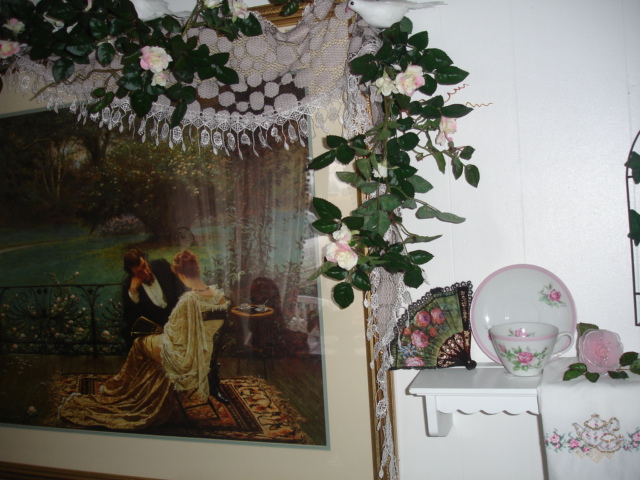
This is a collection of paintings from the 18th and 19th centuries, showing women in various forms of work and leisure, at home.
Every era has had its share of " wars and rumors of wars," (Matthew 24:6) and every woman who has ever lived on the earth has lived in a time when there has been something going on that threatened her home life. During these times, women knew it was especially important to be there for their families and to keep their home life stable.
In times such as these, we must remember to pray for those in political office, (First Timothy 2:2) who are appointed to serve us and carry out God's will. They are not to be a terror to those who are doing what is good and Biblical, but to those who do evil. According to the Bible, the purpose of earthly government is to reward the good and punish the wicked. (Romans 13: 3-4) As members of congress, judges and the executive office move further away from the Articles of Confederation which formed the Constitution, we need to remind them of the dangers of communism and socialism. Through blogging and email, women at home can warn of the unbiblical role of government in private enterprise and in home life.
We also need to remind people within our sphere of influence that no matter how utopian something sounds, it is wrong if it allows the government to intervene where God has already jurisdicted. God has wisely created the family to serve the social, economic, educational and spiritual needs of the home. There is a danger each time the government tries to provide services to replace the functions that belong to the home and to God. The government has no business becoming father and mother to its citizens, from birth to death. Knowing that this had been attempted other countries in the past, (with tragic results) our forefathers wisely planned a different kind of government that would have the least interference in the personal lives of people: in their homes, their businesses, their property, their religion and the education of their children.
There is always something the women at home can do, to alleviate sufferring under an oppressive or tyrannical government. As mentioned previously, they can always pray. The Bible says to pray without ceasing. (First Thessalonians 5:17). When a prayer seems to be unanswered, someone may get discouraged. We are not supposed to pray just one time and give up if there is no anwer. We are to continue to pray.
Political uncertainty and terror stops you in your tracks, but the beauty of the Bible is that it provides comfort and guidance for this very thing. Much of the New Testament was written during the time of the Caesars, (many who were harsh rulers), to give Christians stability and show them how to live during uncertain times. During this time, prison guards were amazed to find the imprisoned Christians singing in their cells. (Acts 16). No matter what, Christians have a job to do, and a purpose in life.
The things that the early Christians during times of terror were told to do were things like: The older women were to teach the younger women about marriage, motherhood and housekeeping. The younger women were to marry, bear children and keep house. Men were told to provide for their own families. Children were told to honor their parents. Mothers were to teach their daughters how to be good homemakers and prepare them to be wives and mothers. The Bible warned about being lazy, and commanded people to work with their own hands and to mind their own business. Knowing that most of the people in the Bible lived during some sort of political upheaval and persecution, make a big difference in your motivation at home.
God wanted his people to be rich in good works and to pray for the government.During those trying times when rulers were against them, he commanded fathers to bring their children up in the teachings of the Bible. These things do not come natural in terrible times, but like Moses, Elijah, God gives us something worthwhile to do when in times of uncertainty. It is in the doing of these things that life becomes worth living and even beautiful. The commands of God were written to people in trials. They were still to do their duty before God. No matter what happens, we are to glorify God and to praise him and to teach what is right, while we live.
The adults of the past had reassuring words for children who worried about the events of the world. Some of you might remember them saying things like, "The Bible says there will be wars and rumors of wars, and that evil men will wax worse and worse, (2nd Timothy 3:13) til the end of time. These things will always go on, in every generation. Meanwhile, our duty is to live right and to show a good example to others."
Homemakers have a big job to do, to keep the house in order and to teach good values to their children. If there are no children at home, her role is still impor
tant, for she owns the world of her home. It is her domain and she can rule it. She can clean it, decorate it, furnish it, maintain it, and share it. She can use her home as a classroom to teach other women and young girls. She can also affect the world if she particiates in free enterprise, by shopping or selling the products of her hands. Blogging and email give the homemaker a window to the world and a chance to influence others for good.
If a woman will teach her own children at home, she can help change the world in just a few years, by showing them the difference between Biblical economics and Communism. She will then turn out a generation of young men and women who will not look to government to provide for them, but will creatively work with all their might in free enterprise. She will produce a generation that will help govern a free society.
From the home front, much can be done to counteract the world's sorrows. Study the paintings above. In the times they were painted, there were terrible things going on in world. Yet the artists were still able to portray something normal and good. I think this is what we should do, in times of crisis.
We should do something really normal: fix a meal, clean a room, have a tea party for women to brighten up their lives, re-decorate, sort things, sew a dress, teach a young girl, write a letter, and provide some sanity to the lives of others. Protect your family from the constant stress of the government media. It is designed to keep everyone upset all the time and to mobilize people to stand in long lines for rice, corn or so-called health treatments. Each year they broadcast some new, future calamity which does not actually materialize. Women at home must be wise and realize it is a distraction to their real purpose in life, and cling to that which is good. (Romans 12:9) We are to center our thoughts on whatever is good, pure and lovely. Home is the perfect place for this.