Families actually enjoy sitting down to a plate of prepared food, or else they would not frequent the restaurants and
 eating establishments. There is something more to meals than food, for the ritual connected to a meal has a big impact on the mind. Compare the action of opening the fridge or pantry door and taking something out of a box and putting it to your mouth to munch on,(even fast food establishments have more protocol than this!), with the ritual of sitting down at a table and first looking at the food that has been carefully prepared. Notice the activity it takes to bring the fork to the mouth and eat it, compared to grabbing a cracker or a chip here and there and grazing until satisfied. Just the very fact that it takes longer to eat with utinsels, gives the body a more reasonable time to adjust to the food that is being sent to the stomach. For that matter, serving the soup or salad as an appetizer, was for the purpose of slowly getting the stomach used to food, before a big, hot, hearty meal hit it all at once, resulting in a stomach ache.
Rather than launch into an elaborate explanation about how lack of meal times at home contribute to the demise of young people and the ultimate breakdown of civilized life, I will send any brave souls to a link that will explain what I was trying to tell in the previous article, about how an author interviewed people in prison as to their childhood habits and discovered that a great number of them did not have mothers at home to prepare good meals for them. The article is called The Starving Criminal by Theodore Dalrymple and can be accessed here: http://www.city-journal.org/html/12_4_oh_to_be.html
In this article, he talks about the lack of appetite in an era of plenty. It makes perfect sense to me, since there is a lot more to eating than food. I know that when I am unhappy or upset, I lose my appetite. There are certain situations that cause my desire to eat, to greatly diminish. As it turns out, it is only natural not to want to eat in situations in which your body and mind cannot fully relax.
So ladies, there is a lot more to staying home and a lot more to mealtime than this century knows, that the 19th century knew and practiced. They taught it from their homes, but the 20th century progressives thought institutional living was better, which included most meals away from home, (meals in colleges, high schools, head start programs, etc.) Many young people are reaping the sad results of it.
My husband's family ate all their meals at home, because their father did not like to eat out. He had been a bachelor til the age of 35, and once he got a wife, he was determined to eat at home. His children grew up "with their feet under his table," as he said, and they didn't eat out, either. It was a real treat when occasionally they broke with tradition and ate at a restaurant.
In my youth, I did not realize the importance of eating at home with the family, but after having my own children, I understand better, the reason for it. At home, you have less self-consciousness. You can say things that you believe, or wonder, without a dozen other ears picking it up and judging you. Parents can pass on their advice to their children with confidence. We had to sit across the table from each other and look at one another and be together, sharing the same food and asking for things to be passed, being courteous not to take the biggest helping, and leaving some for others.
Today, many families divide up during meal time and take their plates to their favorite places in the house and eat, apart from one another. I do think at least that is better than being away from home, but it is not the ideal. One reason that this habit persists, is that in some families where family members challenge the values of the home, eating together becomes so disagreeable that it is more desireable to eat alone in peace. We have a long way to go to bring back the valuable tradition of eating together at home.
Children feel they can be themselves when in the home, away from peering eyes and nosey neighbors. Mealtimes, bedtimes, --all times are good times to be home. That does not mean that you are locked up in your house 24/7, but that your foundation and anchor is the home. It cannot be your foundation if the most fruitful hours of the day are spent in someone else's home, or in institutions. Many of the people interviewed, stated that they did not really understand the purpose of meal times, beyond just eating for fuel. This article brings to light more of what I was trying to get across in my previous article. I think we probably don't know the impact we can have on our own nation, just by learning to eat at home.
At first, it might not seem appealing, but if the father will be the provider and let his wife stay home, there is more likelihood that this can be accomplished. The two of them can embark on the exciting adventure of gathering together the tools and supplies they need to have truly happy meals ;-). Everything from a cookbook to a bright table cloth, nice dishes and cutlery, to good cookware and bakeware and serving dishes, can make it actually more fun to eat at home than to eat out. Think also of the good you are doing in the family, by preventing the problems that this man described in his article.
I just know the first question that will come to everyone's mind is: What if sadness or depression or problems cause you to EAT ALL THE TIME? Well, let me ask you this: when you are unhappy, or there has been an upset in your life, or you are not feeling well, does it make you want to prepare a three course meal with a soup and an entree and a side dish followed by a dainty serving of pie and cheese with a proper cup of tea in a tea cup and saucer? If this is what people would do, instead of opening a bag of chips or a gallon of ice cream, they would not have the same problem of added weight, that they do, today. The problem is, that they do need, in times of stress, a goodly prepared meal, with all the time it takes, which would settle their minds. The activity of preparing it would prevent weight gain. I purposely do not keep much in my house that is easy to eat. Practically everything I have, has to be prepared. That way, when I am feeling out of sorts, I don't reach for a bag of cookies. If I decide to have some cookies, I will bake only one quarter of the recipe and eat them all, which is about 4 cookies. The effort of doing this from scratch is just so much labor, that I'm not likely to do it all day long. Ice cream can be a problem, so I may only buy enough for everyone to eat at once, and not be able to store any back in the freezer. If my husband and I have no family at home and want ice cream, we may buy a container small enough for two. Vegetables are purchased fresh and cooked or stir fried. This year, if I wanted vegetables, I dug up a carrot or two, broke off an ear of corn, and picked some tomatoes. I thought while doing it that it is certainly harder to over eat when you have to dig it up yourself every time you get hungry! While I don't think every one is able to do this, it is certainly a lesson in comparison. We may have a package of frozen vegetables reserved, but for the most part, nothing is very fast-foodish in our kitchen, on purpose.
If you buy a bag of cookies, you are more likely to binge. If I get a craving for potato chips or tortilla chips, I peel chips off a raw potato and cook them in a pan or in the oven. I do the same with tortillas by breaking them off into pieces and cooking them in a little oil. This prevents bored or restless eating, because after I've had to stand there and cook, I'm usually lacking the energy to cook more, and then it is time to do something else. The act of cooking actually is part of eating, for the preparation does something natural to the appetite, that reaching into the bag does not. I believe that there is a lot more to it than we actually know or can explain.
You might try Mr. Breakfast at http://www.mrbreakfast.com/recipe1.asp
and also check out some sites about the affect of breakfast on your body. If you don't like breakfast and never feel you can eat it, you can do one or two things. 1. Stop eating dinner at night so that you will wake up ready to "break the fast," and 2. have a late breakfast. Personally, I find it hard to wake up and hit my body with a heavy meal, so it takes me awhile to get an appetite. One site I read showed how a big breakfast fuels the body for the rest of the day, so that even if you do not eat right, the breakfast will carry you through without affecting your health. One reason has to do with the way the body draws on its own resources if you don't eat a breakfast, and it taxes your insulin and other things, so that you crave the wrong kinds of foods. When I find that, I'll post it here.
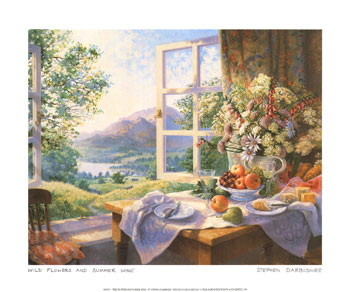
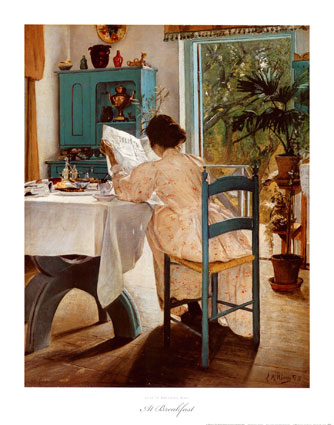
The painting is called "At Breakfast." from allposters.com