Tuesday, October 24, 2006

Sweet Deception


A video here http://www.mercola.com/sweet-deception-aspartame shows the truth behind the artificial sweeteners that are so prevalent. My own objection to them is that I don't know what plant they came from and I cannot be sure the body will process the ingredients. Although I am not exactly "thin," I know that when I ate many of the diet foods and artificial sweetners, I only got fatter. They seem to prevent the body from using up calories. In the end, real food, as close as possible to its original form, (an apple is better than a sweetened apple desert, for example), is the safest way to go. Real foods were created for the body. These imposter sweeteners and fake fats will eventually cause health problems, and may even prevent weight loss.
s

Friday, October 20, 2006

Food for Thought

Continuing with the theme of the effect of home life on society, here are some things to think about regarding meals.

Families actually enjoy sitting down to a plate of prepared food, or else they would not frequent the restaurants and eating establishments. There is something more to meals than food, for the ritual connected to a meal has a big impact on the mind. Compare the action of opening the fridge or pantry door and taking something out of a box and putting it to your mouth to munch on,(even fast food establishments have more protocol than this!), with the ritual of sitting down at a table and first looking at the food that has been carefully prepared. Notice the activity it takes to bring the fork to the mouth and eat it, compared to grabbing a cracker or a chip here and there and grazing until satisfied. Just the very fact that it takes longer to eat with utinsels, gives the body a more reasonable time to adjust to the food that is being sent to the stomach. For that matter, serving the soup or salad as an appetizer, was for the purpose of slowly getting the stomach used to food, before a big, hot, hearty meal hit it all at once, resulting in a stomach ache.

Rather than launch into an elaborate explanation about how lack of meal times at home contribute to the demise of young people and the ultimate breakdown of civilized life, I will send any brave souls to a link that will explain what I was trying to tell in the previous article, about how an author interviewed people in prison as to their childhood habits and discovered that a great number of them did not have mothers at home to prepare good meals for them. The article is called The Starving Criminal by Theodore Dalrymple and can be accessed here: http://www.city-journal.org/html/12_4_oh_to_be.html

In this article, he talks about the lack of appetite in an era of plenty. It makes perfect sense to me, since there is a lot more to eating than food. I know that when I am unhappy or upset, I lose my appetite. There are certain situations that cause my desire to eat, to greatly diminish. As it turns out, it is only natural not to want to eat in situations in which your body and mind cannot fully relax.

So ladies, there is a lot more to staying home and a lot more to mealtime than this century knows, that the 19th century knew and practiced. They taught it from their homes, but the 20th century progressives thought institutional living was better, which included most meals away from home, (meals in colleges, high schools, head start programs, etc.) Many young people are reaping the sad results of it.

My husband's family ate all their meals at home, because their father did not like to eat out. He had been a bachelor til the age of 35, and once he got a wife, he was determined to eat at home. His children grew up "with their feet under his table," as he said, and they didn't eat out, either. It was a real treat when occasionally they broke with tradition and ate at a restaurant.

In my youth, I did not realize the importance of eating at home with the family, but after having my own children, I understand better, the reason for it. At home, you have less self-consciousness. You can say things that you believe, or wonder, without a dozen other ears picking it up and judging you. Parents can pass on their advice to their children with confidence. We had to sit across the table from each other and look at one another and be together, sharing the same food and asking for things to be passed, being courteous not to take the biggest helping, and leaving some for others.

Today, many families divide up during meal time and take their plates to their favorite places in the house and eat, apart from one another. I do think at least that is better than being away from home, but it is not the ideal. One reason that this habit persists, is that in some families where family members challenge the values of the home, eating together becomes so disagreeable that it is more desireable to eat alone in peace. We have a long way to go to bring back the valuable tradition of eating together at home.

Children feel they can be themselves when in the home, away from peering eyes and nosey neighbors. Mealtimes, bedtimes, --all times are good times to be home. That does not mean that you are locked up in your house 24/7, but that your foundation and anchor is the home. It cannot be your foundation if the most fruitful hours of the day are spent in someone else's home, or in institutions. Many of the people interviewed, stated that they did not really understand the purpose of meal times, beyond just eating for fuel. This article brings to light more of what I was trying to get across in my previous article. I think we probably don't know the impact we can have on our own nation, just by learning to eat at home.

At first, it might not seem appealing, but if the father will be the provider and let his wife stay home, there is more likelihood that this can be accomplished. The two of them can embark on the exciting adventure of gathering together the tools and supplies they need to have truly happy meals ;-). Everything from a cookbook to a bright table cloth, nice dishes and cutlery, to good cookware and bakeware and serving dishes, can make it actually more fun to eat at home than to eat out. Think also of the good you are doing in the family, by preventing the problems that this man described in his article.

I just know the first question that will come to everyone's mind is: What if sadness or depression or problems cause you to EAT ALL THE TIME? Well, let me ask you this: when you are unhappy, or there has been an upset in your life, or you are not feeling well, does it make you want to prepare a three course meal with a soup and an entree and a side dish followed by a dainty serving of pie and cheese with a proper cup of tea in a tea cup and saucer? If this is what people would do, instead of opening a bag of chips or a gallon of ice cream, they would not have the same problem of added weight, that they do, today. The problem is, that they do need, in times of stress, a goodly prepared meal, with all the time it takes, which would settle their minds. The activity of preparing it would prevent weight gain. I purposely do not keep much in my house that is easy to eat. Practically everything I have, has to be prepared. That way, when I am feeling out of sorts, I don't reach for a bag of cookies. If I decide to have some cookies, I will bake only one quarter of the recipe and eat them all, which is about 4 cookies. The effort of doing this from scratch is just so much labor, that I'm not likely to do it all day long. Ice cream can be a problem, so I may only buy enough for everyone to eat at once, and not be able to store any back in the freezer. If my husband and I have no family at home and want ice cream, we may buy a container small enough for two. Vegetables are purchased fresh and cooked or stir fried. This year, if I wanted vegetables, I dug up a carrot or two, broke off an ear of corn, and picked some tomatoes. I thought while doing it that it is certainly harder to over eat when you have to dig it up yourself every time you get hungry! While I don't think every one is able to do this, it is certainly a lesson in comparison. We may have a package of frozen vegetables reserved, but for the most part, nothing is very fast-foodish in our kitchen, on purpose.

If you buy a bag of cookies, you are more likely to binge. If I get a craving for potato chips or tortilla chips, I peel chips off a raw potato and cook them in a pan or in the oven. I do the same with tortillas by breaking them off into pieces and cooking them in a little oil. This prevents bored or restless eating, because after I've had to stand there and cook, I'm usually lacking the energy to cook more, and then it is time to do something else. The act of cooking actually is part of eating, for the preparation does something natural to the appetite, that reaching into the bag does not. I believe that there is a lot more to it than we actually know or can explain.

You might try Mr. Breakfast at http://www.mrbreakfast.com/recipe1.asp
and also check out some sites about the affect of breakfast on your body. If you don't like breakfast and never feel you can eat it, you can do one or two things. 1. Stop eating dinner at night so that you will wake up ready to "break the fast," and 2. have a late breakfast. Personally, I find it hard to wake up and hit my body with a heavy meal, so it takes me awhile to get an appetite. One site I read showed how a big breakfast fuels the body for the rest of the day, so that even if you do not eat right, the breakfast will carry you through without affecting your health. One reason has to do with the way the body draws on its own resources if you don't eat a breakfast, and it taxes your insulin and other things, so that you crave the wrong kinds of foods. When I find that, I'll post it here.

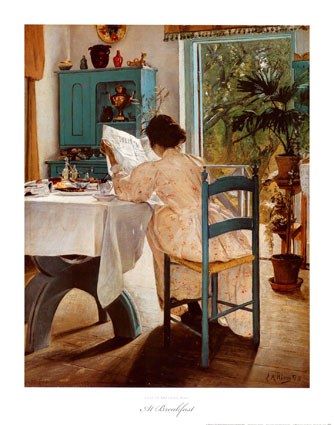
The painting is called "At Breakfast." from allposters.com

Wednesday, October 18, 2006

Show Me


There are many good homemaking sites around that encourage women to return to the home and to dedicate themselves to being wives and homemakers. A problem arises when the wife, though confident in the decision to quit work and become a keeper at home, has to battle the doubts and fears of her husband, who may not understand a woman's role. In cases such as these, it is always good to point out to him that you are not trying to rebel against him personally, and that is not your purpose to create strife between you, but to do what is good and right to do. Then, suggest that you both give it a grace period to work out the problems of adjustment, and show him what you can do.

Many young husbands have not grown up with mothers and grandmothers who were truly keepers of the home, and nuturers of the family. They see only women in the workplace. Their own mothers and sisters always worked, and they cannot remember a time when women stayed home. Therefore, they find it difficult to understand the need for it or the reason for it. They may conclude that "taking care" of a family means making money. The wife may say she wants to stay home and take care of the house, but he may think that making money is the same as taking care of something. We are entering a generation that is trying to emulate and restore the Biblical pattern and the model of women before us; the women of the 1800's, before so many women went to work outside the home, but we also have to deal with several generations of people who have never seen this style of life in action. The "show me" method is always the best way to prove that something can be done.

Husbands whose mothers and grandmothers worked, and who are surrounded by working women, may conclude that being a stay at home wife is nothing but laying around all day. One woman I know, had to take care of her husband once when he got sick and had to stay home from work. After she got him some soup and brought it to him, he wanted her to sit with him and talk or watch television. She said she could not do so because she had to get her work done. She very busy that day washing dishes, doing laundry, cleaning the floor, going to the grocery store, and fixing meals. She said, "After that day, he never asked me what I did all day."

While I do not condemn any woman who works, I would ask that both the husband and the wife take a good, hard look at what the fruits of this really is, and compare it to the wife being at home. Years ago, a prominent author did some hands-on research, in which she interviewed many young men and women in prison. She discovered that none of them had mothers at home, and that both parents were very busy outside the home. She then interviewed those who had made success in their lives and gone on to become responsible husbands or wives, and were raising a family of their own. She discovered that their mothers had been keepers at home, waiting for them guarding them, and watching after their souls. She interviewed men whose wives were at home, and men whose wives were away. The ones whose wives were at home, were confident, healthy and happy. The ones whose wives were away, were rushed and worried.

Begin your new life at home by keeping the laundry caught up. Most marriages suffer when the wife cannot spend any enjoyable time relaxing with her husband because, after work, she has urgent housework to do. She finally lands in bed exhausted, after doing all the things that she could have been doing during the daylight hours when she was, instead, at work outside the home. The simple act of opening a drawer and finding a pair of matching socks, or a folded tee shirt, can take a lot of worry and tension off home living.

Next, learn to iron properly, a man's shirt. Have a look at people in jobs at airports and other places where there is an official dress code, and see where the creases are and and pressed areas. For instructions on how to iron a shirt, click here http://www.napsnet.com/fashion/68355.html Having a pressed shirt and pressed pants each day is one way of showing how your being at home is a help. Some people think that ironing is no longer necessary or important, but even if some kinds of jobs do not require it, pressed clothing is a part of good grooming and sends the message that you take pride in yourself and your work. He will feel differently in a pressed shirt, and be more motivated to do his best. In Victorian times, men would no sooner think of going in public in torn, wrinkled clothing, than they would attend a state dinner in a pair of shorts.

Showing results of your homemaking is a way of providing evidence that the role of women is a successful and necessary one. Thoughtfully prepared meals, a clean kitchen, well arranged rooms and good decorating, are an advantage to your husband. If you work, you cannot pay attention to these details.

Being at home takes part of his tiredness away, for when he gets up in the morning, he does not have to find clean clothes or put any in the washer, fish things out of the dryer, iron his own shirt, make his own breakfast, pack his own lunch. While he is at work, the wife can take care of his mail, pay his bills, and look after his property. She notices when she washes a shirt that it needs a button. She checks to see that she has everything in stock for preparing dinner. She may even plan a quiet evening at home with him, and his favorite interests or hobbies.

Making a list that shows the things that need to be done at home, is very helpful in informing the husband of the many needs of the home and family. Showing him what you accomplished while at home during the day can impress on him the importance and the necessity of the woman being at home.

The other day a package came to my door. I was outside and the delivery person did not notice that I was at home, so left it there. I was glad I was able to get in inside the house to protect it from the rain. Little things like this are very important, as it keeps you and your husband self-sufficient, instead of depending on others to look after your things.

If a husband comes home and smells something good cooking, it relaxes him almost immediately. If the house is orderly and it looks relaxing and comfortable, he will be glad that his wife is a homemaker.

Showing a savings of money is a plus, in being a stay at home wife. Consider that each time you take the car and leave the house, it probably costs you up to twenty dollars, taking into account the cost of fuel and the places you would stop. Instead of getting a $3.00 drink in a paper cup, you can make a pot of tea and drink it in a porcelin cup at home. The cost per cup is just a few cents. Staying home saves the family expense, because you can spot unnecessary expenses. For example, I found I could monitor the use of electricity and keep lights off when not in certain rooms, and use an electric heater rather than heat up the entire house with expensive propane. Not everyone can do this, but this is just an example of how staying home can save you money.

Still, even if the wife cannot manage all these things, her being at home does not have to be justified by cleaning and cooking, but because her very presence is the main factor in home living. Just being there, even if she is not well and can only lay down upon the couch, is doing what she is supposed to do: guard the home.

If the wife approaches her responsibility in a kind and loving way, expressing it as a way to not only make her husband comfortable and happy, but also to be able to be fulfilled as a woman, he will be more likely to concede.

post script: Your appearance does have something to do with the impression that is formed about homemaking. While it is not necessary to wear a power suit or the kind of thing you would wear in the workforce, you can use the opportunity to wear a nice skirt and a feminine top. Support hose and sensible shoes (sensible without being ugly, that is), will improve your own view of life at home and the perception that your husband has of you in that role. If he sees that it improves your appearance and your dignity, it will reinforce in his mind the importance of the wife at home. One old story written around 1930, called "When Queens Ride By," accessed online in several places. One is written in narrative, and easier to read, but at present I can't find the link to it. It tells about a woman whose husband wanted her to work outside the home, and how she refused to do so and why. A part of this play reads:

Saturday, January 07, 2006

When Queens Ride ByBy Olive White Fortenbacher[Note: This prize-winning short play was written in the 1930s, but it calls to us just as loudly today. What an influence one woman can have!]John and Jennie Mangrave had eager plans when they married and took over the old farm. But their great faith dwindled as the first years passed. John worked later and later in the evenings. Jennie took more and more of the heavy tasks upon her own shoulders and had no time for the home and children. They were no further on, and life had degenerated into a straining, hopeless struggle.One hot afternoon, Jennie was loading baskets of tomatoes to take to town when the children came running to tell her there was a dressed-up lady at the kitchen door. Wearily she followed the children back and saw a woman in a gray tweed coat that seemed somehow to be a part of her brownish hair. She was not young, but she was beautiful! An aura of eager youth clung to her, a clean and exquisite freshness. The stranger in turn saw a young woman, haggard and weary. Her eyes looked hard and haunted. Her calico dress was shapeless and begrimed from her work.Stranger (smiling): "How do you do? We ran our car into the shade of your lane to have our lunch and rest for a while. And I walked on up to buy a few apples, if you have them."Jennie (grudgingly): "Won't you go in and sit down? I'll go and pick the apples."Stranger: "May I go with you? I'd love to help pick them."Jennie: "Why, I s'pose so. If you can get out there through the dirt." (She led the way along the unkempt path toward the orchard. She had never been so acutely conscious of the disorder about her. She reached the orchard and began to drag a long ladder from the fence to the apple tree.)Stranger (crying out): "Oh, but you can't do that! It's too heavy. Please let me pick a few from the ground."Jennie: "Heavy? This ladder? I wish I didn't ever lift anything heavier than this. After hoistin' bushel baskets of tomatoes onto a wagon, this feels light to me."Stranger: "But do you think you should? Do you think it's right...? Why, that's a man's work!"Jennie (furiously): "Right! Who are you to be askin' me whether I'm right or not? A person like you don't know what work is!"Stranger (soothingly): "I'm sorry I annoyed you by saying that. If you were to tell me all about it--because I'm only a stranger--perhaps it would help. Why can't we sit down here and rest a minute?"Jennie: "Rest? Me sit down to rest, an' the wagon loaded to go to town? It'll hurry me now to get back before dark."Stranger: "Just take the time you would have spent picking the apples. I wish I could help you. Won't you tell me why you have to work so hard?"Jennie (half sullenly): "There ain't much to tell, only that we ain't gettin' ahead. Henry Davis is talkin' about foreclosin' on us if we don't soon pay some principal. The time of the mortgage is out this year, an' mebbe he won't renew it. And it ain't that I haven't done my part. I'm barely thirty, an' I might be fifty, I'm so weatherbeaten. That's the way I've worked."Stranger: "And you think that has helped your husband?"Jennie (sharply): "Helped him? Why wouldn't it help him?"Stranger: "Men are such queer things, husbands especially. For instance, they want us to be economical, and yet they love to see us in pretty clothes. They need our work, and yet they want us to keep our youth and beauty. And sometimes they don't know themselves which they really want most. So we have to choose. That's what makes it so hard. Just after we were married, my husband decided to have his own business, so he started a very tiny one. I helped my husband in the store, but we would both be tired and discouraged after a hard day at the office and we didn't seem to be having any great success. The house got run down and dinner was always a hasty affair, and soon we both started complaining and bickering with each other. Finally, we decided that maybe I should stay at home and let him take care of his work at the office as best he could. And then I worked in my house to make it a clean, shining, happy place. My husband would come home dead-tired and discouraged, ready to give up the whole thing. But after he had eaten and sat in our bright little living room, and I had told him all the funny things I could invent about my day, I could see him change. By bedtime, he had his courage back, and by morning, he was all ready to go out and fight again. And at last he won."

Thanks to a reader, Heidi, for providing that link to the entire story, that I had been looking for, here http://dana.lifewithchrist.org/permalink/26905

GUIDE, v.t. gide.
1. To lead or direct in a way; to conduct in a course or path; as, to guide an enemy or a traveler, who is not acquainted with the road or course.
The meek will he guide in judgment. Ps.25.
2. To direct; to order.
He will guide his affairs with discretion. Ps.112,
3. To influence; to give direction to. Men are guided by their interest, or supposed interest.
4. To instruct and direct. Let parents guide their children to virtue, dignity and happiness.
5. To direct; to regulate and manage; to superintend.
I will that the younger women marry, bear children, and guide the house. 1 Tim.5.

Monday, October 16, 2006

Cook's Country

Cook's country has been sending out sample issues of their cooking magazine, to stimulate interest in subscribing, and in cooking. I have quite enjoyed this production, because it shows step by step pictures of food preparation. Go here:
http://www.cookscountry.com/ to view this site. If you want to flip through an issue, it is as easy as going to your local grocery store magazine rack, where it should be displayed. It does not just show you how to cook, but often tells the best way to choose food and get the freshest and best for your family. If you are going to go to the trouble to cook, you might as well have the best. Besides that, you and your family are worth it.

Sunday, October 15, 2006

Watch Out For Bad Language

This began as an ettiquette article about bad language. I noticed on various blogs that the comments of angry feminists contained a lot of foul words. And then, I discovered something even worse: how normal words were being used to make women at home feel that what they were doing was not normal. Feminist teachings in colleges use history as their foundation, saying that while women "used to be" subservient and "had to be" at home, that now they had more "freedom" and "privileges" and "rights.
Women at home have a strong influence on husbands and children, which they ought not to shrink from using. In both advertising and politics, words can be used in a sneaky and clever way to win a person's mind over to a way of thinking. Language can be used for good or ill, and so a woman must be alert to the sly wrangling of language that subverts the family and the culture. These words invade the home through television, the movies, the newspapers, the radio, and the web. College students return home with a "new vision" of how life should really be, and try to change the order of life according to the things they have been indoctrinated with. Language usage changes from doing what is the responsible thing to do, to following another agenda.

Bad language even employs noble words, like "responsible," and "duty," or "noble" and "right." Through various media you are being told that it is responsible to get a job and put in 8 hours a day because you are bearing the burden with your husband.

I've seen advertising for dish soap that sounded more like a religious worship service, than a commercial. There were choir singers in the background, and words like "joy," "love," and "renewed." Obviously, certain companies know that it is a great advantage to them to win the business of Christians. Using words that we all identify with, is a great advantage.

But let me get back to my point about bad language. What I call "weasel words," are those which we often overlook, when we find ourselves persuaded to a different doctrine than the one set forth so clearly in the scriptures for women. Let me not be misunderstood: women have always been free to do as they wanted, and there were women who sold things and women who were in politics, and women who did other things besides home living. There were also the wild women with evil influences who came to no good end.

But what is happening today is very subtle. The people who want society to become more socialistic and Marxist are using our words and our beliefs, to slyly twist the understanding of things. "In the past," they say, women were "oppressed," and "now, you have a choice." Look carefully at how these phrases are used to make you believe something that is false. In the past, were all women truly oppressed, and did all women have no choice whatever?

History, the Bible, and later history does not bear this out at all. Women have always had a choice. Yet today many young women in Western society do not realize they have the choice of being wives and homemakers, and that they don't have to compete for jobs and fight with men in the workplace. Feminists have used the schools for many years to send their message, which is not one of choice. Go into the high schools and ask if there is an opportunity to learn about marriage, home and family, and if there is anyone teaching the boys and girls of this life in a positive sense. The history books are now so revised and so askewed, that they don't even show the success of the Biblical, time worn and time proven pattern of the home and the family, with the women guiding the home.

I keenly recall talking to a high school girl who told me about the job fair that her school had promoted. She had gone to all the different tables and booths and collected a large bag of free literature showing all the opportunities that were available to women. I asked her, "Was there a Homemaker table?" and she said "No," so I said, "Why ever not?" and she replied, "Because that is not a real job." Well you see dear ladies, they used that bad language again. Not a "real job." I then talked to her about how unbalanced and unfair it was that they did not have a table or booth with someone showing the girls how they could become homemakers and have a greater hand in the destiny of men and children. I spent a lot of time talking to her about this, and in a short time it was reported to me that she married and engaged in the full time job of taking very good care of him and their first home.

Another way that language is misused is through twisting scripture, which I call "Twisted Scripture." In this instance, the progressives change the Proverbs 31 woman, the Titus 2 Model, and the 1 Timothy 5:14 example, to mean that women worked outside the home and became super women who never got exhausted and who made things constantly, planted huge fields, were in the real estate business and sat in markets all day to sell their crafts.

I heard an inspirational speaker in a church speaking to a group of women about liberation. "This is not the 1950's anymore," she said. "Girls, no one is going to take care of you all your life. You have to get a job and work." Yet sadly she left out the alternatives--that of carefully monitoring the family income and investing it so that she would bring in more income and not have to leave the home. The stress that many women are coping with is such that they are often resorting to pharmacueticals and psychiatric drugs to keep them going. This speaker did not mention any of the side effects of women having to be providers. She would have done well to have introduced a divorced woman who was forced to provide, and have her tell the real story.

Even preachers will say that Bible women were so involved in commerce, and stretch the description of them to the point that it justifies sending their wives to work. They do this through the bad use of language, just like the progressives do in politics and the feminists do in their speeches and publications.

Bad language twists words like "privilege" and "opportunity" and "rights" to mean now you have the right to do what the progressives, the social planners, and those who think they have a better plan, want you to do.

It is amazing, isn't it, that it took the 20th century, and now the 21st century progressives to discover, after all this time, that the Proverbs 31 woman and the Titus 2 woman and the I Timothy 5:14 woman was not really a homemaker or a wife--she was really into commerce. How is it that this era is so much more enlightened than all time before it? How is it? Dictionaries have changed the meanings of words. Bibles are revised with modern language, the excuse being that we can't understand the old English or the old language. (We're too stupid, I guess).

Now, you cannot even read the Bible without coming to their conclusions, because modern versions use bad language. One woman asked me, "Why do you say parents should teach their children, when that verse says "talk to your children." I pointed out that the original Hebrew language used the word "teach," which meant "discipline," which meant "to follow," where we get our word "disciple." She discovered that she was using a modern version that did not use the original Hebrew translation. There is a big difference, then, in teaching someone, and in merely talking. The bad language in the modern version changed the sense of the passage quite a bit. No wonder we are all so confused. Bad language is something you really have to watch out for.

Other words in our world are "better," and "improved." It astonishes me that even the new preachers think that modern man has discovered something about how women should live, even though men centuries before, never reached that conclusion. Now women can have "improved" lifestyles, no longer restricted to marrying someone for a lifetime; now they have the privilege of quitting whenever they want to and moving on to the next guy. Were the people in past centuries who built up civilization all wrong, and are we so much smarter just because we have references and computers and can get more information? You would think we would be wiser, but unfortunately, a lot of that language has been changed, and the meaning of words changed, so that it portrays a completely different scene. Do they mean to tell us that no one knew what was really good for women until the 20th century? That our great grandmothers and great great grandmothers and the pioneers and the Victorians were all really in the dark, wrong, misguided, and stupid?

If you are home, or wanting to come home, don't listen to all this bad language. If you don't think you can trust what anyone is telling you, have a look into the past, if you can find anything that has not been revised with weasel words and fictional descriptions, and see how women really lived. The best source is our own grandmothers and great grandmothers. Have a look at their pictures and notice how they dressed, how they wore their hair. Notice the things around them. Find out from their letters and diaries what they believed and what they did. We recently connected a set of embroidered pillowcases that we had, with our grandmother's diary. She wrote an entry that said, "Worked on the purple pillow cases today." Now we know that they were a work of her own hands. We are able to see how she lived from day to day. There is no mention in these diaries of having to fight her way in the workplace and watching out for unfair treatment. She was at home, in charge of everything. She was at the top.

I have even read a copy of my great-great grandmother's story of pioneer days. While she complained of a storm that had destroyed part of the place that they lived, and that she had not had word from her husband, who was across the river before it flooded, there was none of this "unfair" and "oppressed" business between the men and the women. They were obviously doing the best they could under the circumstances, and both husband and wife were enduring the suffering of the storm and the flood. She was left home with the children because it was safer than having to go across the river to find work. In the end, it was the man who was the most put upon and who endured the most danger. I suppose modern feminists would say that it took the 20th century radical feminists to free women of the oppression of being left protected at home while the husband went to work. Even the men in our society are to a large extent influenced by bad language. The young ones are especially vulnerable to the feminist message, as it has been portrayed as an advantage to them to have their wives working: more money. Modernists may say that the man should have stayed home and let the woman cross the river and look for work.

Using bad language is like taking someone's favorite ice cream and trying to persuade them to buy something bitter and ugly in its place. Simply say that it is too bad they have to put up with such an inferior product, but now they don't have to eat that horrid stuff any more. In the past, it was all they had, and there was no choice, but now, they can be liberated to eat this other ice cream, which is better. It is all in the language.

Looking At Drawingsby Adolfo Belimbau (this is from a previous century. If women were so deprived of knowledge and learning, I wonder why so many artists depicted them reading and writing.)

Thursday, October 12, 2006

Free to be Home


While the world impresses women with words of liberation and freedom, women at home are finding that true freedom is the freedom to be at home, to guard it, to keep it, to manage it, and to enjoy it. Feminists for years have taught their own version of slavery verses freedom. Slavery, they said, was being at home, and freedom was having a career. What the younger generation of women are finding, is that this was a totally false definition.What was supposed to be "freedom," became oppression. Women went in to debt and became a slave to the workplace with its regulatory life.

The wonder of such promises of freedom is that they actually force women to work. Many women say that although they wish to be home being a full time manager of the home and family, they do not feel they have a choice. So much for the elevated choice that feminism promised. Many women feel they have no choice but to work outside the home for a wage. Very few are working because they absolutely love dropping their children off at daycare, putting in long hours, going home to a dark house, scrambling to get the laundry and dinner, or paying all the expenses of going to work. Most women would like to have the freedom to be home and not be tied down to a job.

The feminists were thinking more about their likes and dislikes, then about their duties and responsibilities and the need for them in the home. Believing that being at home would stifle them or give them less economic advantage in their lives, many women went to work, only to find themselves slaves to time schedules and locations. They had no time for leisurely breakfasts with their families, and ended up shuffling everyone off to various institutions, and themselves off to a factory or an office or to work for the highway department managing traffic during road construction.

Many of us knew our grandmothers and great grandmothers and had knowledge of great-great grandmothers. They were not straining to go out and work. They did not demand to be "liberated" from their cozy homes. They didn't want to leave their children. They were not complaining that men had more freedom than they did. The men, actually, had a hard role to play because before this modern time with all the conveniences, many things had to be done without equipment and without electronics. The men worked literally by the sweat of their brow.

The wives and daughters and mothers who loved them, created a home base for them and helped them to be good providers by being homemakers. The only way that the powers-that-be could get the women of the next generations to reject the role of homemaking was to paint a bad picture of it. They were told by people like Betty F. (I never could spell that last name, and isn't it eerie how much it sounds like "freedom"?), that women were just assigned to drudgery jobs in dark houses and had no freedom and no status and they were required, unfairly to have children.

They were told that they shouldn't "have" to stay home and should be given a "choice," but that choice was usually a choice between different colleges and careers, not a choice between providing and home-keeping. The next generation of girls grew up in schools which regularly taught them to do something else, and played down the important role of homemakers, wives, and mothers.

Working outside the home was presented as freedom, while home living was presented as slavery. Now, most women who write in and say they are working, say that they feel that they have no choice. So, what happened that the great "choice" that they were given through education and career became a harsh taskmaster that they could not escape? The workplace became a place where women felt they had to go. They felt they had no choice in the matter. Many women say that they have no choice. Once they begin working, they cannot get out of it easily. It is very demanding and consuming. So much for the choice that the feminist leaders gave them. Now if you even suggest that you would like to go home full time, you are met with ridicule.

Relationships at work were second best to their own families, but they believed they were doing the right thing. They soon found that to join a company and work daily, was greater slavery and confinement, than to be at home seeing to the needs of a family. At least they were related to their family, and loved them.

It is easy to see, by looking over the many homemaking blogs, that many young women are not buying into the feminist doctrine that being home is being nowhere. They know they are somewhere important and that no one can take their place, emotionally, in the hearts of their families.

Even those without children, have a special feeling for the house they live in, puttering and cleaning and decorating, and making it the best atmosphere they could possibly want. She gets to choose the color of the drapes and the kind of furniture, and the meals that will be served, and usually only has to negotiate with one person, her husband. At work, she may have to go through many departments to get something done. At home, it is her decision and her hands that change things.

A homemaker can go when she wants, and stay when she wants. She is not confined to the perimeters of her house all the time. She can shop or have friends over, and even help her own husband in his work, if she wants to. At work, she will be let out of the building perhaps for 10 minutes twice a day and half an hour for lunch. She cannot talk to her loved ones any time she wants to. She will be restricted in many ways at work, that she is not, at home.

If she chooses to spend the day outside gardening, the homemaker can do so, and does not need permission from anyone. This is her domain, and she is the manager. At work, not everyone gets to be at the top of their ladder, but at home, the homemaker is in charge of almost everything to do with managing the home.

While feminists loudly proclaimed liberation to women, they liberated them right into slavery. They had to get up, often not fully rested, and head off to work in all kinds of weather, and sometimes when they weren't really feeling well or had a headache. They stayed there til the bell rang for quitting time, and then headed home. By the time they got home they didn't want to make any decisions or think about anything. They then got up the next day and started the whole thing all over again.

The jobs "at the top" were few, even for the men, and most of the women went to work in very non-glamorous jobs. Home can be as uplifting and fun as the homemaker wants it to be, because, like anyone with freedom, she does her best when given the freedom to be creative and discover what works best for her.

Being a homemaker certainly does not mean that she will not ever be able to pursue her talents. Many homemakers are also interior decorators, crafts experts,designers, artists, musicians, seamstresses and writers. Homemaking offers the time and the freedom to really pursue some of these goals, whereas the day at work will not only leave one exhausted, but dull their creative side, if they have to conform to the rules and regulations of the job. Free to be home, she finds more freedom than college or work ever allowed, and many women are taking advantage of it.

I still remember part of a poem that I read in an old magazine: "If I sing, or dig in the garden, I'm free: Remember, the choices were all made by me."

Thankfully, younger women are coming to realize that the mothers and grandmothers who were fooled by feminism, had much less freedom, and much less fulfillment in their 9 to 5 jobs. They were not free to be home.

Think about how free a woman at home really is. She can come and go as she needs to. She is free during the hours of the day when other people need help--for example, her mother, grandmother, her children and grandchildren, and those who could benefit the most from having her being available during the day. Sometimes, even children cannot help their aging parents, even though they live in the same town, or even next door to them, because they are gone during the day. Children especially, need a home life that is not full of the rush-rush music of "hurry up, it's time to go," and "Where are your shoes? We will be late!" Mothers at home create the stability and the happy childhood memories that children really need to carry the through the difficulties of later life. The really free woman is the one who does not have to be at work or bring in a paycheck.

Comments are temporarily open, as time allows.

I will not limit myself to just posting handy dandy helpful household hints. I hope to persuade as many whose hearts are open, to take the Titus 2 and the I Timothy 5:14 of the Bible seriously. I mean to plainly speak the real philosophy behind homemaking--not merely a bunch of interesting ideas. This blog is not for the faint of heart but for those who really want to stay home or eventually come home. I'm happy to see so many young women carrying out this work and doing it so well, but unfortunately, it was the older women who espoused this so-called "liberated woman" and it is often they who are the hardest to talk to.
If you don't want to be home, and don't ever intend to be home, and believe the feminist spin about homemakers, but don't believe the Bible is serious about the role of women, this blog is not for you. Comments will be taken at my leisure, and when they are turned off, my email is available ladylydiaspeaks@comcast.net.

Please note: I am being particularly selective about the comments that I allow to stick, because they need to reinforce the Biblical standards, and not twist them or water them down or refute them, and I don't want to discourage young women who need the support to be homemakers. I realize a lot of women can't or won't stay home, and that has always been the case since the beginning of time. Even the Bible speaks about the women "whose feet do not stay home." If you have strong objections to the material here, you need to email me. If your comment does not get posted, it is either because I was not using the computer that day or because it required too long of a reply.

Friday, September 29, 2006

Symbols of home

The little sentiments of home cannot be measured with money or with market value. The pictures and the objects owned by our mothers and our families may be meaningless to the world, but hold great status in our hearts.

Take for example, the symbols of home life in the 19th century. The Victorians often would present newlyweds with things like birdcages or ivy, to decorate their homes. The birdcages were objects to emphasise the love of home. A proverb says, "As a bird that wanders from his nest, is a man who leaves his home." Birdcages were reminiscent of the protection of the home.

Ivy was often given to new brides to plant around the doorway of the house. Ivy was symbollic of loyalty and everlasting stability. If you are familiar with ivy growing near a house, you might know how hard it is to get rid of it when it begins to cover the house and take over, so it is a plant that stays with you always and is difficult to destroy.

Paintings of old home places that the grandparents used to live in, may have been given, to add beauty to the walls, but also to add sentiment for days gone by. Some people say it is not good to be too reminded of the past, but perhaps this is where some of our problems lie. We remember only the bad things, and not the good things. Paintings of our homeplaces remind us that the things that were good back then, are also good for us today: a home to come to, a place of our own, a family with its own humor and personal ways of communicating, and certain values our fathers held dear. Other things that might have been given would have been hand made quilts and blankets, or herbs for the garden, such as rosemary and sage. These things were much appreciated because, like ivy, they seemed to be everlasting
and even though they clipped off pieces for cooking, the plant had a continuous yield.

In making home "homey" it is important not to buy in too much to modern decorators. If there is something you like, use it and display it and enjoy it, and don't worry too much about it matching or being in the right style. Most children growing up in a homeplace do not remember the perfect decorating, but that the objects in it had a purpose and a meaning. My own homeplace must have looked like gypsies lived there but although I travelled far and wide, I never saw anything I liked better than my own home. Children like what they are around the most, so creating symbols of home can be very useful, especially if you move around often. These things can be placed around your next dwelling, and the next and the next, so that the family will always feel the comfort and reassurance of being at home.

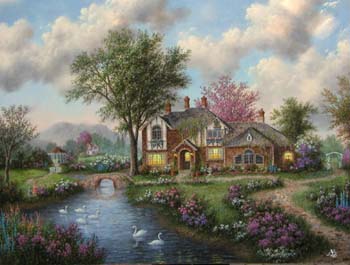
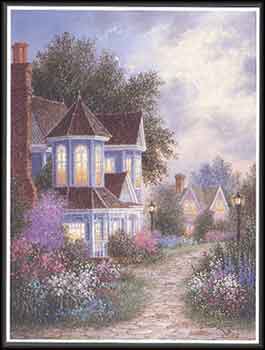
Paintings by Dennis Patrick Lewan, sold here http://www.knottywood-treasures.com/id52.html

(at this point, we don't have comments, due to time limitations, but emails arewelcome (ladylydiaspeaks@comcast.net)

Thursday, September 28, 2006

Windows

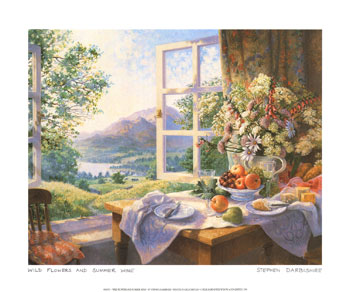
Two Stephen Darbyshire paintings here show beautiful views from windows. No matter if you live in an apartment or a house; in the country or in town, windows are very important. Consider making a private view of your own with hedges, birdhouses and birdpaths, pathways and seating areas. Little "views" outside a window, even if it is just a flower box, are so restful to the eyes and calming to the blood pressure.It has been said that a picture is worth a thousand words. That is why it is so important to have meaningful pictures in the home.


During Victorian times, artists sometimes painted stories into their pictures. You could guess what was happening by looking at the things in the painting. Here, you can just imagine a woman pausing for a moment to catch her breath and reflect on the beauties of the earth. I hope you all have wonderful views and if you don't, that you will create them.

In case one does not have a window and/or a beautiful view one can be created using fabrics, which are curtains at $39.75 a pair with a beautiful view portrayed on them.

There is "English Garden" T71A, "Woodland Crossing", T71B, "Island Retreat", T71C, "Tuscan Life Vineyard" T71D, "Cottage Garden" T71E, "Desert Garden", T71F, "Park Avenue" T71G, "French Cafe"' T71H, and "Bamboo Beach", T71I and all are available at the window art section at http://www.touchofclasscatalog.com/jump.jsp?itemID=99&itemType=CATEGORY&iMainCat=12&iSubCat=99
There are also wall murals and wallpapers that create views, available from various places.

If you do not have a view, it is even more important to go sight-seeing and look at views. It reminds me of my father, who would take us on Sunday drives on the way home from church, where we could see a view from afar off. Looking at scenery seems to be one of the lost arts of childhood, which we need to revive.

I've temporarily halted comments because, as much as I don't want to admit it, my house is a wreck and I am running behind in just about everything. Comments tend to make me want to sit and "talk" instead of doing urgent things. However, emails are welcome: ladylydiaspeaks@comcast.net

Breakfast Burrito

When cereals and commercial breads began to make their way onto the shelves of grocery stores, hearty high-protein breakfasts that would "stick to your ribs" as they used to say, fell by the way. Men would go to work filled only with a muffin or a cinnamon roll or some kind of toaster tart, and then become tired and irritable before the morning was over. Here is a recipe that may not require much shopping, as it can include things from the garden.

1 cup canned black beans, rinsed and drained
1/3 cup bottled chunky salsa
4 eggs, slightly beaten
2 tablespoons milk
1/4 teaspoon pepper
1/8 teaspoon salt
Nonstick cooking spray or cooking oil
1 medium tomato, thinly sliced
1/2 cup crumbled queso fresco cheese or shredded Monterey Jack cheese (2 ounces)
1/4 cup dairy sour cream
4 teaspoons snipped fresh mint
Bottled chunky salsa (optional)
(This recipe from www.bhg.com )

Wednesday, September 27, 2006

Homemade Soup and Crackers


(Here are recipes for soup and crackers. I found that you could eliminate the bouillon cubes and the tomato paste and it would taste just fine. No need for the hot pepper sauce, either, so almost everything can come from the produce stand or garden.)

Ingredients
3 medium tomatoes, peeled and quartered
1-1/2 cups water
1/2 cup chopped onion (1 medium)
1/2 cup chopped celery (1 stalk)
1/2 of a 6-ounce can (1/3 cup) tomato paste
2 tablespoons snipped fresh cilantro or basil
2 teaspoons instant chicken bouillon granules
1 teaspoon sugar
Few dashes bottled hot pepper sauce
Snipped fresh cilantro or basil (optional)

Directions
1. If desired, seed the tomatoes. In a large saucepan combine tomatoes, water, onion, celery, tomato paste, the 2 tablespoons cilantro, bouillon granules, sugar, and hot pepper sauce. Bring to boiling; reduce heat. Simmer, covered, about 20 minutes or until celery and onion are very tender. Remove from heat and cool for 10 minutes.
2. Place half of the tomato mixture in a blender or food processor. Cover and blend or process until smooth. Repeat with the remaining mixture. Return all to the saucepan; heat through. If desired, garnish with additional cilantro.
3. Makes 4 servings (4 cups)
4. Chilled Fresh Tomato Soup: Prepare as above, except after blending, cover and chill soup for up to 24 hours. If desired, top chilled soup with dairy sour cream.
(from http://recipes.bhg.com/recipes/recipedetail.jsp?recipeId=R089984&searchResults=true&showSearchNav=true&recipeNumber=8&resultCategory=kitchen&searchType=null&adCategory=&_requestid=291732

Soda Crackers
4 c flour 1 ts baking powder 3/4 c shortening 1 1/3 c milk salt to taste
Mix flour, baking powder and shortening; add milk an blend well. Form a ball of dough and cut into four pieces. Roll dough out very thin. Cut with a cookie cutter or the top of a glass (wet the glass first). Place on cookie sheet. Prick with a fork 4-5 times and sprinkle with salt. Bake at 375 degrees 8 to 10 minutes or until golden (watch crackers carefully so they don't burn).

from http://www.angiesrealm.com/crackers.html

Serve soup in bowls that are set on plates, and then on placemats, for an appealing setting.
Homemade soups and crackers are best eaten right away and do not taste as good as leftovers, so just make enough to eat at the particular meal. Soup can be stored in the fridge and will last maybe another day, but fresh food ought to be eaten fresh, when possible. Crackers can be stored in airtight containers, in the refrigerator, but are best eaten within a day or two.

Tuesday, September 26, 2006

Getting By Without Buying


The comments we have gotten have stimulated a lot of thoughts about how homemakers used to "make it" and yet devote themselves to the home, while their husbands sought employment.

If you are new at home and feeling confused about making ends meet, you will be surprised at what you do not have to buy, erstwhile making life at home quite beautiful. Eventually when you can afford it, you may want to spend more money, but while you are trying to limit your spending, here are some ideas.

The things that are most pressing, financially are the rent or house payments, utilities, and car expenses and food. There are ways to reduce the cost of all of these.

Find a creative real estate agent who really is an enthusiastic possibility thinker, and ask them to turn your rent money into house payments. By the time you have paid rent for many years, you could have been using that money to make house payments and build up equity, which is a great investment. When you pay rent, you are pouring money into someone else's investment, and you cannot re-sell and get your money back. People who own houses will be much more secure than people who rent.

Fuel is another problem. Natural gas was supposed to be so great and so inexpensive that every American could have it. What we are finding out is that it is costing sometimes more than $200.00 a month for heat and the other things that require propane. You can use less of this if you will use space-heaters, which are small enough to move from room to room, and sometimes cost less than $50.00 at discount department stores like Wal-Mart and ShopCo. If you have no choice but to use this fuel, find ways on the web of making it more efficient. Some people claim that although they pay a big price for it, they are still shivering and not satisfied with the results.

If you go back to the old fashioned way of shutting off lights and turning off radios, computers and other machinery, you can cut back quite a bit on the electric bill. When we were young, we were shown the meter on the outside of the house and told that every time we left a light on, the meter would run, and add up more money that we would have to pay.

Car expenses can be a big drain on the homemaker's budget. If you are really hurting, you can reduce the expenses by sharing a car. In marriage, two can live as cheaply as one, if they do not insist on having two of everything. Instead of cutting back on the amount of expense to run a car, couples sometimes just think they have to bring in extra income. You can actually have money in savings if you cut down on your vehicles. The combined cost of registration and fuel and repairs (flat tires, engine problems, etc), can really be as high as house payments. I am not suggesting that everyone give up their second car, but only if you are really going under and cannot find a way of paying it and feel you will have to go back to work in order to get it. Most full time homemakers eventually do have vehicles, so do not worry that you will never have one.

If you are really under stress financially, it makes sense to sell of things that you are not using. Also, you can give up the newspaper delivery, which can cost sometimes over $100.00 a year. Who needs all that bad news, anyway? Some of it is not even fit to read. There are many alternative newspapers that cost much less, and no one ever went without information just because they didn't get a newspaper. Word of mouth is actually faster than the news these days, anyway.

Magazine subscriptions can be limited only to those that are really helpful to you, and for the new homemakers, I would suggest a good homemaking magazine that really cares about helping women cut down on expenses and prospers. I have saved favorite magazines from days that I had a subscription, and over the years, have enjoyed recycling them. Each month I get out that month's two or three magazines from my collection, and put them out on the coffee table. It is enormously entertaining to see them again, and after a year, they seem like new.

Food is another expense that is overwhelming, so let me give you a good tip here that will help you tremendously: Shop the outer perimeters of the grocery store where the fresh things are, and fix the highest quality food you can.

Live food, or food as close to its natural form as possible, is much more beneficial to your body than processed foods. Processed foods are foods that have been altered by putting them through a process and adding things to them. Live food will give you the optimism and sense of well-being that you need to balance your body and your mind and function well at home. Yes, a bunch of grapes can be high priced, but it is a lot cheaper than being sick. If you feel you just have to make a pie, buy fresh apples for it.

If you cannot always get fresh brocoli, your next best choice is frozen. Sometimes the frozen is even better than the fresh, as it is frozen when it is fresh, and the fresh produce does sit in the store a few days. However, in general, it is better to eat the produce than to eat out of cans. The food inside of cans and packages is dead, and the produce is still live. Choose the firmest and nicest smelling fruit you can find. If it makes your mouth water when you get near it, it is probably pretty good.

Produce combined with dried grocery items such as rice and beans and whole grains, makes very good meals. Buying fresh may seem expensive, but if you eat fresh, you will find you don't have cravings for the expensive junk foods that are available. People complain about the cost of fresh produce, and that salad items are so high, but think nothing of paying five dollars for a bag of chips, which does not have the life-giving nutrients they need.

Someone asked me about vitamins and all I have to say about it is this: Be careful that you don't substitute vitamins for good eating. In order to sell some nutritional products, advertisers will often say that the apples and pears and brocoli and carrots in the grocery store are inferior and you would have to eat 20 pounds a day to get the vitamins your really need. People then buy the vitamins and then avoid the fresh food, buying instead the chips and the pop. Pop is hard on the kidneys and chips and snacks will stuff up your body and make you tired and lethargic. It is still better to eat the fresh produce, even it if it comes from the grocery store. And fresh is better than frozen; frozen better than dried; dried better than canned.

Type in "frugal homemaking" and find ways to avoid shelling out money. If you can possibly live without it and not perish, then do so. When ever I have to pull in tightly and not spend, I find great inspiration thinking of the pioneer women, and my own mother, who didn't have all the niceties of life, and yet lived beautifully, from their own resourcefulness. Though they were poor, they left behind wonderful creative hand work such as doilies and quilts. They knew what was beautiful and would not spend money on anything that was not worthwhile. .

Buying pretty things is a lot of fun, and ordering them is great, but if you want to cut down on expenses, try sending a package of things you don't want, to a friend, and getting the friend to send a package to you. It is a lot of fun and gives you something to look forward to when you might formerly have used shopping as entertainment.

We don't need a lot of clothing if we are staying home. I have one pair of boots to wear outside, and a pair of shoes for indoors, and another pair for church and going out in public if I need them. I have two skirts for winter and two jackets, with two blouses. I have several summer cotton dresses that I sewed myself, and something made of sturdy fabric for working outside. I do not have closet space for many clothes, so I wear them out and then get new ones.

Lots of people recommend going to yard sales. They are a lot of fun and get you out of the house. Children love them, because sometimes there are things for 25c and under a dollar, even a dime. Most yard sales now have a box of things for free, and just before they are going to pack up everything and close, they may give away some things. While you may not want to hang on to the items forever, you can get some things that will tide you over temporarily. Besides that, the shabby look is considered quite upscale these days, so you need not feel inferior about having some of the more worn items. Even worn curtains, when washed and ironed, are quite charming. Sheets are often sold because the owners got tired of them and upscaled their collection. You can dye old sheets and have a lot of fun using them to make things for your home, even without sewing.

No one starts out "on top" and most people have stories to tell of how things were when they were just beginning to establish their home. If we all started out with new things, we wouldn't have stories to tell.

You don't have to buy all those expensive cleaners, or even cough syrups. Recipes for these can be found online, by typing in "homemade (whatever)" and it is actually very satisfying to make a few things. They aren't as caustic as comercial things and don't wear out the clothes as fast.

Even in your tightest stage, financially, you will be glad you invested in retirement funds and other investments. Find one that you only have to put a little bit in --say 25 to 50 dollars a month, and go from there. It will be worth the sacrifice.

Practice not spending. When you see something, think of ways you could substitute. I've been to the grocery stoe and when I saw the price on something, I would think, "Hmmm...I think I could find a way to make my own crackers this week. (yes, there are cracker recipes)." Those crackers become a family favorite that you are "known" for, years later.

You are probably wondering just how much work this all is and who has time for such things, but when you take into consideration how much time it takes to go to work and come back home, you will see it is actually less effort than going to work, and is more fulfilling.

Lastly, there is the old fashioned way of bringing in more money with what you have. I just recently heard that you could make $50.00 for a bucket of pine cones that were not opened, if you cared to do the work. This is excellent activity for children, and can teach them a lot. Some companies buy these so that they can plant tree farms, or send them to other places that order them. If your husband is under a lot of stress, and you still want to make money, choose something that would interfere the least with your home life. In other words, not pet sitting or day care or typing for other people. Do things that do not interrupt the routine of the home; something almost unnoticeable.

Depression era quote:

Use it up,
Wear it out,
Make it do,
Or do without.

Remember that although everything is only a dollar at the dollar store, if you don't spend it, you can have it, and a dollar saved, is a dollar earned.

The husband has to cooperate, too. He cannot go on buying all the "toys" he wants and he will have to do his share to cut down on expenses, whether it be finding work closer to home, taking homemade lunches, and not buying the latest cool shirt or jacket on the market. Our purpose in life is not spending and living it up, but to work together for the ultimate good.


There are lots of blogs out there with great ideas that you can tap into, and lots of great sites.

Sunday, September 24, 2006

The Letter That Fell into the Right Hands


My husband was picking up pieces of trash at the airport where he works part time. He found a folded piece of paper that looked like it might have some importance, so he opened it up and read it. He brought it home to me because he thought it said a lot about women who have inner turmoil and conflict with their consciences when they go against their own nature. This letter must have fallen out of someone's pocket when he was being searched, and had been in that pocket for almost a year, as it was dated February 2005. He used this example in his sermon this morning to show how we must put first things first, and how no child cares a whit about the brilliant career of her mother or the income of their father. What they see as real love, is the presence of the parents in their daily lives.

No one remembers the latest car they drove or the nice furniture, or the affluent neighborhood, as much as they remember the moments with their mothers. They aren't impressed with this as much as they are with their mother's hugs and knowing they are in the house with them at night. Children need long, carefree days at home, not worrying about being rushed from place to place, getting up at the crack of dawn to be transferred to some waiting place so mother can go to work. Child labor was outlawed a long time ago, but the stress that a working woman puts on the husband and children amounts to more stress than child labor ever embodied.

Sitting on a swing and enjoying the sunshine in their own yard is better than any organized sport that mothers could ever enroll them in, but working mothers want to be sure their children have the best of everything.

In the end, most of these children have a hole in their hearts for their mothers, and the husbands for their wives. It is one thing for a man to come home tired and discouraged, trying to wind down after a stressful day at work, but it is worse if they both come home that way. It is better that at least one of them are rested and feeling normal, so that it provides an anchor for the one who must battle the world during the day.

This is all more reason for the wife to be at home as a full time career. When my mother was young, no one had to argue with her about staying home to look after her husband and the house. It was just so natural, you just did it. Anyone who didn't was considered irresponsible, unstable and immature, thinking only about her own wishes and not thinking of others.

Feminists have done women much harm. They've made life harder for them. They promise them everything, and give them nothing.

These young mothers are torn between their brilliant careers and their children, and it is a constant tug at their hearts. Feminism has so little to do with what a real, successful family is all about. They reckon it is all about money. I've never met one yet who thought feminism was the right to be supported by your husband and stay home with your children--the right not to be pressured into going to work.

I'm going to copy this letter and hope that by now this woman has decided to choose home. I am printing it because I know it represents the feelings of hundreds of young women today who are torn between taking a once in a lifetime opportunity to work and travel, and the duty to stay with their husbands, houses and children. A woman is replaceable at work, but there is no substitute for the wife and mother at home. Only she will do. There is no one else better.She was taylor-made for that particular husband, that house, and those children.

Dear James,

It seems we have it all right now; good marriage, family is now complete, beautiful home and great jobs. You know, 6 months ago this was to be the dream jobe: corporate position and travelling. It is a lot more difficult than I had ever imagined. Leaving you and the girls gets more difficult each time I have to go away.

The one thing that makes it somewhat easy is knowing you support me 100%. I know we are trying to provide and give to our family in a way we didn't have growing up, and I am working hard to do that. I just want you to know this is harder for me than I thought it would be.

Don't get me wrong, I love my job and all the experiences I have in front of me and I don't regret our decision one bit; it is just I want you to know how hard it is for me leaving you and the girls. I just hope in 10-15 years we won't regret working so hard and wish we spent more time with each other and the girls; that is the only thing that haunts me. I keep convincing myself that I won't, because we will be in a position to enjoy our lives, and provide for the girls in a way we had hoped and dreamed for.

I love you so much and hope the next few days go by very quickly; give the girls lots of hugs and kisses for me. Tell them every night I love them and to dream of me. I will be dreaming of all of you.

With all my love,
Your wife,
Jane

I have printed this because I think she speaks for a lot of breaking hearts out there--hearts that are not able to enjoy fully the pleasure of careers or their marriages and families, because they are divided. They are not able to put their minds fully to either thing. While at work, she dreams of her husband and children.

While at home, she cannot fully abandon herself and relax and be a dedicated wife and homemaker, because looming in the future is the next trip she will have to take on business. At work, she wants the days to go by quickly, yet it is a job she dreamed of. This is the conflict women have today, but I hope they will all come to choose the better part and put first things first. There are plenty of unmarried women and widows, as well as men, who can fill the spaces in these jobs, but there are not plenty of people to replace her role in the lives of her people at home.

We are opening up comments to this one. My husband says the saddest thing he sees when he works at the airport, is the childrens faces pressed against the windows of the airport, crying for their mothers who are on the airplane.


(The photo above is of the children who were with their mothers at the Homemaking Tea in our home a few weeks ago.)

Thursday, September 21, 2006

Peace in the Home


We will always be threatened with turmoil, but the homemaker can shield the home from unrest and worry, simply by putting into place a few beautiful rituals. One is the arranging of flowers, and another is the setting of the table. Still another can be the placement of a decorative pillow on a just-made bed, and the unwrapping of a new bar of soap in the bathroom. Reading a good book at night, and eating wholesome food, surrounding yourself in soothing music, or having productive conversation with family and friends, seem to keep a relaxed and safe feeling in the home. Some people have found that a media "fast" for a number of days has helped them tremendously in getting mental balance in their lives. Getting out of debt, and learning to be resourceful to have what we need, can reduce the pressure on the mind. These days, there is enough to be worried about, without adding pressure by bringing problems on ourselves, so the house is a perfect place to escape. The woman at home is a tremendous influence on the mood and destiny of the family. It would take volumes to explain why this is so. If she only knew the power that she has to influence the family and the nation, more women would be putting their energy into making the house a home.

Sunday Tea Time by Stephen Darbyshire

Wednesday, September 20, 2006

Mantel of Mementos

Please click on the picture for enlargement.
Comments are still temporarily halted til the editors of this blog can get more organized at home, since we cannot spare the time to monitor them. Both Mrs. Alexandra in Europe, and I, in Oregon, are occupied with guests in our homes. We love your input and your ideas, and you are welcome to email me by clicking on the address at the end of the article.

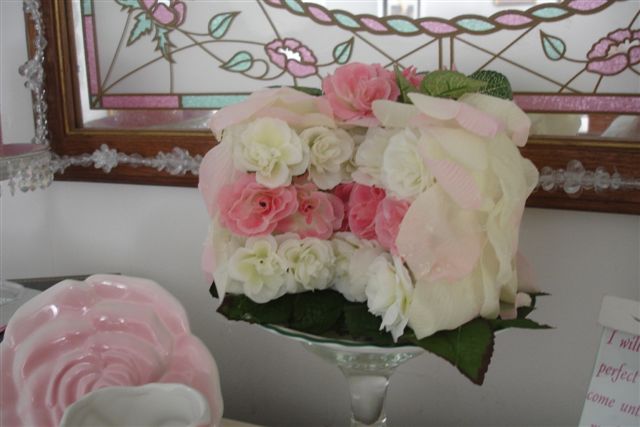
By clicking on the photograph here, you can see a closer view of some family mementos in one of the rooms of our home. This is a special corner that is just for me, and I enjoy bringing out pieces left to me by my husband's mother, handmade items from friends, and gifts from others. I just happened to find this collection of pink things and enjoyed setting them up in an arrangement. To figure out how to best display them, I looked for articles in books, and on the web. Each item has a history or a story. The plate of round things is a collection of sea shells called "sand dollars." The rose on the left is a craft item made by a friend, from colored nylon and wire. The candle stands atop a stack of old books, to give it height. The decorative cake is made of silk petals from fake flowers, and has a wonderful scent called "birthday cake." The runner is an old piece that has been dyed in a tint called "rose." I have seen on the web several places where you can look at "mantel of the month" arrangements. While I try to keep most of the house the same, this is one shelf that I enjoy changing more often, in my own personal style. It is the one section of the home that no one else will occupy or use, which can be arranged for nothing more than pleasure and beauty.


ladylydiaspeaks@comcast.net

Wednesday, September 13, 2006

Homemaking Day


We were busy with our now annual homemaking day last week, and wanted to show you some pictures, as well as explain what took place. Several of the women brought something to demonstrate: how to prepare vegetables, interesting crafts for the home, tips on making hospitality easy, and helpful household hints. Afterwards, the women shared a lunch on the lawn, allowing their children to play in the grass.


Between demonstrations, one of the young women led the children in character-building songs. This enabled the mothers to keep their children by their sides during the program, which lasted from 11 a.m. til 2 p.m.

One of the speakers talked a little about children's manners, one being that they should not take the most comfortable chair in a room, when there are older people present, and that even as they grow up, they should continue to defer to the elderly. On the point of hospitality, one way to remove hesitation on the part of the hostess, is for the children to be careful not to destroy the order of the house, take things down or create havoc in the bedrooms. The idea was presented that children need to be within sight or earshot of their parents, when visiting at someone elses home, or else stay near their mother, as you see the little girl is doing, in the picture of one of the class presentations.

One of our speakers presented a gardening album that she had made, showing how she planned her gardens and took pictures as she went along. Over the years, she even recorded the month that a certain plant was in bloom, and when her daughter got married, she planned the date of the wedding around the time that plant would be blooming, so that her reception would have the colors she desired. This teacher also showed how to manage the household income so that you could have a profit at the end of a year, by keeping careful track of all money spent and all money coming in, being frugal, and finding ways to get things with a minimum of spending.

Another teacher showed the same concept with recipes. As she tried menus and recipes that really worked for her, she copied them and put them inside plastic pages. As she built her cookbook, she also placed pictures of her own mother preparing the same recipes, and pictures of the family eating the meals. Her plastic pages kept ingredients from splashing on to the book. Since most cookbooks only have a few recipes that people use, this was a way of putting all the recipes she used, into the same collection.

Each guest was presented with a shiny gift bag of silver or gold mylar, which contained

A hand made booklet called "Homemaking With Love:" which taught about preparing for the day.

A pen: for taking notes during the presentations, and writing down ideas.

A crocheted doily - to remind them to add some soft touches and beauty, with a few facts about the history of looking after furniture.

A scented candle - to remind them to put a pleasant scent in the home; the candle need not be lit, and the scent will last a long time. It can be put in troublesome areas that get musty, such as closed drawers, shelves, and corners.

A cookie cutter for children shaped like an animal - to remind them of the importance of the children being part of the functioning of the home, and that they can be tactfully taught to have good habits and appreciate the home.

All of these items were purchased at a dollar store, sometimes at the price of four for a dollar, so in all, we were pleased that such a gift could be presented with minimal expense.

The day began and ended with singing. A good time was had by all, but the person who was most impressed, was my husband, "Papa," who heard the singing through the walls from his office at home. He thought we ought to have one of these events each month. We don't know if we could prepare one each month, but will be considering stepping up the frequency of classes so that they occur more often than once a year. We certainly regret that we did not film it, but will try to remember to do so the next time.

The fake cake in the picture above is a decorative craft made with styrofoam bases and silk flower petals, glued on to look like frosting. It is sprayed with a scent called "birthday cake," which also scents the house beautifully, especially in a climate like ours, which often makes the indoor air damp and cloisome.

Friday, September 08, 2006

Quilts in the Home


These quilts are from www.GooseberryPatch.com , where you can order online or get a paper catalog for your home. The catalog is a delight to look at and full of other little tidbits besides their beautiful, homey merchandise.

Quilts don't have to be left in the blanket trunk or the linen closet, or buried beneath other blankets on the bed. They can now be used in any part of the hosue to give it a bit of color and a feeling of history. Originally, some quilts were made with old scraps of clothing, as a frugal way of using up every available piece of material.

A sleeve can be attached with self-stick velcro to the back of a quilt, and a curtain rod run through it for hanging on a dining room wall. They can be laid gently across the back of a couch or draped on the top of a piano, to display the beautiful colors. Some people use them as table cloths for afternoon tea parties, but put clear plastic over them to protect them. It does not seem to damage them to leave them under the clear plastic--the heavier grade--for awhile. Small, pieced quilts can also be used for curtain toppers, or runners for coffee tables and mantel tops.

Another way to display quilts if you have any and don't know where to put them, is folded up and stacked in an open shelf. Just be sure they are re-folded a different way every now and then, to avoid permanent creases or wearing or being faded by the light in only one area.

You don't have to be an expert quilter to make a quilt. Just get out your sewing machine and start putting leftover pieces together, joining them in a sturdy one-fourth inch seam, using a mark on the bed of your sewing machine, as a guide. Hand-sewing pieces together can be a quiet evening activity. Sewing one square to another every day of the month will yield thirty squares that may be a nice quilt top that you can call your own. While it is nice to have the art form all figured out and the colors coordinated, most people agree that a quilt made by the hands of a relative or a friend, is precious, no matter how it looks. Some people would rather have a quilt than money in the bank or jewels in a chest.

Throughout the world, quilts take on different forms. The Welsh quilts of the previous centuries were not pieced. They were made with huge yardages of cloth which were just sewn to a padding and a backing, stitching a design with the thread. Hawaiian quilts are usually only two contrasting colors such as blue and white and take on a floral look. Quilts in India are bright an colorful and sometimes have bits of sparkly gold threads in them.

It is a pity that so many of the mothers and grandmothers of today had to spend so many hours away from home working, and did not have the time to make such quilts that could be handed down to the next generation.

This is one more reason to try to stay out of debt and protect a woman's privilege of being at home, seeing to the welfare of the family and the house. In the end, most children would rather have a quilt that their mothers made them. I heard a lady who ran a daycare for 20 years say that the children always wanted their mothers and always wanted to be home. They did not want to be there.

The parents loaded them with toys and gifts, but the children always told the daycare lady that they would rather their mothers stay home and sew and cook and just be with them.

Quilts certainly represent a lot of time spent by the creators. Children love looking at the tiny little prints in each square, no matter if it is color coordinated or properly themed. A simple quilt can be made in a weekend, using large squares of fabric and a sewing machine. Even a one-foot square quilt is a charming addition for a lamp to set on or to use as a placemat.

If you didn't have quilts in your family and feel you've missed out on something, you can always purchase them somewhere. There are people who make quilts especially to sell, and many new quilts available at craft fairs. Baby quilts are especially popular and do not have to be used in baby beds, but make great lap quilts and warm blankets to wrap your shoulders in on cool days.

Wednesday, September 06, 2006

Quilts, Tablecloths and Lace


I don't know a lot about the history of crochet, or lace or table cloths. Someone once told me that it would be better to use them, than to have them sit in boxes and trunks, where they sometimes collect rust spots and deterioriate. I have found this to be true, but I know there are now good methods for storing such things in order to preserve them. If I had known more about it, I would have saved a lot of pieces of crochet that were eaten by moths or torn.

I have seen quilts with little pieces of old crochet. It is a good way to preserve some of the item, at least, if you can't save the entire thing. The lady who posted about her aunt's house burning down, made a good point. It is better to get out these things and enjoy them, if possible. They can also be framed.

Lace curtains allow the light to come in, while still preserving privacy.Lace shawls allow some air to circulate, without making you feel cold. Lace and crochet seem to have never lost their charm.

I like the contrast that crochet doilies and lace provide in a house. Against wood, it softens the feeling of a room. Doilies were used as protection for hard wood surfaces, and that may account for the fact that there is still so much of the Victorian furniture available. There was a trend from the 60's on, not to use them, which was interesting, since the furniture at that time was incredibly expensive. One lady I knew had a designer come and do her new home. Not one doily or piece of lace fabric or table cloth was out on anything, because it didn't go with the new furniture of the time, yet she paid quite a price for the furniture.

Homesteaders generally did not use these niceties, but their furniture, made from logs, was much more hardy and did not require protection. It could take the wear and tear just fine.

We have temporarily closed comments, but you are welcome to email. ladylydiaspeaks@comcast.net.

Kristy writes this about quilts; Hi,As a quilter I just wanted to share that if you must store quilts, I have found it best to store them in white or old cotton pillow cases. This way they can still breath (plastic might trap in moisture to allow a mildew smell), are dust free, don’t unfold, store neatly, and by using an old or white pillow case there is no color transfer (don’t ask how I know this last one). The pillow case also protects one quilt from others as often dark colors are used and a little moisture can allow color to run.Not sure if you were looking for info on this after today’s post, but thought I would send it on.I have noticed that hand made quilts are becoming extremely popular not only for bedding, but also as wall hangings, pillows, throw quilts, and table accents or even cloths! A baby quilt with extensive quilting might sell for $150.00, much more if there is an intricate pattern such as a white on white, but a baby quilt can often be made for about $30 in materials.Just some odd tidbits to go with today’s column...Kristy

She's right about storing them in plastic--DON'T. I've see this first hand. It makes the quilts get rust stains on them, particularly in the folded areas.